
Learn how to protect your big dog from the silent killer called bloat

You know that feeling when your Great Dane finishes dinner, and you find yourself watching them a little too closely? When your German Shepherd gulps down water after a run, and something in your gut tightens?
That’s the bloat fear talking.
But you need to pay attention. Because bloat doesn’t knock politely. It kicks down the door, and by the time you realize what’s happening, you’re racing against a clock that’s already running out.
Bloat is life-threatening, so let’s talk about the nightmare scenario that keeps large-breed dog owners up at night.
What is bloat in dogs?
- What is bloat in dogs?
- Risk factors, especially in deep-chested breeds
- Dog stomach flipping signs to watch for
- Emergency response steps
- Gastric torsion prevention
- When to see a veterinarian
- Early warning vs. emergency
- If you suspect bloat, do this now
- Care and monitoring after a bloat episode
- Frequently asked questions
- Bloat emergency action plan
- Final thoughts on bloat in dogs
Bloat—or gastric dilatation-volvulus (GDV), if we’re getting technical—is when your dog’s stomach fills with gas and twists on itself like a garden hose kinking shut.
Imagine a balloon inflating inside your dog’s abdomen, then picture that balloon rotating until it cuts off its own blood supply.
That’s bloat. And it’s as horrifying as it sounds.
The stomach expands. Then it rotates. Blood flow stops. Tissue dies. Organs shut down.
Without emergency surgery, most dogs don’t survive. Even with surgery, the mortality rate hovers around 10-30%.
This isn’t a “wait and see” situation. This is a “your dog has hours, maybe less” emergency.
And the cruelest part? It can happen to a perfectly healthy dog on a perfectly ordinary day.
Risk factors, especially in deep-chested breeds
Here’s where your worry becomes statistically justified.
Bloat in large breeds is alarmingly common—deep-chested dogs with barrel chests and long torsos are bloat’s favorite targets. Great Danes top the list with a 42% lifetime risk.
Let that sink in. Nearly half of all Great Danes will face this at some point.
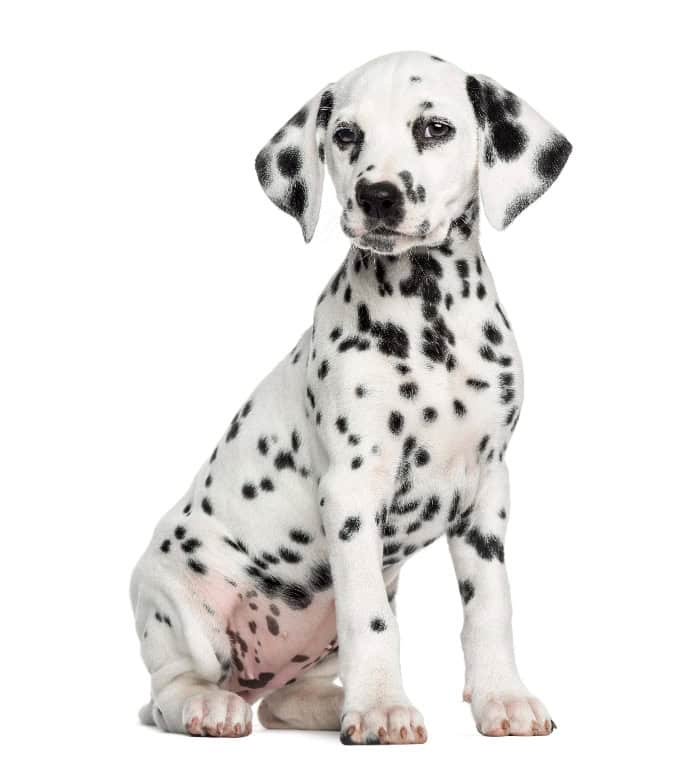
German Shepherds, Standard Poodles, Weimaraners, Saint Bernards, Irish Setters, Dobermans, Dalmatians—if your dog’s chest cavity could house a small family, you’re in the danger zone.
But breed isn’t the only culprit.
Age matters. Dogs over 7 are at higher risk. Males get bloat more often than females. And if your dog has a first-degree relative who experienced bloat? The genetic dice are loaded against you.
Then there’s behavior. Fast eaters who inhale their food like it’s a competitive sport? Higher risk.
Dogs that eat one large meal a day instead of smaller portions? Higher risk. Anxious, nervous dogs? You guessed it—higher risk.
Even the food bowl matters. Elevated feeders were once recommended to prevent bloat. It appears they may increase the risk. The research flipped the script on that one.
Dog stomach flipping signs to watch for
This is where your vigilance pays off. Early recognition of dog stomach flipping signs is the difference between life and death. Period.
Your dog’s abdomen swells—visibly distends like they’ve swallowed a basketball.
They’ll try to vomit, but nothing comes up. Just retching. Dry heaving. The stomach is twisted shut, so nothing can escape.
They’ll pace. They can’t get comfortable. They’ll look at their sides, whine, and drool excessively.
Look for pale gums. Your dog will seem restless, anxious, like something is terribly wrong, but they can’t tell you what.
And they can’t. Because the thing killing them is invisible.
As bloat progresses, your dog will have difficulty breathing. Their heart rate spikes. They might collapse. Go into shock.
Here’s the provocative truth nobody wants to say out loud: if you’re wondering whether it’s bloat, you need to act like it is.
Don’t Google symptoms for 20 minutes or call your regular vet and leave a message. Don’t wait until morning.
Get in the car. Drive to the emergency vet. Now.
Emergency response steps
Speed is everything. Bloat is a life-threatening condition, a surgical emergency, not a “let’s monitor this” situation.
Call the emergency vet while you’re en route. Tell them you’re coming with a suspected GDV case. They’ll prepare for your arrival, saving precious minutes.
You can’t treat this at home. Don’t give medications. Don’t attempt to make your dog vomit. You can’t fix a twisted stomach in your living room. This condition requires veterinary care.
Keep your dog as calm as possible during transport. Stress makes everything worse. If they’ll lie down, great. If not, don’t force it.
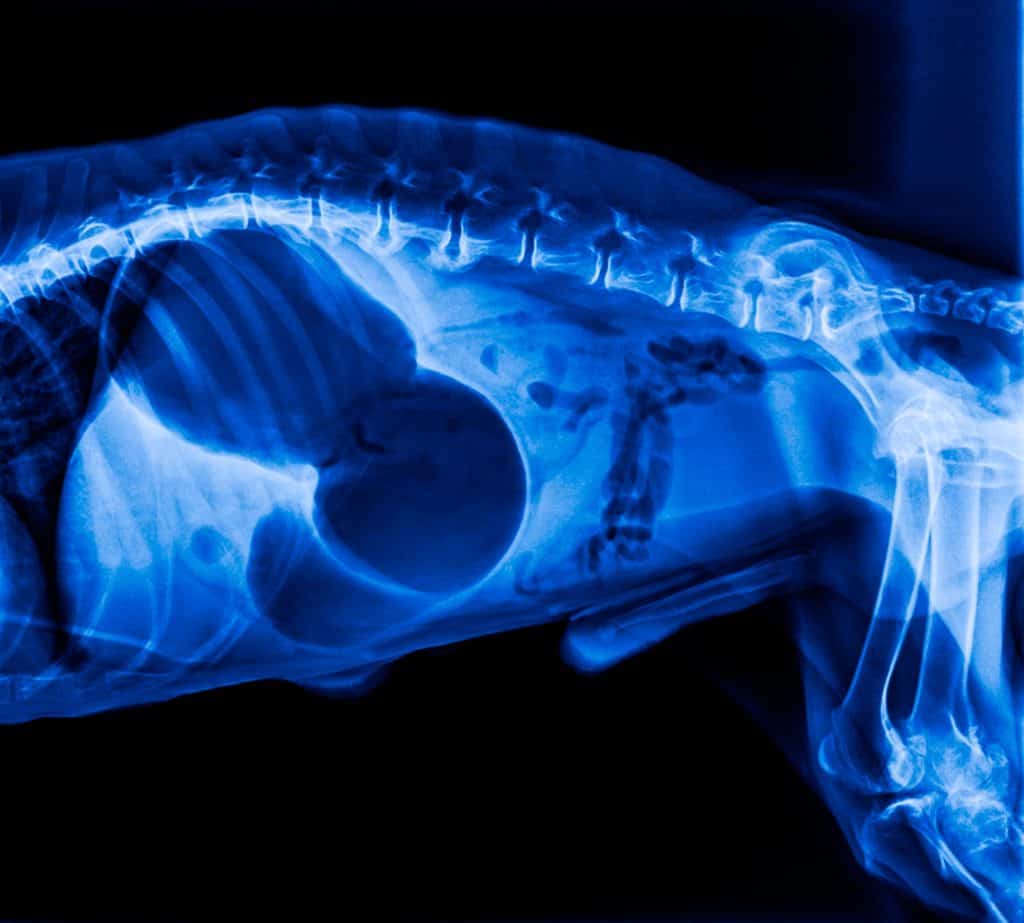
At the vet, they’ll likely take X-rays to confirm the diagnosis. If it’s bloat, your dog will need emergency surgery to untwist the stomach and secure it to the abdominal wall—a procedure called gastropexy.
The surgery isn’t cheap. We’re talking thousands of dollars. But cost becomes irrelevant when you’re watching your dog suffer.
Gastric torsion prevention
You can’t eliminate the risk of bloat entirely. But you can stack the odds in your favor.
Here’s how.
Feed smaller meals to large breeds. Two or three times a day instead of one massive dinner. Slow down fast eaters with puzzle feeders or slow-feed bowls. Make eating an activity, not a race.
Watch what you’re feeding, not just how much. Diet composition plays an underappreciated role in bloat risk.
Foods high in highly fermentable carbohydrates—things like soy, peas, beans, and some fiber-heavy ingredients—produce significantly more gas during digestion. That gas has to go somewhere, and in a deep-chested dog, it can accumulate fast.
Read ingredient labels. Avoid foods where fermentable carbs dominate the first few ingredients. If your dog is chronically gassy, that’s worth a conversation with your vet—it may signal that their current diet isn’t the right fit.
Limit water intake immediately after meals. Not completely—dehydration is dangerous too—but don’t let them gulp down a gallon right after eating.
Avoid vigorous exercise for at least an hour before and two hours after meals. No running, jumping, or wrestling matches on a full stomach.
Consider a preventive gastropexy a key part of preventing gastric torsion. It’s a surgical procedure where the stomach is tacked to the abdominal wall, preventing it from twisting. Many vets will perform this during a spay or neuter. If you own a high-risk breed, this is worth discussing with your vet.
Manage stress and anxiety. Nervous dogs are more prone to bloat. Create calm feeding environments. Address anxiety issues with training or, if necessary, medication.
Recognize stress triggers beyond the food bowl. Most owners know not to let their dog sprint after dinner.
Fewer realize that psychological stress—not just physical activity—can also set the stage for bloat. Travel, boarding, thunderstorms, fireworks, a new pet in the home, and even a change in routine can spike anxiety in susceptible dogs.
Elevated cortisol levels affect gut motility and can contribute to the type of stomach dysfunction that precedes GDV. If your dog has an anxious temperament and a high-risk body type, managing their stress environment is just as important as managing their mealtime habits.
Plan ahead for known stressors: use calming aids, maintain familiar routines, and, where possible, avoid feeding immediately before or after a stressful event.
And here’s a controversial one: trust your gut. If something feels off about your dog’s eating habits or behavior, investigate. Your instincts exist for a reason.
When to see a veterinarian
With bloat, “when” is always “immediately.” But beyond the acute emergency, there are other times your vet needs to be involved.
If your dog has chronic digestive issues—frequent gas, stomach discomfort, irregular eating patterns—get them checked. Sometimes, underlying conditions increase the risk of bloat.
If you’re considering preventive gastropexy, have that conversation before an emergency forces your hand. Elective surgery is safer and less expensive than emergency surgery.
And if your dog has survived bloat once? They’re at significantly higher risk for recurrence. Post-surgery monitoring is now part of your life.
Early warning vs. emergency
Print this. Screenshot it. Save it somewhere you can find it in three seconds.
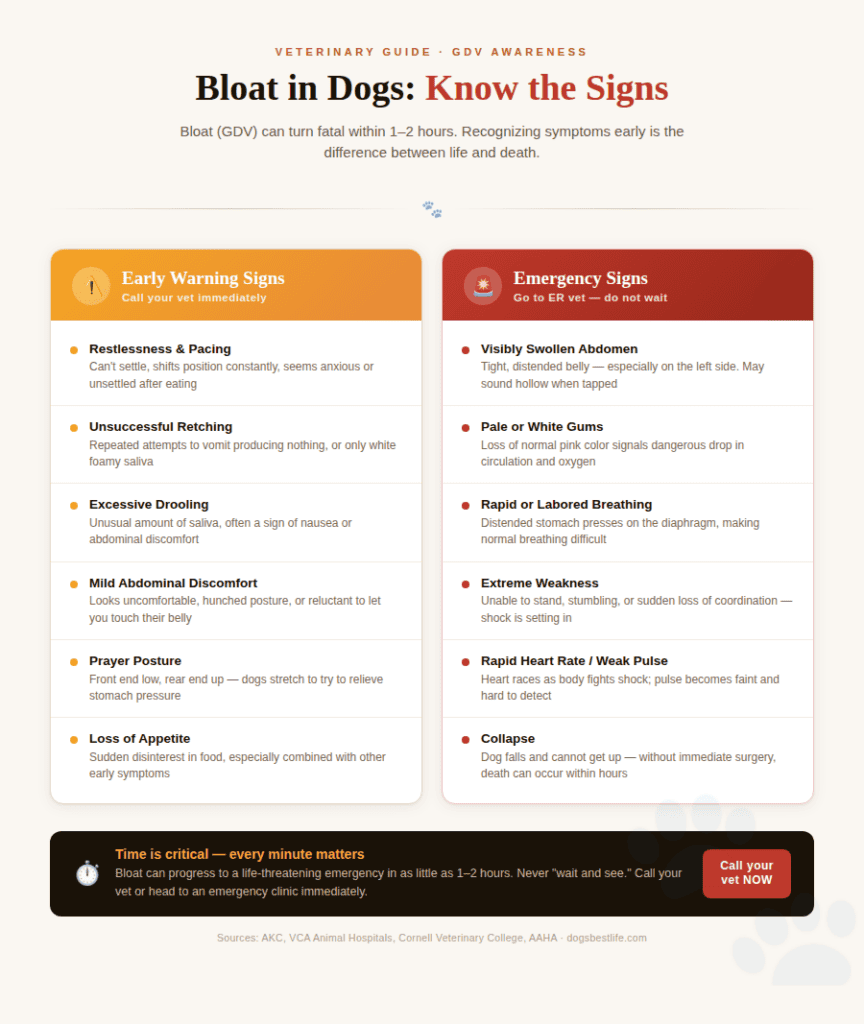
Early warning signs (get to a vet within the hour)
- Restlessness, pacing, or discomfort
- Excessive drooling
- Attempting to vomit with nothing coming up
- Looking at or biting at their abdomen
- Mild abdominal distension
Full emergency (get to a vet now)
- Visibly swollen, hard, distended abdomen
- Repeated unproductive retching
- Pale or white gums
- Rapid breathing or panting
- Weakness, collapse, or signs of shock
- Rapid heart rate
Here’s the truth: even “early warning” signs require immediate action. With bloat, there’s no such thing as overreacting.
If you suspect bloat, do this now
1. Call the emergency vet immediately while someone else prepares the car
- Tell them you’re coming with a suspected GDV case
- Ask how far away they are and if there’s a closer emergency facility
- Get their exact address in your GPS now
2. Get your dog to the car as calmly as possible
- Don’t wait to see if symptoms improve
- Don’t try to treat at home
- Don’t give food, water, or medications
- Keep them as calm and still as possible
3. Drive safely but urgently
- Have someone ride with the dog if possible
- Monitor breathing and gum color
- Call ahead again if the status changes
4. At the emergency vet
- Tell them immediately upon arrival that you suspect bloat
- Be prepared for X-rays and potential emergency surgery
- Have your vet records or emergency contact info ready
Time is tissue. Every minute counts. Don’t second-guess yourself—go.
Care and monitoring after a bloat episode
Surviving bloat doesn’t mean you’re out of the woods. Recovery is a process, and vigilance becomes your new normal.
Your dog will need restricted activity during the healing process. Pain management. Careful dietary reintroduction. Follow your vet’s post-op instructions like your dog’s life depends on it—because it does.
Watch for complications: infection, irregular heartbeat, stomach ulcers. Some dogs develop cardiac arrhythmias days after surgery. Post-op monitoring isn’t optional.
In the long term, you’ll implement all the prevention strategies we discussed. Smaller meals. Slow feeding. Limited post-meal activity. If gastropexy is performed, the stomach’s twist is prevented, but it can still bloat with gas.
Your relationship with worry changes after bloat.
You scrutinize every meal. Every belly rub. Every moment of discomfort.
Here’s what nobody tells you: living with a high-risk dog means living with fear.
But it also means living with intention.
You notice things and act quickly. You become the kind of owner who doesn’t dismiss symptoms or wait until morning.
Your vigilance isn’t weakness. You’re prepared.
And maybe—just maybe—that hyperawareness is exactly what will save your dog’s life when seconds matter most.
Frequently asked questions
Can small dogs get bloat?
Yes, but it’s rare. Bloat can technically occur in any dog, but small breeds face a dramatically lower risk than large, deep-chested dogs. The anatomy of a small dog’s chest and abdomen makes the kind of stomach twisting seen in GDV far less likely.
That said, Basset Hounds and Dachshunds—small but deep-chested—have shown higher rates than most other small breeds. If you have a small dog and notice classic bloat symptoms (unproductive retching, a distended belly, restlessness), don’t dismiss it. Call your vet.
How effective is gastropexy really?
Very. Preventive gastropexy is one of the most reliable tools for preventing gastric torsion.
Studies show it reduces the risk of life-threatening stomach twisting (volvulus) by more than 90%. It doesn’t prevent the stomach from filling with gas—so some degree of bloating can still occur—but it stops the deadly rotation.
For high-risk breeds like Great Danes, Irish Setters, and Standard Poodles, many veterinarians consider it a near-essential procedure, ideally performed during a routine spay or neuter.
Is there a genetic test for bloat risk?
Not yet—at least not a commercially available, validated test. Research has identified certain genetic markers that may be associated with an increased risk of bloat, particularly in breeds such as Great Danes and Irish Setters, but no definitive genetic screening tool exists for the general public.
What we do know is that family history matters. If a first-degree relative (parent or sibling) has had GDV, your dog’s risk is meaningfully higher. Until a reliable test exists, breed, body type, age, and behavioral factors remain the best predictors we have.
What if my dog drinks a lot of water after a meal?
It’s worth managing, but don’t panic. Drinking large amounts of water immediately after eating can contribute to stomach distension, which is the first stage of bloat.
The concern isn’t a few laps from the bowl—it’s a dog that gulps down enormous quantities right after a meal. A practical approach: offer water freely before meals, then limit access to small amounts for about an hour after eating.
Make sure your dog stays well-hydrated throughout the day so they’re not desperately thirsty at mealtime. If your dog consistently drinks excessively, mention it to your vet—it can also signal unrelated health issues worth investigating.
Bloat emergency action plan
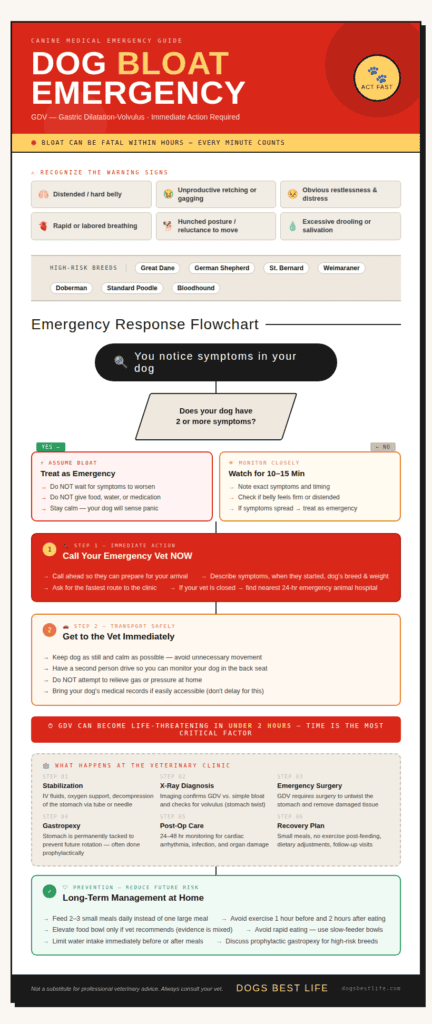
Bloat is a life-threatening emergency that requires immediate veterinary intervention.
Step 1: Recognize the signs of GDV
Distended, hard, or visibly swollen belly
Repeated retching or dry heaving with nothing coming up
Restlessness, pacing, inability to get comfortable
Excessive drooling or salivating
Pale, white, or grayish gums
Rapid breathing, weakness, or collapse
If you see ANY of these signs, move immediately to Step 2. Do not wait.
Step 2: Call the emergency vet right now
Do not call your regular vet and leave a message
Search “emergency vet near me” if you don’t have a number saved
Tell them: “I’m coming in with a suspected GDV case.”
Ask for their exact address and confirm they can treat GDV
Step 3: Get your dog to the car
Move calmly — your stress transfers to your dog
Do not give food, water, or any medications
Do not try to make your dog vomit
Have a second person ride with your dog if possible
Step 4: En route
Drive urgently but safely
Have your passenger monitor breathing and gum color
Call the vet again if your dog’s condition worsens
Step 5: At the emergency vet
Announce immediately: “I suspect bloat or GDV.”
Be prepared for X-rays and possible emergency surgery
Have your dog’s vet records or emergency contact info ready if possible.
Remember: Time is tissue. Every minute counts. When in doubt, go.
Final thoughts on bloat in dogs
You’re not in this alone
If you’ve made it this far, you’re already doing something right. That anxious instinct that makes you watch your dog after meals? That’s vigilance that saves lives.
Bloat is terrifying. But you’re not powerless. You know the signs, the risks, and your dog better than anyone. Trust that knowledge. The love that makes you worry is the same love that will make you act when it matters most.
Most dog owners learn about GDV in an emergency waiting room. You now know better — and that knowledge is worth sharing.
Share this post with every large-breed dog owner you know. You don’t need to add anything — just send it. Awareness costs nothing.
Save the emergency checklist before you need it. Screenshot the “If you suspect bloat, do this now” section and keep it somewhere you can grab in seconds — your phone’s home screen, the refrigerator, your car.
Talk to your vet about gastropexy at your next appointment. Not someday — next appointment. If you own a high-risk breed, ask whether a preventive procedure makes sense and when it can be scheduled.
Your dog can’t advocate for themselves. But you can.
Sara B. Hansen has spent 20-plus years as a professional editor and writer. She’s also the author of The Complete Guide to Cocker Spaniels. She created her dream job by launching DogsBestLife.com in 2011. Sara grew up with family dogs, and since she bought her first house, she’s had a furry companion or two to help make it a home. She shares her heart and home with Nutmeg, a Pembroke Welsh Corgi. Her previous dogs: Sydney (September 2008-April 2020), Finley (November 1993-January 2008), and Browning (May 1993-November 2007). You can reach Sara @ editor@dogsbestlife.com.