
Dogs don’t see black and white: Why your pup sees better than you think

Ever wonder what your pup sees when they tilt their head at a sunset? Here’s the short answer: they’re not stuck in a black-and-white movie.
Dogs see color. But there are limits to their color vision. They see a smaller slice of the rainbow than you do.
That myth has been wagging its tail at us for decades. Time to send it back to the kennel.
Two cones, not three
Your eyes pack three kinds of color-sensing cones. Your dog’s eyes pack two. That’s the whole story behind canine “colorblindness.”
Scientists call your dog’s setup dichromatic vision. You’ve got trichromatic vision: same plumbing, fewer pipes.
So what does that mean in practice? Dogs see blues and yellows beautifully.
Reds, oranges, and greens? Those wash out into a yellowish-brown soup. Picture a faded vintage postcard.
That’s closer to your dog’s color world than the Technicolor you’re working with.
Are dogs really colorblind?
Not exactly. Think of it this way: your dog sees color the way a person with red-green colorblindness does.
A red ball on green grass? Basically camouflage.
A blue ball on green grass? Now we’re talking.
Researchers nailed this down back in 1989, when neuroscientist Jay Neitz and his team ran color-discrimination tests on dogs. The “dogs see only black and white” myth has been busted for over 30 years. Don’t let it fetch its way back into your brain.
A more recent twist: when scientists ran a modified version of the Ishihara colorblindness test on dogs, the dogs responded almost exactly the way red-green colorblind humans do. Same wiring, basically. Same blind spots.
Why does yellow stop dogs in their tracks?
Here’s where the science just got fun. A 2024 study published in Animal Cognition tested 134 free-ranging dogs in India.
The result? Dogs preferred yellow objects over blue or gray ones. Strongly. Consistently.
The kicker? The preference even beat out food. When researchers placed a yellow object next to a gray bowl of treats, the dogs went for the yellow one first.
A follow-up study with pet dogs in the United States replicated the finding. Dogs younger than seven approached yellow bowls first more often than blue or gray ones.
Why yellow? Researchers suspect it pops against natural backgrounds. Yellow stands out. It signals.
What does that mean for you?
Toss a red Kong on the lawn, and your dog might lose it in the grass. Toss a yellow one and watch them light up.
For quick wins, try popular yellow or blue toys, like Chuckit! Ultra Ball (especially in orange or blue) or the West Paw Zogoflex collection in bright shades.
These stand out so your dog can spot them easily during play.
Beyond color: What dogs see better than you
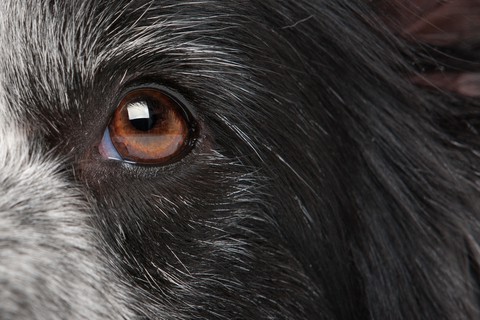
Color isn’t the whole picture. Dogs trade richer color for sharper vision in low light, faster motion detection, and a wider field of view.
Fair trade? For an animal that evolved to chase squirrels at dusk, absolutely.
Built-in night vision
Ever notice your dog’s eyes glowing in the bright light of a flashlight beam? That’s the tapetum lucidum at work.
It’s a mirror-like layer of rods behind the retina at the back of the eye that bounces light back through the photoreceptors. Light gets a second pass. Your dog’s eyes squeeze every photon.
The result: dogs have better night vision because they see in roughly five times less light than humans need. Twilight walks in dim light aren’t hard for them. They’re prime time with superior night vision.
Motion masters
Stationary objects? Eh, dogs are OK.
Moving objects? That’s a whole different story.
Their motion sensitivity outpaces ours by roughly 10-20 times: a frisbee mid-flight, a squirrel mid-sprint, a tennis ball mid-bounce.
Your dog’s eyes were built for the chase.
A wider lens on the world
Most humans see about 180 degrees side to side.
Most dogs see around 240 degrees, give or take.
Long-snouted breeds like greyhounds get the widest view. Flat-faced breeds like pugs see more like dog owners do.
How sharp is your dog’s vision?
Most dogs clock in around 20/75 on the human eye chart. What you can read at 75 feet, your dog has to walk up to 20 feet to see clearly. In human terms, your dog is a little nearsighted.
Does your dog need glasses? Nope. Smell does the heavy lifting. Hearing fills in the gaps. Movement-tracking handles the rest. Vision is just one tool in your dog’s sensory toolkit.
That said, dogs, especially as they age, can develop vision problems just like people. If you notice signs such as bumping into things, hesitating in new places, cloudiness in their eyes, or trouble finding toys, it might be time for a checkup. Your vet can help spot early signs of vision loss and recommend ways to keep your dog comfortable and confident.
In fact, a recent study in the Journal of Neuroscience found a direct neural connection between the canine olfactory bulb (smell) and the occipital lobe (vision). Translation: your dog literally sees and smells the world at the same time. Their senses aren’t just teammates. They’re fused.
How dogs use their vision day-to-day

Ever watched your dog track a thrown ball, navigate a cluttered yard, or light up when they spot a familiar face?
Their unique vision shapes these everyday moments.
Dogs rely on their ability to see motion, detect contrast, and pick out specific colors, especially blue and yellow, to play fetch, avoid obstacles, and recognize people.
That head tilt you love? It’s a real-time adjustment for their field of view, helping them make sense of what they see.
Understanding these real-world scenarios grounds all the science in the daily joy of living with a dog.
How vision influences behavior and training
Knowing what your dog sees can make training easier and more fun.
Use toys and cues in colors they spot best, think yellow and blue for fetch or agility games.
Moving objects are irresistible, so harness their motion sensitivity with dynamic training exercises.
When you want their attention, choose high-contrast signals or cues that stand out in their visual world.
Training becomes smoother when you work with your dog’s natural strengths, not against them.
Breed differences in vision
Not all dogs see the world the same way.
Long-nosed breeds like greyhounds and collies enjoy a wider field of view, catching more action on the periphery.
Flat-faced breeds like bulldogs and pugs have a more human-like field of vision and sometimes reduced acuity.
Genetics, skull shape, and even coat color around the eyes can tweak how dogs see. If you have a long-nosed breed like a greyhound or collie, your dog benefits from a wider field of view.
To make the most of this, try games that use more lateral movement, such as fetch with long-distance throws, or hide-and-seek with toys placed at the edge of their sightlines.
For flat-faced breeds like pugs or bulldogs, who have a field of vision more like ours and sometimes slightly less acuity, pick brightly colored toys in yellow and blue, and use simple, straightforward tosses so they can spot and track the toy more easily.
Adjusting how you play and the toys you choose helps every dog make the most of their vision.
Celebrating these differences adds nuance and a little extra admiration for the diversity in the dog world.
What this means for life with your dog
A few small shifts can make their world brighter:
- Pick toys in blue and yellow. Those are the colors they actually see.
- Skip red and orange toys for outdoor play. They vanish into the grass.
- Lean on contrast. A dark toy on a light surface (or vice versa) helps them spot it.
- When in doubt, go yellow. New research suggests yellow might be your dog’s favorite color of all. Want to see it for yourself? Try offering your dog toys or bowls in yellow, blue, and another color like red or gray. Set them outside by side and see which one your dog chooses first. You can repeat this a few times and switch up the locations to make sure it’s not just random. Watching your dog’s natural pick turns science into a fun game, and you might discover their personal favorite.
- Don’t feel bad if they ignore your pointed finger at a sunset. They’re seeing it. Just differently. Your dog might not spot a red ball lost in green grass, but they will notice a yellow ball from across the yard. When you hide treats outside, their ability to spot movement and contrast helps them find tiny morsels in difficult places. The same goes for recognizing family members at a distance; they’ll use their unique vision, along with their sharp sense of smell, to pick you out of a crowd, even if you’re wearing a color that doesn’t stand out to them.
The bottom line on how dogs see
Your dog isn’t stuck in a black-and-white film. They’re watching a quieter, more selective version of the bright world that you see.
They miss some reds. They miss some greens.
But they catch each twitch in the grass at twilight, every flash of yellow on the lawn, every flicker of motion you would never notice.
When we learn to see the world through our dogs’ eyes, we open ourselves to new ways of understanding and loving them.
Their vision isn’t a limitation but a reminder: every wag, every chase, every moment is colored by a perspective uniquely their own.
Appreciating how dogs see helps us cherish every shade of their experience, and deepens the bond we share.
Sara B. Hansen has spent 20-plus years as a professional editor and writer. She’s also the author of The Complete Guide to Cocker Spaniels. She created her dream job by launching DogsBestLife.com in 2011. Sara grew up with family dogs, and since she bought her first house, she’s had a furry companion or two to help make it a home. She shares her heart and home with Nutmeg, a Pembroke Welsh Corgi. Her previous dogs: Sydney (September 2008-April 2020), Finley (November 1993-January 2008), and Browning (May 1993-November 2007). You can reach Sara @ editor@dogsbestlife.com.