
Mast cell tumors in dogs: What every owner needs to know
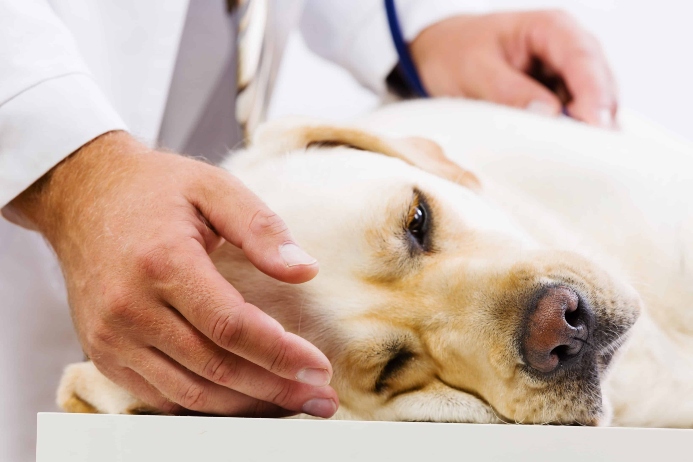
Your dog has a lump. It’s probably nothing. That’s what you tell yourself while you poke at it for the third time this week, hoping it shrinks, hoping it’s just a bug bite, hoping you’re not on the verge of learning a new vocabulary word like “oncologist.”
Here’s the truth nobody wants to hear: that lump might be a mast cell tumor, and mast cell tumors are the most common malignant skin cancer in dogs. Not the second most common. Not a rare fluke. The most common. If your dog lives long enough, the odds of facing one of these someday aren’t exactly in your favor.
That’s not meant to scare you into a panic spiral at 11 p.m. with your phone flashlight aimed at your dog’s belly. It’s meant to do the opposite. Knowledge is what turns fear into action. And action is what saves dogs. So let’s talk about what these tumors actually are, which dogs face the highest risk, what to look for, and what you can actually do about it.
What are mast cell tumors?
Mast cells are part of your dog’s immune system. Think of them as the body’s first responders, the cells that rush to the scene whenever there’s an allergic reaction, an injury, or inflammation. They carry small packets of histamine and other chemicals, ready to release them the moment trouble arises.
A mast cell tumor occurs when these cells multiply out of control. Instead of responding to a real threat, they keep dividing, piling up into a lump under your dog’s skin. And because these cells are loaded with histamine and other inflammatory chemicals, the tumor doesn’t just sit there quietly. It can cause swelling, redness, itching, even stomach ulcers if enough histamine floods the bloodstream.
Here’s the part that throws people off: mast cell tumors are notorious shape-shifters. They can look like almost anything. A soft little fatty lump. A hard pea under the skin. A red, angry bump that looks like an insect bite. Some grow fast. Some sit there for months looking harmless. There’s no single “tumor look” that lets you diagnose it from across the room, and that’s exactly why so many of these get missed until they’ve grown bigger or spread further than anyone wanted.
Which dogs face the highest risk?
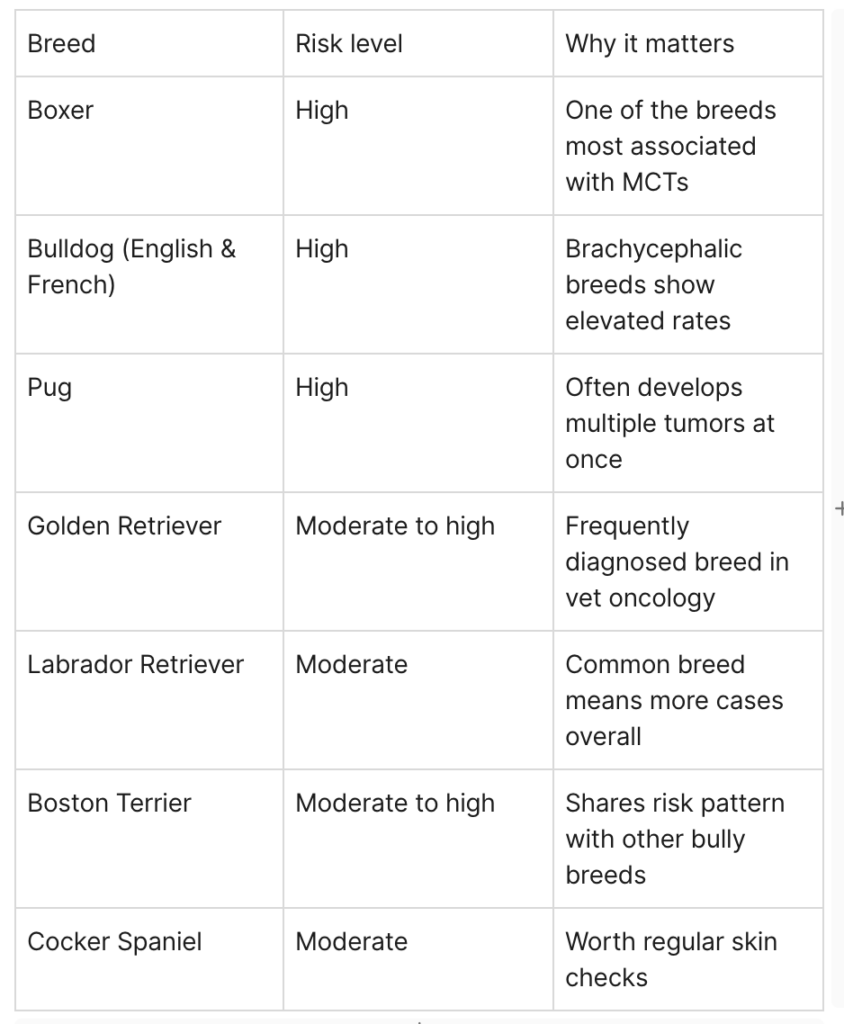
Genetics load the gun here. Some breeds are more prone to mast cell tumors than others, and if your dog falls into one of these categories, it pays to be a little more vigilant.
Some of the highest-risk breeds include Boxers, Pugs, Boston Terriers, Labrador Retrievers, Golden Retrievers, Bulldogs, and Shar-Peis. If your dog belongs to one of these breeds, extra vigilance during skin checks is especially important.
Mixed breeds aren’t off the hook either. Any dog can develop a mast cell tumor. But if you share your couch with a Boxer or a Pug, consider this your signal to run your hands over your dog a little more often.
Age matters too. Most dogs are diagnosed somewhere between 8 and 10 years old, though younger dogs aren’t immune. Older dogs carry more years of cellular wear and tear, and cancer risk climbs as a result. That’s not a reason to dread your dog’s golden years. It’s a reason to pay closer attention during them.
Warning signs: what to look for on your dog’s skin
You don’t need a veterinary degree to do a skin check. You need your hands, a few quiet minutes, and a preparedness to actually feel around instead of just glancing at your dog’s coat from the couch.
Run your palms over your dog’s body the way you’d pet them, except slower and more deliberate. Pay attention to:
- New lumps or bumps, no matter how small
- Lumps that change size, especially ones that grow quickly
- A lump that seems to swell after your dog scratches at it or after exercise
- Redness, irritation, or hair loss around a bump
- Lumps that come and go in size, almost like they’re “breathing”
That last one trips people up the most. A classic mast cell tumor can swell up one day and look smaller the next. This is sometimes called Darier’s sign, and it happens because histamine release causes local swelling. It’s not your dog magically healing. It’s the tumor reacting to touch or irritation, and it’s actually one of the more telling clues that something deeper is going on.
The two-week rule
Here’s a simple rule worth tattooing on your brain: any new lump that doesn’t resolve in two weeks needs a vet visit. Not a Google search. Not a wait-and-see approach borrowed from your neighbor’s cousin’s dog. A vet visit.
Most lumps turn out to be harmless—cysts, fatty deposits, old scar tissue. But you can’t tell the difference by peering at it under bad kitchen lighting. Only a vet can tell you what it actually is, and the only way to find out for certain involves a tiny needle, not a guessing game.
The grading system explained
If a biopsy confirms a mast cell tumor, your vet will talk about “grade.” This single word carries enormous weight in your dog’s prognosis, so it deserves a clear explanation instead of jargon soup.
Grade I tumors are the well-behaved troublemakers. They tend to stay put, grow slowly, and rarely spread. Surgical removal often cures the dog completely.
Grade II tumors sit in a gray zone. Some behave almost like Grade I, calm and containable. Others act more aggressively. Vets often run additional tests to figure out which camp a Grade II tumor falls into.
Grade III tumors are the aggressive ones. They grow quickly, invade surrounding tissue, and carry a higher risk of spreading to the lymph nodes, spleen, or liver. These require the most intensive treatment and the most honest conversations with your vet.
Grading isn’t a death sentence handed down in a single word. It’s a roadmap. It tells your vet how aggressively to treat the tumor and helps you understand what to expect going forward. Knowing the grade turns a terrifying unknown into a plan.
How vets diagnose mast cell tumors

The diagnostic process is far less invasive than most owners imagine, and that alone should ease some of the dread.
Fine needle aspirate (FNA): Your vet inserts a small needle into the lump and draws out a tiny sample of cells—no sedation required in most cases. The sample gets examined under a microscope, often the same day, and mast cells have a distinctive look that makes them relatively easy to spot. This simple test is usually the first step, and it’s often enough to confirm a mast cell tumor.
Biopsy: If the FNA is inconclusive or your vet wants more detail about the tumor’s grade, a biopsy comes next. This involves removing a piece of the tumor, or the whole thing, and sending it to a pathology lab for a closer look. This is how grading works, since grading requires examining the tumor’s structure rather than just identifying individual cells.
Staging: For higher-grade tumors, your vet may recommend additional tests, such as bloodwork, lymph node checks, or imaging like ultrasound or X-rays. This helps determine whether the cancer has spread beyond the original tumor, which directly shapes the treatment plan.
None of this happens overnight, and waiting on results is its own special kind of agony. Still, each step exists to give your dog the most accurate, most effective treatment plan possible. Skipping steps to save time rarely saves anything in the long run.
Treatment options: surgery, radiation, chemotherapy, and more
The good news, and there is genuine good news here, is that mast cell tumors are often treatable, especially when caught early.
Surgery is the frontline treatment for most mast cell tumors. Surgeons aim to remove the tumor along with a wide margin of healthy tissue, since microscopic tumor cells can spread beyond what’s visible. For Grade I and many Grade II tumors caught early, surgery alone can be curative.
Radiation therapy comes into play when surgery can’t remove the entire tumor, often because of its location near a joint or sensitive area. Radiation targets remaining cancer cells with focused precision and is frequently used alongside surgery rather than as a substitute.
Chemotherapy typically gets recommended for higher-grade tumors or cases where the cancer has spread. Dogs generally tolerate chemotherapy far better than people do. Hair loss is rare across most breeds, and severe nausea is uncommon when protocols are well managed. It’s not the brutal ordeal pop culture has trained you to expect.
Palladia (toceranib phosphate) represents a newer class of treatment called targeted therapy. Rather than attacking all rapidly dividing cells the way traditional chemo does, Palladia targets specific pathways that mast cell tumors rely on to grow and spread. It’s administered as an oral tablet, which makes it considerably easier on both the dog and the owner than IV chemotherapy visits.
Your vet, often working alongside a veterinary oncologist, will weigh the tumor’s grade and location, and whether it has spread, before recommending a specific combination of treatments. There’s no one-size-fits-all protocol here, and that’s actually a strength of modern veterinary oncology. Treatment gets tailored to your dog, not the other way around.
When to see a vet urgently
Most lumps deserve the two-week rule. Some situations deserve a same-day call instead. Get your dog seen right away if you notice:
- A lump that’s grown noticeably in just a few days
- Sudden vomiting, especially with a known or suspected mast cell tumor
- Black, tarry stool, which may indicate a bleeding stomach ulcer from histamine release
- Sudden lethargy or collapse
- A lump that bursts open, bleeds, or becomes severely ulcerated
These symptoms can indicate that a tumor is releasing significant amounts of histamine into the bloodstream, which is a genuine emergency rather than a wait-and-see situation.
Living with a dog post-diagnosis: Quality-of-life tips
A cancer diagnosis rearranges your whole world in about four seconds flat. One minute you’re scheduling a routine vet visit, the next you’re researching survival statistics at 2 a.m. with your dog snoring obliviously beside you. That whiplash is real, and it deserves acknowledgment, not dismissal.
Here’s something worth holding onto: a diagnosis is not the same as a death sentence. Plenty of dogs live full, happy years after mast cell tumor treatment. Quality of life depends heavily on grade, location, and how quickly treatment started, but countless dogs bounce right back to chasing squirrels and snatching socks within weeks of surgery.
A few ways to support your dog, and yourself, through this:
• Establish a gentle, consistent daily routine. Keeping feeding times, walks, and restful periods as predictable as possible can help dogs feel secure and reduce stress after treatment. Try to maintain their favorite rituals—whether that’s a morning stroll around the block or time on their special blanket.
• Make their recovery space comfortable. Provide a soft, clean bed away from heavy foot traffic. Some dogs appreciate an extra blanket or a familiar toy nearby. If mobility is limited, keep food and water bowls within easy reach and consider placing anti-slip mats on hard floors.
• Monitor appetite and hydration closely. Some treatments may affect your dog’s interest in food or water. Offer small, frequent meals of their usual diet or vet-recommended bland foods, and encourage drinking with fresh water always available. Notify your vet if you notice changes in appetite, persistent nausea, or vomiting.
• Support gentle activity. Short, calm walks and gentle play can be valuable, as long as your vet approves. Don’t force activity, but encourage movement if your dog’s energy allows. Rest is just as important as exercise during recovery.
• Manage medication and wound care. Follow your vet’s instructions for medications and any post-surgical site cleaning. Use a simple chart or a phone reminder so nothing is missed. If giving pills is a struggle, ask your vet or pharmacist about hiding them in treats or using a pill pocket.
• Watch for changes. Look for new lumps, changes at the surgical site, or behavior changes. Logging these observations in a simple notebook or phone app can help you spot patterns and share details with your vet during follow-ups.
Support your dog
Shower them with attention. Gentle petting, extra cuddles, or quiet time together go a long way in keeping your dog’s mood bright. Dogs thrive on connection, especially when they are recovering.
- Keep up with check-ins. Regular vet visits after treatment catch recurrences early, when they’re most treatable.
- Watch for new lumps. Some dogs develop multiple mast cell tumors over their lifetime. One diagnosis doesn’t rule out the need for future vigilance.
- Don’t skip the fun stuff. Walks, treats, belly rubs, all of it still matters. A dog doesn’t know what cancer is. They know whether today felt good.
- Lean on your support system. Talk to your vet, your vet tech, online communities of owners who’ve walked this road. You don’t have to carry this alone, and frankly, you shouldn’t try.
- Give yourself grace. Guilt creeps in fast. “Did I miss it sooner? Could I have caught it earlier?” Maybe you could have. Maybe not. Either way, beating yourself up doesn’t heal your dog. It just steals energy you need for the road ahead.
Frequently asked questions about mast cell tumors
Once a tumor is found, it typically becomes a pre-existing condition, so timing matters.
Can mast cell tumors be prevented?
Not entirely, no. Genetics play a major role, and you can’t rewrite your dog’s DNA. What you can do is catch tumors early through regular skin screenings and prompt vet visits, which dramatically improves outcomes.
Is a mast cell tumor contagious?
No. Cancer doesn’t spread between dogs through contact, shared bowls, or backyard sniffing sessions. Your dog’s diagnosis poses zero risk to other pets in the household.
What’s the survival rate?
This varies enormously depending on grade and the timing of treatment. Dogs with low-grade tumors caught and removed early often achieve a complete cure, and many of these dogs live two to five years or more after treatment—some even for the rest of their natural lifespan.
For higher-grade or metastatic tumors, the outlook is more guarded, with survival times ranging from several months to a year or more in some cases, depending on response to treatment.
Even so, many dogs with aggressive mast cell tumors live well beyond initial expectations with appropriate care. Your vet can give you numbers specific to your dog’s exact situation, which will always be more useful than generic statistics.
Do certain locations on the body matter?
Yes. Tumors on the mouth, paws, or other areas with less surrounding tissue can be harder to remove with clean margins and may require more aggressive treatment, even at lower grades.
Should I get pet insurance because of this?
Worth considering, especially for breeds at higher risk. Cancer treatment costs add up fast, and insurance purchased before a diagnosis can ease that financial pressure considerably. Once a tumor is found, it typically becomes a pre-existing condition, so timing matters.
The bottom line on mast cell tumors
Mast cell tumors are common, sneaky, and genuinely scary to face as a dog owner. But they’re also one of the more manageable cancers in veterinary medicine when caught early.
Many dogs go on to live long, joyful lives after treatment, returning to their favorite routines and activities as if nothing happened.
The single biggest factor in your dog’s outcome isn’t luck. It’s how quickly that first lump gets checked out.
So run your hands over your dog tonight. Feel for anything new. Set a notification to do it again next month. It takes two minutes and costs nothing, and it just might be the two minutes that change everything.
Sara B. Hansen has spent 20-plus years as a professional editor and writer. She’s also the author of The Complete Guide to Cocker Spaniels. She created her dream job by launching DogsBestLife.com in 2011. Sara grew up with family dogs, and since she bought her first house, she’s had a furry companion or two to help make it a home. She shares her heart and home with Nutmeg, a Pembroke Welsh Corgi. Her previous dogs: Sydney (September 2008-April 2020), Finley (November 1993-January 2008), and Browning (May 1993-November 2007). You can reach Sara @ editor@dogsbestlife.com.