How to make your dog feel secure when fireworks go boom

Does your dog turn into a nervous wreck every Fourth of July? You’re not alone. The sound of fireworks sends millions of dogs into a full-blown panic, and it breaks your heart every single time.
Think about it. Your dog’s ears pick up sounds you’ll never notice, like the soft footfall of a mouse 30 feet away. Now multiply that sensitivity by a hundred and add a sky full of flashes of light and booming sound.
No wonder your pup wants to dive under the bed. Most dogs are afraid of fireworks, the same way they’re afraid of thunder.
The good news? A scared dog isn’t a lost cause. With the right prep, a little patience, and a few smart tools, you can turn fireworks night from a nightmare into just another evening at home.
Here are seven tried-and-true dog fireworks fear remedies, plus a printable checklist, a few sensory comfort tricks, and a real game plan for what to do if panic takes over.
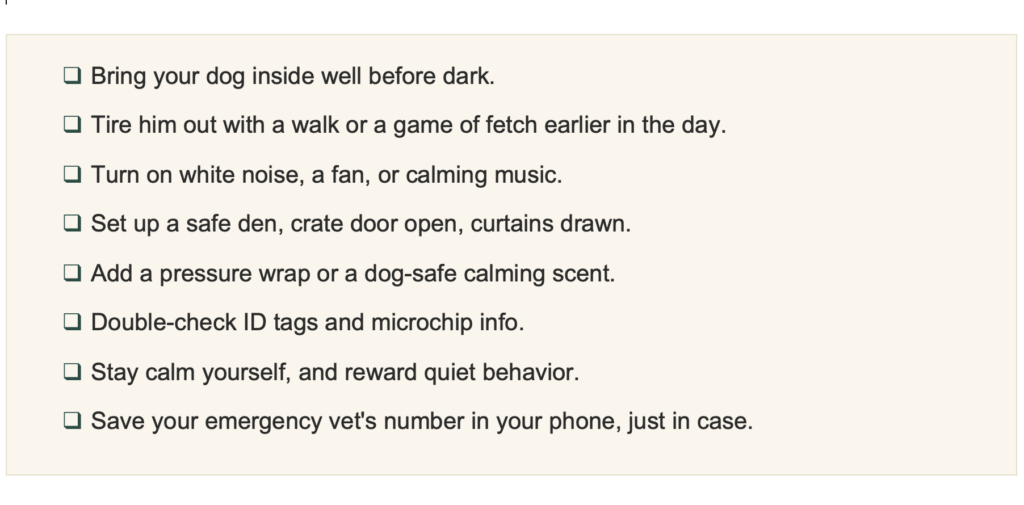
Your fireworks night checklist
Pin it to the fridge. Tape it to the door. Just keep it close, because fear is always easier to head off than to undo once the first boom hits.
Bring your dog inside
When the sky starts popping, get your dog inside, fast. Pick a room away from windows and street noise, somewhere quiet and out of the action.
Flip on the TV or radio. The familiar hum of voices or classical music gives your dog something else to focus on. A white noise machine works just as well; it blankets the booms in a steady, boring hum.
Tire your dog out
Take your dog for a long walk before the fireworks start. Act before your dog starts showing signs of fear. Toss the ball. Play tug. A tired dog is a calmer dog, plain and simple.
Don’t wait for the first boom to start soothing him. Show him now, while everything’s quiet, that calm behavior earns rewards. That lesson sticks long after the noise begins.
Train calm responses
Fear doesn’t disappear overnight. But you can chip away at it, one calm rep at a time.
Desensitization
Play a recording of fireworks at a low volume. Toss a treat. Next session, turn it up a notch and reward again. Slow and steady wins this race. Use behavior modification to keep your dog calm.
Positive association
Every time a loud noise hits, follow it with something good: a treat, a favorite toy, a scratch behind the ears. Your dog starts to associate “boom” with “bonus.”
Calming aids
A Thundershirt, an Adaptil spray, or a CBD treat can soothe and calm your dog while you work on training. Think of these as training wheels, not a permanent fix. Always run new products past your veterinarian first.
Obedience cues
Teach “sit” and “stay” long before fireworks season arrives. A dog who knows the drill has somewhere to put his attention besides the noise outside.
Call in a pro
If your dog’s fear runs deep, a certified trainer or veterinary behaviorist can build a plan made just for him. There’s no shame in asking for backup.
Build a safe den
Pick a room that swallows sound. Close the doors, draw the curtains to create a safe haven. If your dog has a crate, leave the door open and let it become his hideout, not his prison. If you haven’t already done any crate training, start now.
Toss in his favorite toy. A stuffed Kong gives him a job to do, and a job beats worry every time. Puzzle toys work too- anything that keeps his brain busy and his paws occupied.
Soothe the senses
Your dog takes in the world through more than just his eyes. Sound, touch, and smell all play a part, and you can use every single one of them to calm him down.
Sound
Keep that white noise running. A fan, a playlist, even the dishwasher can mask the worst of the booms.
Pressure
A Thundershirt or anxiety wrap hugs your dog’s torso like a constant, gentle bear hug. Vets aren’t entirely sure why it works, but plenty of dogs settle down within minutes of putting one on.
Calming scents
Smell is your dog’s superpower, and you can use it to your advantage on a stressful night. Lavender and chamomile both have a reputation for taking the edge off, in people and dogs alike.
Here’s the catch: raw essential oils are far more concentrated than the plant itself, and some vets warn they can irritate a dog’s airway or skin if you’re not careful. So skip your bathroom diffuser.
The safer route is a pet-formulated calming spray or diffuser, the kind built specifically for dogs, using a diluted, dog-safe blend of lavender or chamomile. Set it up in the safe room about 30 minutes before the fireworks start, so the scent has time to settle before your dog needs it.
A few ground rules: never apply undiluted oil directly to skin or fur, keep diffusers well away from any cats in the house (lavender is riskier for them), and check with your vet first if your dog has asthma, allergies, or is pregnant. When in doubt, dilute more, not less.
Calming treats
Brands like Zesty Paws, PetHonesty, and NaturVet make calming chews with natural ingredients built for stressful nights. Watch for warning signs of anxiety like pacing or drooling so you know when to reach for supplements or anti-anxiety medications.
Lock down the exits
More dogs go missing on the Fourth of July than on any other day of the year. Panic makes dogs run, and a closed gate won’t stop a dog who’s desperate to escape the noise.
Double-check his ID tag and microchip info before the sun goes down. Never leave him alone during fireworks. If you can’t be there, line up a trustworthy sitter or a secure kennel for the night.
A custom ID tag can be the difference between a quick reunion and days of searching.
Be the calm anchor
Ever notice how your dog checks your face before deciding whether to panic? He reads you like a book. If you’re tense, he’s tense. If you’re steady, he borrows that steadiness too.
So skip the dramatic reactions. No frantic hugging, no high-pitched “it’s okay, it’s okay!” Just be the calm in his storm.
Here’s the tricky part: comforting a scared dog with constant petting can actually reinforce the fear. It tells him that shaking and panting earn him a reward. Instead, redirect him. Ask for a “sit.” Offer a chew. Let calm behavior, not panic, get the attention.
Watch his tail. A happy dog wags it loose and free. A scared dog tucks it tight between his legs. That’s your cue to dial up the comfort, minus the drama.
Emergency action plan: When fear turns to panic

Sometimes, despite your best efforts, fear tips over into full panic. Here’s how to handle it without making things worse.
Know the signs
Watch for non-stop pacing, drooling, panting that won’t quit, destructive chewing or scratching at doors and windows, frantic attempts to escape, or a dog who won’t respond to his name at all. These go well beyond garden-variety nerves. According to veterinary behavior specialists, this level of fear is functionally equivalent to a panic attack. This is a dog in crisis, not just a dog who’s a little spooked.
Comfort without reinforcing fear
Get low. Get quiet. Sit near your dog and let your presence, not your panic, do the talking. A hand resting on his back or a steady, low voice helps more than frantic cuddling ever will.
Skip the baby talk and the tight hugs. Don’t force eye contact, and don’t scoop him up if he’s a dog who wants space. Let him choose how close he gets.
If he wants to hide, let him hide. A crate, a closet, under the bed, wherever feels safest to him is the right place for him to be right now.
Know when it’s an emergency
Call your emergency vet right away if you notice bleeding from broken nails or torn paw pads (common after frantic scratching), gums that look pale, blue, or unusually bright red, vomiting, collapse, seizure-like activity, or a dog who’s run himself to exhaustion and still won’t stop trying to escape.
Emergency vet teams treat these as true emergencies, not something to wait out until morning.
Keep your regular vet’s after-hours number and the nearest emergency animal hospital saved in your phone before the Fourth of July rolls around, not after.
Keep yourself calm
Easier said than done, right? But your dog needs you steady, not spiraling. Take a breath. Slow your own movements. Speak low and even.
Think of yourself as the lighthouse, not the storm. Your dog is looking for steady ground, and tonight, you’re it.
Understand the long-term toll of fireworks fear
A scary night doesn’t always end when the fireworks stop. If it goes unaddressed, fireworks fear can ripple into bigger problems.
Behavior changes
A dog who’s constantly on edge may bark more, hide more, or chew through your favorite shoes. Stress has to go somewhere, and it often comes out sideways.
Generalized anxiety
One bad fireworks season can exacerbate your dog’s fearful response and turn your dog into one who startles at slamming doors, thunder, even the vacuum cleaner. Fear has a way of spreading.
Physical health
Chronic stress doesn’t just live in your dog’s head. It can upset his stomach, weaken his immune system, and tip the scales toward overeating or skipping meals altogether.
Quality of life
A dog who lives in fear can’t fully enjoy walks, visitors, or play time. That’s a steep price to pay for a few noisy nights a year.
Your bond
Watching your dog suffer takes a toll on you too. Frustration and helplessness can chip away at the connection you’ve worked so hard to build. Tackling the fear head-on protects that bond, for both of you.
Safety first
Don’t forget the fireworks themselves. Store them in their original packaging, somewhere cool, dry, and completely out of reach: think locked cabinet or high shelf, never the garage floor where a curious nose can find them.
A dog can easily mistake a firework for a chew toy, and that’s a trip to the emergency vet nobody wants to take.
Whatever combination of these tips you use, start early. Be ready, be steady, and give your dog the calm, safe night he deserves.
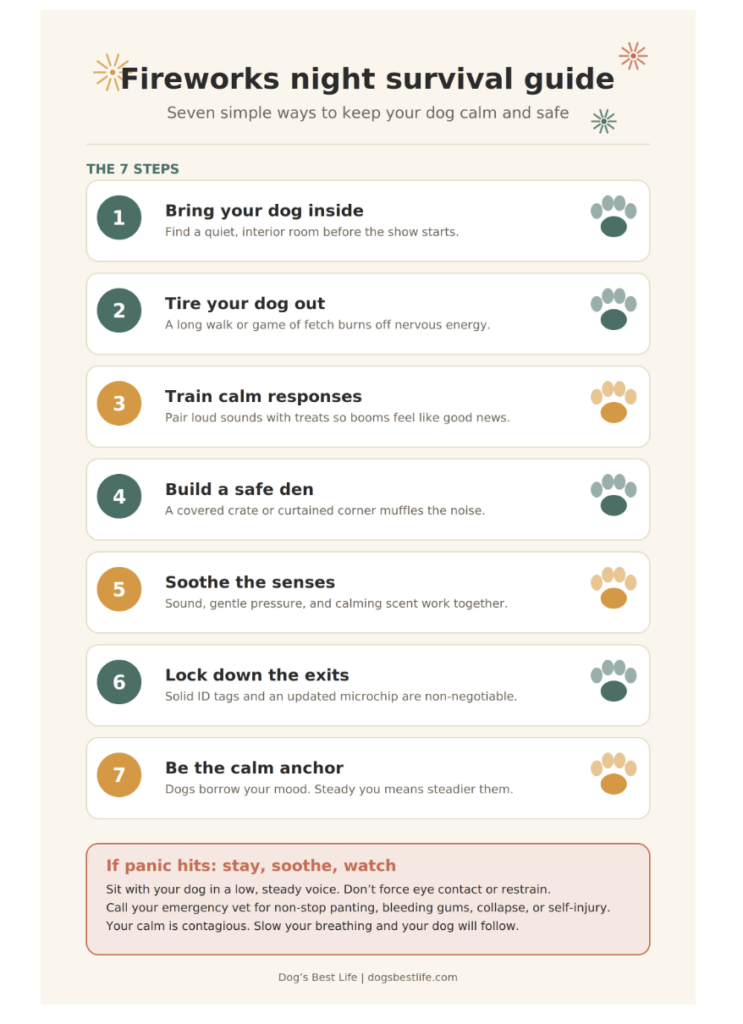
Quick-look infographic
Share this one-page summary with anyone in the house, sitters included, so everyone’s on the same page when the sky starts popping.