
Spring shedding in dogs: What pet parents should expect
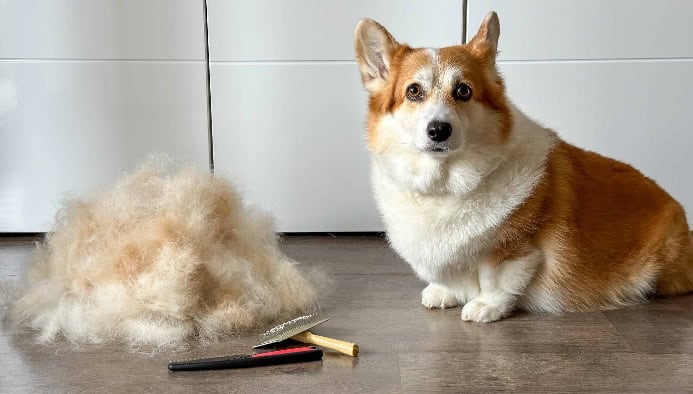
You swept up a pile of dog hair this morning. By lunchtime, there was another one. By evening, you’d found dog hair in your dinner, on your work shirt, and somehow inside a sealed Tupperware container.
Meanwhile, your dog is stretched out on the couch without a care in the world, totally unaware that they’ve basically redecorated your entire home in fur.
Sound familiar?
And if your brain has gone to that anxious place — “Wait, is my dog sick? Is this much shedding even possible?”
No, you’re not being dramatic. That thought crosses every dog owner’s mind at least once during spring.
It’s a lot to deal with. Nobody hands you a pamphlet when you adopt a dog that says, “By the way, every April your home will look like a snow globe filled with fur.”
The frustration is completely understandable.
Here’s what actually matters, though: in the vast majority of cases, heavy spring shedding is perfectly healthy — and there are real, practical ways to get it under control.
Why do dogs shed more in spring?
- Why do dogs shed more in spring?
- The role of daylight and temperature changes
- Understanding your dog’s coat type
- Common signs of spring shedding
- Controlling and minimizing shedding
- Grooming tips for the season
- Diet and nutrition to support a healthy coat
- Keeping your dog comfortable during seasonal changes
- When to consult your vet about excessive shedding
- Final thoughts on spring shedding
Let’s start with the basics. Dogs don’t shed more in spring to annoy you. They shed because their bodies are designed to adapt to seasonal changes.
All winter long, your dog’s body has been building up a dense, insulating coat to protect them from the cold. The moment spring signals its arrival, that coat becomes a liability rather than an asset — and the body knows it.
So off it comes. Think of that as your dog doing their own version of a seasonal wardrobe swap. The problem, of course, is that unlike your winter clothes, their old coat doesn’t go neatly into a storage box. It goes on your sofa.
Breeds with double coats — think Huskies, German Shepherds, Golden Retrievers, and Labradors — tend to experience this most intensely.
Their coats are built in layers, and when the season shifts, the whole undercoat can seem to release at once. Dog owners sometimes call it “blowing coat,” which is a tactful way of saying your vacuum is about to earn its keep.
The role of daylight and temperature changes
Most people assume it’s the heat that kicks shedding into overdrive. Reasonable guess — but it’s actually only part of the story. The real trigger is something most of us never think about: the length of the day.
Your dog’s coat cycle is driven primarily by photoperiod — the scientific term for the amount of daylight in a given day.
As spring brings longer days, your dog’s hormonal system picks up on the shift and begins activating the coat to change.
Temperature is a secondary factor. Light is the main event. That’s why a dog who spends most of their time indoors, in a climate-controlled home, will still go through a full spring shed — their internal clock is responding to the sun, not the thermostat.
There’s no escaping it, even for the most sheltered, coddled house dog. This is simply what their biology does.
In fact, dogs that live primarily under artificial lighting tend to shed more evenly throughout the year — which means when spring hits, the surge may feel even more dramatic by comparison.
Suddenly it’s everywhere, all at once. Now you know why.
Understanding your dog’s coat type
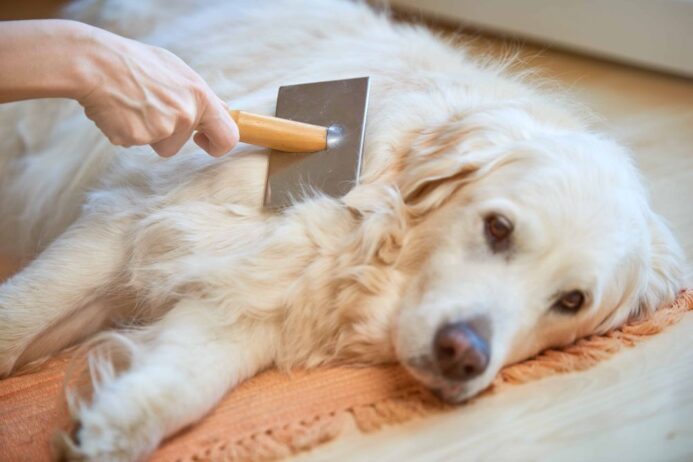
Not all shedding looks the same, and not all coats behave the same. Understanding what kind of coat your dog has changes everything about how you approach grooming season.
Double-coated dogs carry two distinct layers: a dense, soft undercoat sitting beneath a coarser outer layer.
When spring arrives, it’s that undercoat that releases in clumps and drifts. The goal with these dogs is to clear out the loose undercoat efficiently, without roughing up or damaging the protective outer layer.
Short-coated dogs are a different story. They shed more steadily throughout the year, and while individual hairs are tiny, they have a special talent for weaving themselves permanently into fabric.
If you own a Beagle or a Boxer, you already know. Regular, gentle brushing and consistent bathing are your best line of defense.
Beyond coat type, factors like age, overall health, and diet all play a role. Young puppies and older dogs often shed differently from dogs in their prime. A dog with nutritional gaps or an underlying skin condition may shed more than expected, even accounting for the season.
Getting clear on your dog’s coat type isn’t just interesting background knowledge — it’s what lets you select the right tools and build a routine that actually works.
Common signs of spring shedding
It helps to know what you’re actually looking at. There’s a clear difference between “my dog is shedding a ton” and “something is genuinely wrong with my dog” — and being able to tell them apart saves a lot of unnecessary worry.
A normal spring shed looks like a coat that’s gradually thinning out, with loose hair coming away easily during brushing or even just petting.
What it doesn’t look like is patchy bald spots, raw skin, persistent scratching, or any sign of inflammation. If you’re seeing a lot of fur but the skin underneath looks clean and healthy, you’re almost certainly in normal territory.
During the transition, you’ll typically notice more hair collecting on floors and furniture, and possibly small tufts or clumps of undercoat releasing around the shoulders, hindquarters, and base of the tail. This is the undercoat doing exactly what it’s supposed to do.
There’s actually an upside here worth appreciating. Once that heavy winter coat is gone, many dogs visibly perk up. They move more freely, seem more comfortable, and some even appear more energetic. Shedding season has an end goal — a lighter, airier coat that’s far better suited to warmer days.
So, as frustrating as the cleanup is, all that fur on your floor is actually evidence that your dog’s body is working perfectly.
Controlling and minimizing shedding
Shedding isn’t something you can switch off. But “unmanageable” and “unstoppable” aren’t the same thing. The key is to stop treating it like a problem to solve and start treating it like a seasonal rhythm to work with.
Using the right approach, you can dramatically reduce the amount of loose hair that ends up on your floors, furniture, and wardrobe.
At home, ditch the broom. Sweeping dog hair is essentially just relocating it — it catches air and resettles somewhere else. A vacuum picks it up for good. During the heaviest weeks of shedding season, running the vacuum through busy areas every couple of days makes a noticeable difference.
Washing your dog’s bedding frequently and keeping a lint roller within reach for upholstery and clothing will also help keep things manageable. Small, consistent habits beat sporadic deep-cleaning sessions every single time.
Grooming tips for the season
If there’s one thing that makes the biggest difference during shedding season, it’s a consistent grooming routine. Not an occasional one. A consistent one.
Regular brushing intercepts loose fur before it has a chance to drift onto your sofa or embed itself in your clothes.
But the benefits go beyond just tidiness. Brushing stimulates circulation in the skin and spreads your dog’s natural oils evenly through the coat, which keeps it looking healthy and feeling soft — and actually reduces how much hair falls out between sessions.
For most dogs, five to 10 minutes of brushing three to five times a week is enough to keep it under control. Double-coated breeds during peak blowout weeks may need a quick daily session.
Brushing after walks is also a smart habit — it removes allergens and loose coat that get stirred up during outdoor activity.
Tool selection matters more than most people realize. A slicker brush is a reliable all-rounder — good for clearing loose hair and working through mild tangles with light, short strokes. For dogs with thick undercoats, an undercoat rake does the heavy lifting, pulling out the deep, fluffy layer that a regular brush can’t reach.
If your dog is sensitive or resistant to bristle brushes, a rubber grooming mitt is often a gentler entry point — it lifts loose hair while feeling more like a massage than a grooming session.
Bathing is a useful part of the shedding toolkit, but frequency matters. A well-timed bath loosens dead hair and flushes out the undercoat before it has a chance to scatter through your home.
Bathe too often, though, and you strip the coat of its natural oils, which leads to dry skin — and ironically, more shedding. For most dogs, once every three to four weeks, using a gentle deshedding shampoo hits the right balance.
And if home grooming sessions have become a two-person rodeo? A professional deshedding treatment from a groomer can remove a remarkable amount of loose coat in one go, giving you a much cleaner slate to work from.
Diet and nutrition to support a healthy coat
Grooming is the visible side of coat care. But what happens at the cellular level — in the skin, the follicles, the oils your dog’s body produces — is driven almost entirely by diet. What goes into your dog directly shapes what comes out of their coat.
When a dog’s diet is low in essential nutrients, particularly omega-3 fatty acids, the coat is often the first place it shows.
Dullness, increased shedding, dry or flaky skin — these are classic signs that the body isn’t getting what it needs. Many standard commercial kibbles, despite their convenience, fall short on these critical fats.
Omega-3 fatty acids do several things at once for coat health. They nourish the skin from within, helping it stay hydrated and less prone to irritation.
A well-moisturized skin produces a stronger, shinier coat — and a coat that’s in better condition sheds less excessively. Less dandruff, less itching, less fur on your couch.
Biotin — also known as Vitamin B7 — is an additional key player. It supports the production of keratin, the structural protein that hair is made of.
Without enough of it, hair becomes brittle and breaks more easily. Zinc is similarly important for follicle strength and skin repair. A targeted supplement that combines omega-3s, biotin, and zinc can give your dog’s coat meaningful support during the heaviest shedding weeks.
That said, always run supplements by your vet first — dosage differs by size, breed, and health status.
Don’t expect overnight results. Nutritional changes work gradually, as the body rebuilds from the inside.
Most owners start to notice a difference in coat quality — more shine, less shedding, softer texture — somewhere between three and six weeks of steady supplementation. Stick with it.
Keeping your dog comfortable during seasonal changes
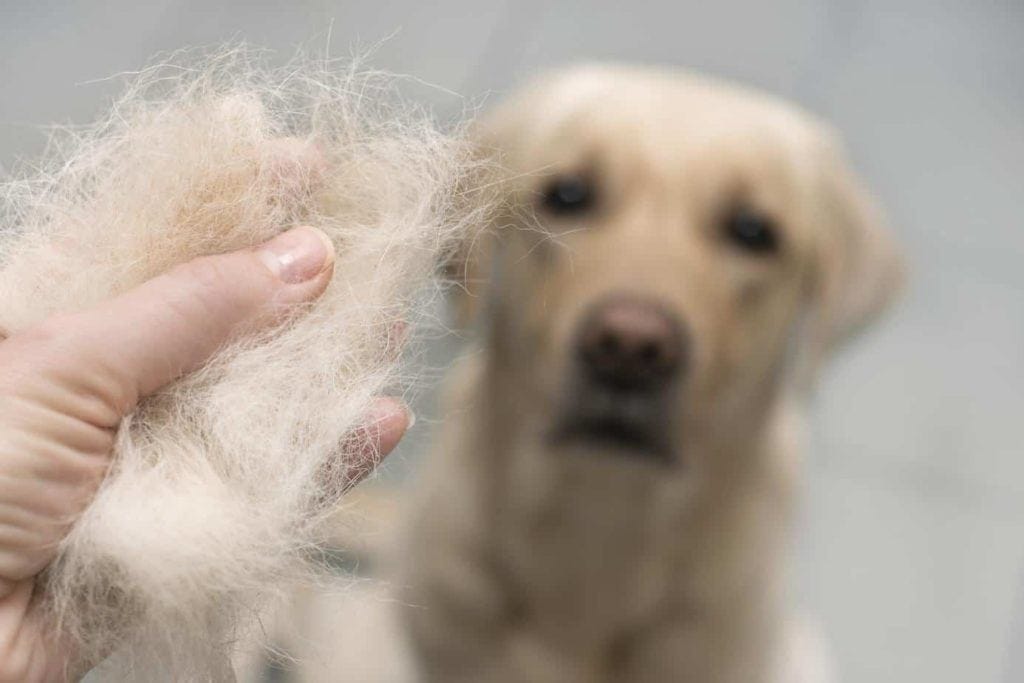
It’s easy to focus on the inconvenience shedding causes you — the cleaning, the fur on everything, the lint rolling. But your dog is living through it too. A coat in the middle of a seasonal transition can feel itchy, tight, and uncomfortable. Keeping them comfortable during this period is just as important as keeping your home clean.
Regular grooming sessions do double duty here. Yes, they help manage the shedding — but they also give you a chance to check in on your dog’s skin up close.
You can spot early signs of irritation, parasites, or hot spots before they become a bigger issue. And for most dogs, once brushing becomes a familiar routine, it stops feeling like a duty and becomes quality time together.
Keep your dog well-hydrated — water is as important for skin health as any supplement. And don’t underestimate the relief that comes from clearing out that heavy undercoat promptly.
The whole point of spring shedding is to help your dog regulate their temperature more effectively. The faster you help move that process along through regular brushing, the sooner they’ll feel genuinely comfortable in the warmer weather.
One more thing worth watching: stress. Anxiety and emotional tension can trigger or worsen fur loss in dogs, and it’s more common than people think.
A new pet in the house, a shift in your schedule, a move, or separation anxiety can all trigger stress-related shedding — when a dog scratches, licks, or chews at itself to the point of hair loss.
If the shedding seems concentrated in specific spots, or if your dog looks anxious or unsettled alongside it, that’s a signal worth taking seriously.
When to consult your vet about excessive shedding
The vast majority of what you’ll see in spring is completely routine. But shedding can occasionally be your dog’s way of flagging something that needs attention — and knowing the difference matters.
Normal shedding spreads evenly across the coat and doesn’t leave the skin looking angry or bare.
If you’re noticing bald patches, persistent redness, or flaking, or if your dog is constantly scratching and biting at themselves, those are signs worth investigating.
Allergies, parasites, hormonal imbalances, and skin infections can all show up as excessive fur loss — and they won’t resolve on their own.
Pay close attention if the shedding is accompanied by other symptoms: persistent dandruff, hair that breaks rather than falls out naturally, recurrent ear infections, a dull or lifeless coat, or any clear change in your dog’s energy or appetite. These combinations suggest the issue goes beyond seasonal biology.
A vet visit — with proper testing — is the only way to get a real answer and start the right treatment.
Early intervention almost always means simpler, less expensive treatment. And more importantly, it means your dog feels better sooner. You spend more time with your dog than anyone else does.
If something appears off — not just “a lot of shedding” but really wrong — act on that instinct.
Final thoughts on spring shedding
Spring shedding is a lot. There’s no sugarcoating it. It’s weeks of extra cleaning, constant lint-rolling, and finding fur in places that defy all logic.
Feeling worn down by it doesn’t make you a bad dog owner — it makes you a normal one.
But it does end. The coat settles, the floors stay cleaner for longer, and your dog emerges on the other side looking lighter and feeling better for it.
You’ve got the knowledge now. You’ve got a plan. Handle it.
Sara B. Hansen has spent 20-plus years as a professional editor and writer. She’s also the author of The Complete Guide to Cocker Spaniels. She created her dream job by launching DogsBestLife.com in 2011. Sara grew up with family dogs, and since she bought her first house, she’s had a furry companion or two to help make it a home. She shares her heart and home with Nutmeg, a Pembroke Welsh Corgi. Her previous dogs: Sydney (September 2008-April 2020), Finley (November 1993-January 2008), and Browning (May 1993-November 2007). You can reach Sara @ editor@dogsbestlife.com.