
Place command: How to get your dog to settle on cue every single time
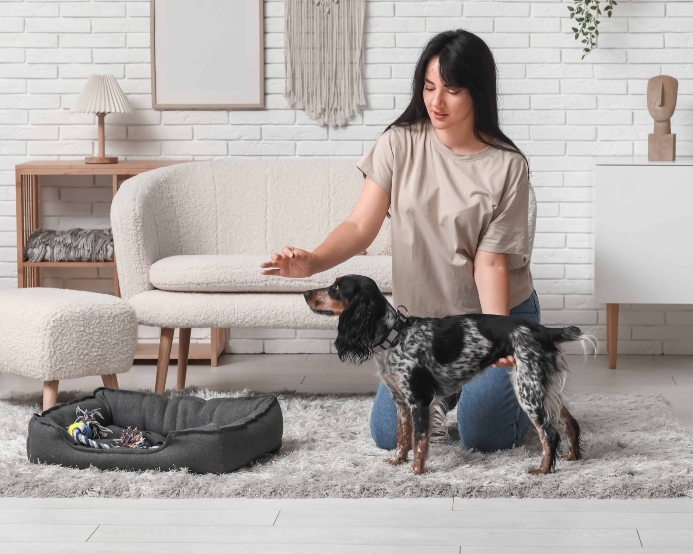
Imagine this: the doorbell rings, and instead of a barking, spinning, jumping mess of a dog, you get … nothing.
Your dog trots to a mat in the corner, lies down, and waits. Guests walk in without getting mauled by enthusiasm.
Dinner happens without a nose in your lap. That’s not a fantasy. That’s what the “place” command does, and it might be the single most useful thing you ever teach your dog.
What “place” actually means
“Place” tells your dog to go to a specific spot and stay until you release them. Simple concept. Powerful result.
People often confuse “place” with “stay,” but they’re not twins. “Stay” freezes your dog wherever they happen to be, in whatever position they’re in, for a set amount of time.
“Place” is a destination. It’s a job. Your dog has somewhere to go, and once they’re there, they get to relax into it. They can shift, lie down, sigh, resettle.
The rule isn’t “don’t move a muscle.” The rule is “stay on the mat.”
Think of “stay” as pausing a video and “place” as sending your dog to their own room. One’s a freeze frame. The other’s a location with a purpose.
That difference matters because it’s what makes “place” so livable. You’re not asking for statue-like discipline.
You’re asking your dog to hang out in a designated spot while life happens around them. That’s a skill dogs can actually maintain for twenty minutes, not twenty seconds.
Equipment: Why elevation helps
You don’t need much. A raised dog cot, a sturdy platform, or even a flat mat all work, though elevated options tend to work faster and better.
If you are on a budget or beginning, household items like a folded blanket, a towel, or a rug can serve as a place spot too. Special purchases are optional—what matters is having a clear, consistent location.
Here’s why elevation matters. A raised cot gives your dog a clear physical boundary. Their paws can feel the edge. There’s no ambiguity about where “place” ends and “not place” begins. A flat mat blends into the floor, and a lot of dogs will slowly ooze off the edges without even realizing they’ve left. An elevated cot doesn’t allow that kind of gray area.
Elevation also makes the spot feel special. It’s not only the floor; it’s a designated perch, a little island that belongs to your dog. Dogs tend to settle faster somewhere that feels like their own turf.
If you’re starting, a cot with a defined edge (something like a raised camp-style dog bed) is worth the investment. You can graduate to a flat mat later once the behavior is solid.
The step-by-step shaping process
Building “place” is a ladder. Skip a rung, and you’ll end up with a dog who understands the command in your living room and nowhere else.
Climb it in order, and you’ll build something that holds up in the real world.
Progress looks different for every dog—some pick it up in a few days, others need a couple of weeks or more. Go at your dog’s pace and expect that steady practice and patience will pay off.
Step 1: Lure onto the mat
Start with the cot a few feet away. Lure your dog onto it with a treat, let all four paws land on the surface, and mark it immediately with a “yes” or a clicker. Feed the treat while your dog is still standing on the mat, not after they step off. You’re paying for presence, not for the approach.
If your dog is hesitant or refuses to step onto the mat, break the step down further by rewarding for any movement toward the mat or even a single paw touching it.
Use higher-value treats if needed—something extra tasty can increase motivation. Some dogs need a few tries or smaller steps before getting comfortable with the new surface, and that’s totally normal.
Repeat this ten or fifteen times in a session. Add the word “place” right as your dog steps onto the cot. You’re not asking for anything fancy yet. You’re just building the association: mat equals good stuff happens here.
Step 2: Build duration
Once your dog reliably hops on the mat, start asking for a pause of quietness before the treat comes.
One second. Then three. Then ten. Build slowly. If your dog breaks position, that’s not a failure; it’s information. It means you asked for more time than they were ready to give. Back up and shorten the interval.
A release word matters here too. Pick one (“break,” “free,” “ok”) and use it every single time you end the exercise. Without a clear release, your dog has to guess when they’re allowed to get up, and guessing leads to breaking position early.
Step 3: Add distance
Now start stepping away. One step back, then return and reward. Two steps. A lap around the room. Eventually you’ll walk clear across the house and back. Your dog’s job doesn’t change: stay on the mat until released. Only your position changes.
This is where a lot of owners rush and pay for it later. Distance is genuinely hard for a dog who’s still new to the concept. Add it in small increments, and if your dog pops up and follows you, calmly reset them without drama. No scolding, just a reset.
Step 4: Add distractions
This is the step that makes “place” useful in real life. Bounce a ball. Have a family member walk by. Drop a toy. Ring the actual doorbell. Each new distraction is basically starting over at a lower difficulty level, so drop your duration and distance expectations when you introduce something new, then build back up.
Distractions should escalate gradually: quiet house, then normal household noise, then a knock, then a full doorbell-and-guest scenario. Rushing this step is the number one reason “place” falls apart the moment it matters most.
Real-world applications
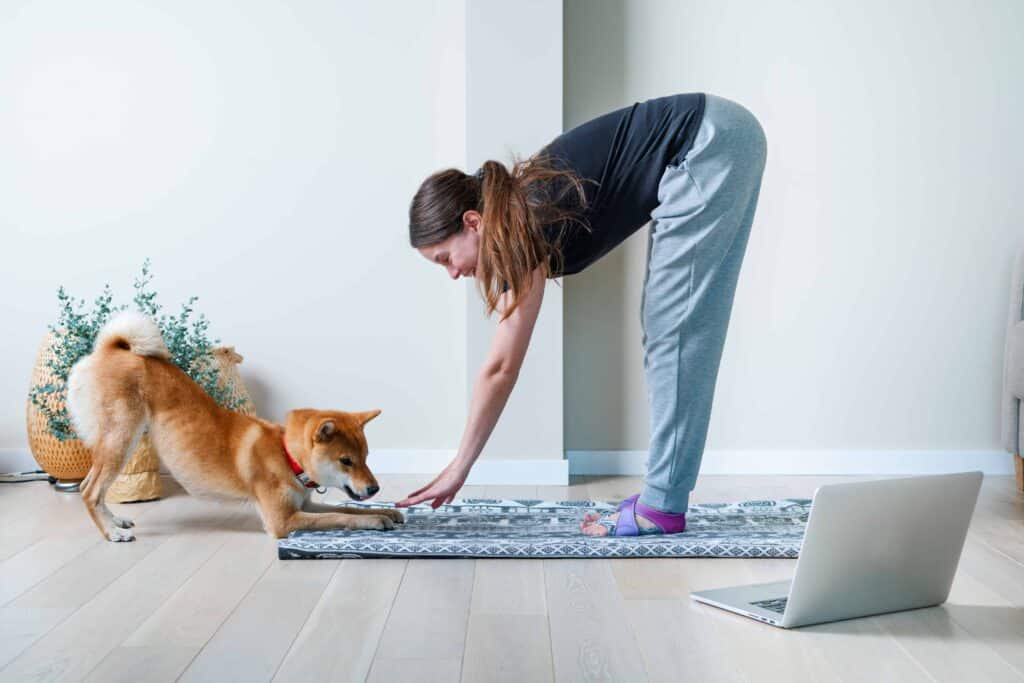
This is where the payoff shows up.
Mealtimes. Put the cot near, but not at, the dining table. Send your dog to place before you sit down—no begging, no drool on your knee, no dog inhaling a dropped fork. You eat in peace, your dog learns that dinner isn’t a group activity.
Doorbell and guests. This is the big one. Instead of a chaotic scramble at the front door, your dog goes to their place the second the bell rings. Guests can enter, take their coats off, and get settled before your dog is even invited to say hello. It turns a stressful thirty seconds into a non-event.
Multi-dog households. “Place” gives each dog their own spot, which cuts down on resource guarding, doorway pileups, and general chaos when multiple dogs are trying to greet the same person or chase the same ball.
Always start by teaching each dog the place command separately so they can learn without distractions or confusion.
Once each dog is steady on their own mat solo, you can begin to practice with two dogs at a time, then all together. Give each dog a designated cot and suddenly the living room has some order to it.
Vet and grooming waiting rooms. A dog who understands “place” can settle on a mat in an unfamiliar, stressful environment because the command itself is familiar, even if the surroundings aren’t. That predictability is genuinely calming for an anxious dog.
How to generalize “place” to new locations. Once your dog is steady at home, help them transfer the skill by practicing in quiet, low-distraction environments outside your house.
Bring your dog’s mat to different rooms, your backyard, a friend’s house, or a quiet park spot, and practice the same steps: cue “place,” build duration, use your release word. Start simple, then gradually add interruptions or more challenging settings.
Taking it slow helps your dog understand that “place” means the same thing wherever you are, setting you both up for everyday success.
Troubleshooting a dog who keeps breaking position
If your dog keeps popping off the mat, don’t take it personally, and don’t escalate your frustration. Work through this checklist instead.
You’re moving too fast. This is the most common culprit by far. If your dog breaks at ten feet, that means ten feet is too far right now. Drop back to five and rebuild.
The reward isn’t worth it. If the squirrel outside is more exciting than your treats, upgrade your treats. Save the really high-value stuff (chicken, cheese, whatever your dog loses their mind for) specifically for place training.
Your dog doesn’t have a release cue, or you’re inconsistent with it. Every session should end the same way, with the same word, every time. Consistency here removes the guesswork.
You’re skipping the boring reps. Duration and distance both need way more repetition than most owners expect. If it feels tedious, you’re probably doing it right. Real, reliable behavior is built on volume, not shortcuts.
The environment jumped too many levels at once. Don’t go from a quiet living room straight to a full house party. Layer distractions gradually so your dog can succeed at each stage before moving to the next.
A dog who breaks position isn’t being stubborn. They’re telling you where the training plan has a gap. Listen to that, adjust, and keep going.
“Place” won’t fix every behavior problem in your house. But it gives your dog a job, a spot, and a clear expectation, and that structure does more for a calm household than almost anything else you can teach.
Sara B. Hansen has spent 20-plus years as a professional editor and writer. She’s also the author of The Complete Guide to Cocker Spaniels. She created her dream job by launching DogsBestLife.com in 2011. Sara grew up with family dogs, and since she bought her first house, she’s had a furry companion or two to help make it a home. She shares her heart and home with Nutmeg, a Pembroke Welsh Corgi. Her previous dogs: Sydney (September 2008-April 2020), Finley (November 1993-January 2008), and Browning (May 1993-November 2007). You can reach Sara @ editor@dogsbestlife.com.