
Dog travel tips: Why airline policies matter more than you think
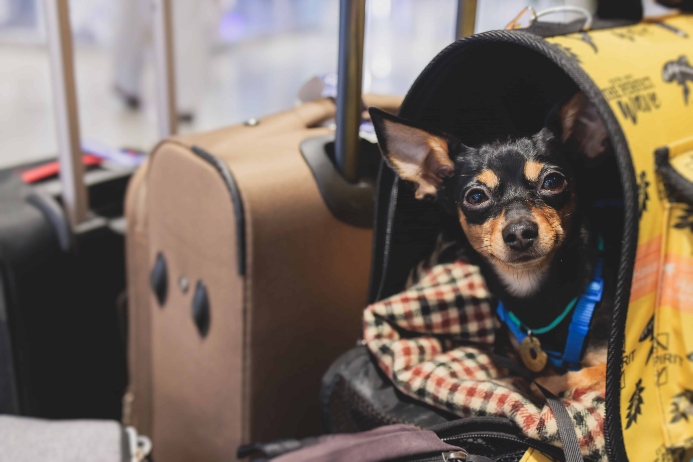
Airline policies for dogs change more often than most people realize — and getting it wrong can mean your dog gets left at the gate.
Before you book, there’s a lot to sort out: whether your dog can fly in the cabin or has to go cargo, which breeds get restricted or banned outright, what paperwork your vet needs to sign off on, and how to actually keep your dog calm through all of it.
This guide to flying with your dog covers everything. Read it before you book anything.
In-cabin vs. checked vs. cargo: Understand the difference
- In-cabin vs. checked vs. cargo: Understand the difference
- Major airline pet policies at a glance
- Breed restrictions: Which dogs can’t fly
- Health certificate requirements
- Approved in-cabin carriers
- Cargo crate requirements
- Managing dog travel anxiety on a plane
- Day-of travel tips
- International travel: The extra steps
- When NOT to fly with your dog
- The bottom line on flying with your dog
There are three ways a dog can travel by air, and they’re very different experiences.
Flying with your dog in the cabin means your dog rides under the seat in front of you in an approved soft-sided carrier. This is the safest, least stressful option and the one most dog owners prefer. The catch: it’s only available for small dogs, typically under 20 pounds, including the carrier. Can your dog fly in the cabin? Only if they meet the airline’s size and weight limits — and only if there’s a spot available, since most airlines cap the number of pets per flight.
Checked baggage is how some airlines used to handle larger dogs — transported in the cargo hold but booked through the passenger ticket counter. Most major U.S. airlines have quietly phased this option out after several high-profile incidents. Always confirm whether a specific airline still offers it.
Cargo means your dog travels as air freight in the pressurized hold, booked separately from your own ticket, often through the airline’s cargo division. Dog cargo airline rules are stricter and more involved than in-cabin rules. The crate must be IATA-compliant, the paperwork requirements are more stringent, and the whole process requires more advanced planning. Larger breeds and dogs over the in-cabin size limit usually end up here.
Major airline pet policies at a glance
The best airline for dogs depends heavily on your dog’s size and breed. Here’s how the major U.S. carriers stack up.
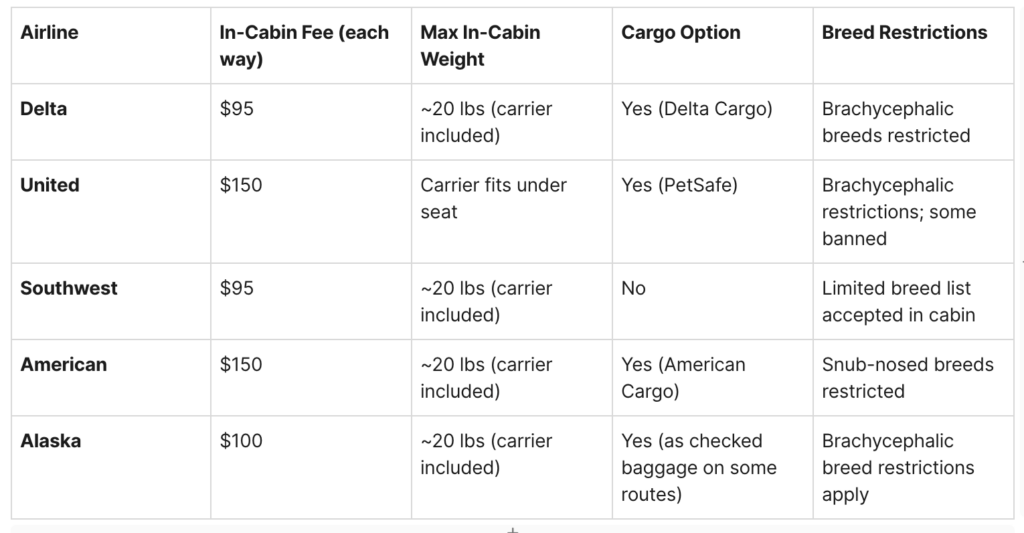
Book early. Most airlines allow only a handful of pets per flight — sometimes as few as four in the cabin. Spots fill fast, especially on popular routes and during holidays.
Reserve your pet’s spot the moment you book your own ticket, not as an afterthought.
Airline pet policies change, so always call the airline directly before finalizing plans. The website may be out of date.
When you speak to the airline, have these questions ready to cover every detail and avoid surprises:
- What are your current breed restrictions? Are there any additional rules for my dog’s breed?
- What is the maximum carrier size allowed for in-cabin pets on my specific flight?
- How many pets are allowed per cabin on each flight, and is there still space available?
- What are the weight or size limits for in-cabin travel?
- What paperwork or health certificates do you require?
- Are there any additional fees for bringing my dog, and how are they paid?
- If I have layovers, will the same rules apply on each flight, or do connecting flights have different requirements?
- What are the seasonal embargoes for pet travel in cargo or checked baggage?
- What is the current process for checking in with a pet?
Using a list of specific questions will help you feel assured and ready before booking.
Breed restrictions: Which dogs can’t fly
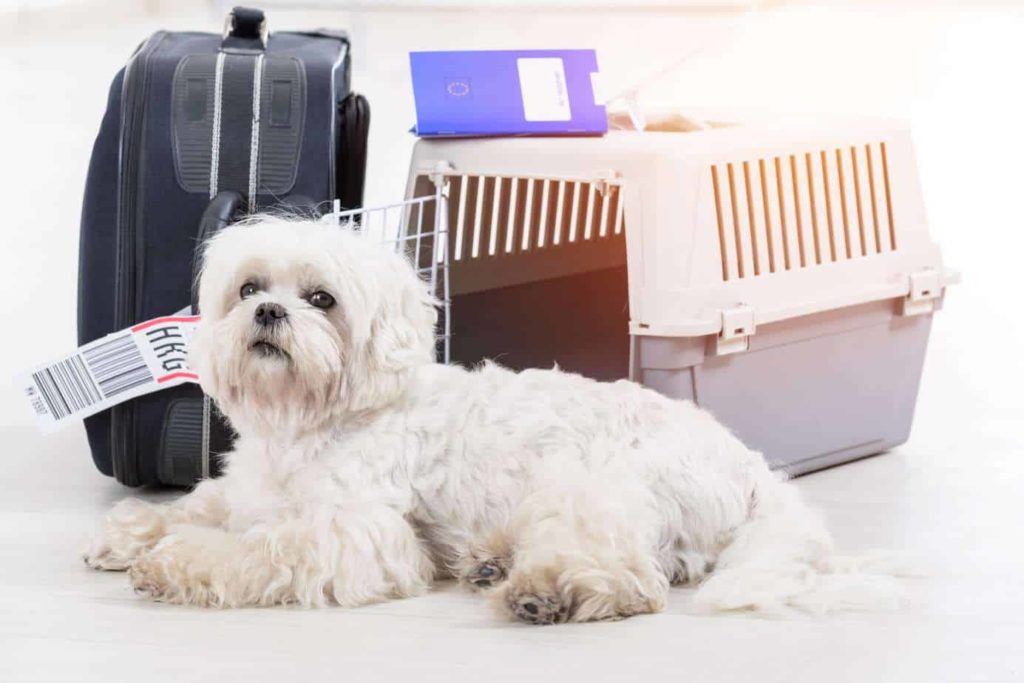
Breed restrictions are among the most important factors in airline pet policies and among the most overlooked.
Brachycephalic dogs — the flat-faced breeds — face the most significant restrictions.
Their shortened airways make them more vulnerable to respiratory distress, heat stress, and panic than other dogs.
Many airlines restrict or completely ban these breeds from cargo, and some also limit them in the cabin.
Commonly restricted brachycephalic breeds include:
- English Bulldogs and French Bulldogs
- Pugs
- Boston Terriers
- Shih Tzus
- Boxers
- Pekingese
- Bull Mastiffs
Warning: Brachycephalic breeds and cargo risk. Dogs with flat faces are at serious risk during cargo travel.
High stress, inadequate ventilation, or temperature fluctuations can quickly trigger respiratory distress.
Several airlines have had in-flight fatalities involving these breeds. If your dog is a brachycephalic breed, flying cargo should be considered a last resort — and only with direct guidance from your vet.
Beyond brachycephalic restrictions, some airlines ban specific breeds outright because of perceived aggression concerns, including certain large working and guarding breeds.
This varies by airline, so check your carrier’s specific list.
Health certificate requirements
A health certificate cannot be negotiated. It’s your dog’s proof of fitness to fly, and most airlines won’t let you board without one.
Officially called a Certificate of Veterinary Inspection (CVI), the health certificate must be issued by a licensed, USDA-accredited veterinarian.
Most airlines require it to be dated within 10 days of your departure date. If you have a connecting flight or multi-leg trip, the certificate must still be valid for the entire journey.
What the vet checks:
- Overall health and physical condition
- Current vaccination status, especially rabies
- No signs of respiratory illness, lameness, or disease
- Age eligibility (most airlines require dogs to be at least 8 weeks old)
- Weight, breed, and confirmation that the dog is fit for travel.
Costs typically run $50–$150, depending on your vet and location, and that’s on top of any standard exam fees.
Schedule the appointment strategically. Too early, and the certificate expires before your flight.
Most owners target the 7-day mark before departure, giving a small buffer without cutting it too close.
If you’re flying internationally, the requirements go much deeper. That country sets the exact rules for bringing a pet into another country and can change with little notice, so it’s vital to consult official sources before you make any plans.
Start by checking the USDA Animal and Plant Health Inspection Service (APHIS) Pet Travel website for up-to-date export requirements, and contact the embassy or consulate of your destination country to confirm current regulations and documentation.
Many countries also list pet import requirements on their official government or agricultural department websites. Relying solely on outdated online guides can lead to costly mistakes or travel delays.
Many countries require USDA endorsement of the health certificate, the vet’s signature, and proof of specific vaccines, microchipping, and sometimes blood titer tests showing adequate rabies antibody levels.
Some destinations require all of this to be completed months in advance. More on that below.
Approved in-cabin carriers
Flying with your dog in the cabin means living within some firm dimensional constraints. Every airline publishes maximum carrier dimensions, and the carrier must fit under the seat in front of you without being forced in.
Typical maximum dimensions are around 18 x 11 x 11 inches, though these vary by airline and even by aircraft type.
Measure twice. Some seat configurations have less under-seat space than others, and a carrier that works on one flight may not work on another.
Soft-sided vs. hard-sided:
Soft-sided carriers are almost always the better choice for in-cabin travel.
They compress slightly to fit snugly under the seat, they’re lighter, and they tend to be less intimidating for dogs than rigid plastic boxes.
Most airlines prefer or demand soft-sided carriers for in-cabin use.
Hard-sided carriers are typically reserved for cargo travel, where the rigid structure provides more protection during handling.
What to look for in a carrier:
- Enough interior space for your dog to stand, turn around, and lie down
- Ventilation mesh on at least two sides, ideally three
- A top-loading option in addition to a front door (easier for getting a reluctant dog in and out)
- Secure, reliable zippers
- A non-slip base
Introduce the carrier weeks before travel. Leave it open in your home with a comfortable blanket inside. Feed your dog near it. Let them sleep in it voluntarily.
A dog that sees the carrier as a safe, comfortable space before travel day will handle the journey much better than one encountering it for the first time at the airport.
Cargo crate requirements
If your dog is flying cargo, the crate is everything. Airlines won’t accept a dog in cargo without an IATA-compliant container, and the International Air Transport Association’s standards are specific.
IATA-compliant crates must:
- Be rigid and escape-proof, made of solid plastic, wood, or metal.
- Have ventilation on at least three sides for domestic travel and four sides for international travel.
- Have a secure locking mechanism that can’t be opened accidentally but can be accessed for emergencies.
- Be large enough for your dog to stand at full height without touching the top, turn around completely, and lie down in a natural position.
- Include a water and food dish accessible from outside the crate.
- Be labeled with live animal markings on the outside, plus your contact information and your dog’s name.
Line the bottom with absorbent bedding. Include a familiar item — a worn t-shirt or a favorite toy — to give your dog something that smells like home.
Freeze a small dish of water the night before and place it in the crate: it won’t spill during loading, and it’ll be available as drinking water once your dog is settled.
Book direct flights whenever possible. Every layover is an additional stress point, an additional transfer, and an additional opportunity for something to go wrong.
Managing dog travel anxiety on a plane
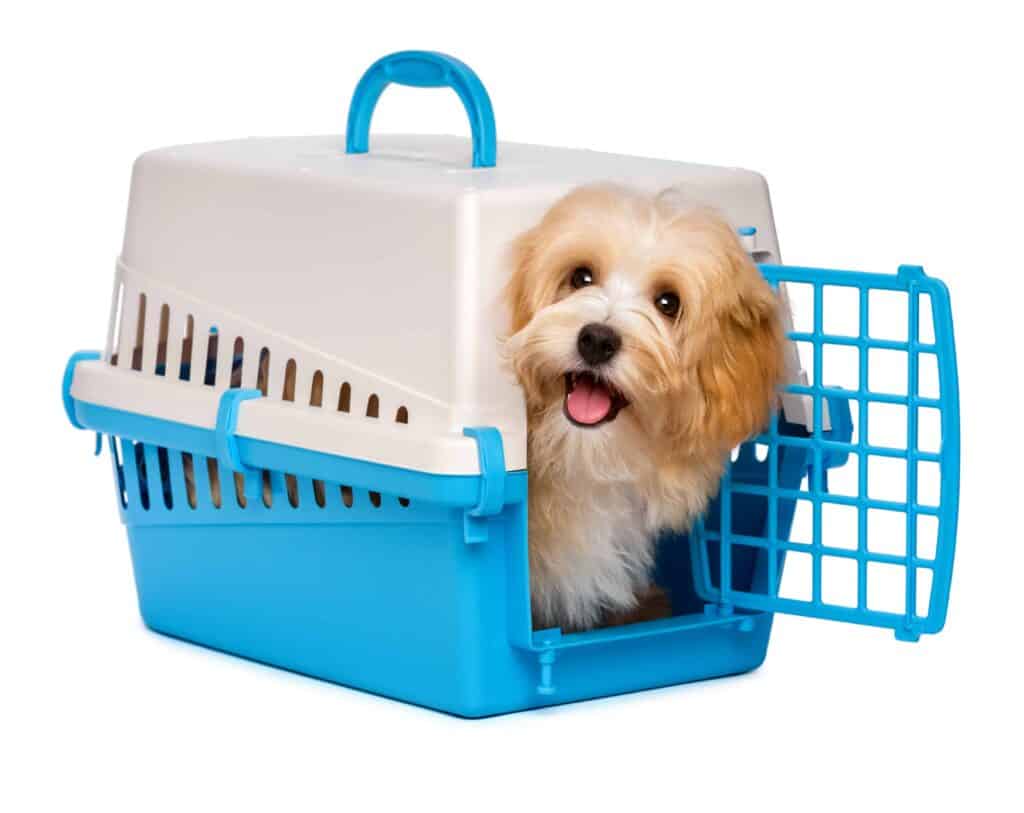
Dog travel anxiety is real, and for some dogs it’s significant. The combination of unfamiliar smells, loud noises, close quarters, and motion is a lot to process.
Desensitization starts at home. Weeks before the flight, work on carrier training and gradually expose your dog to the sounds and sensations of travel.
Play recordings of airplane cabin noise at low volume while your dog eats or rests. Practice car trips with the carrier secured. Make the carrier a place your dog chooses to go to on its own.
Calming supplements can take the edge off for mildly anxious dogs. Options worth discussing with your vet include:
- Calming chews containing L-theanine, chamomile, or melatonin.
- Pheromone sprays (such as Adaptil) are applied to the carrier’s bedding before travel.
- Anxiety wraps like a Thundershirt, which applies gentle, constant pressure.
Vet-prescribed options are available for dogs with moderate to severe travel anxiety.
Trazodone and gabapentin are routinely prescribed and considered safer for travel than traditional sedatives, which can dangerously affect a dog’s ability to manage balance and breathing at altitude.
Whatever you plan to use on travel day, test it at home first. You don’t want to discover your dog reacts unusually to a new supplement at 30,000 feet.
Bring along your dog’s favorite toy, blanket, or an item that smells like home—known scents and objects can have a powerful calming effect in stressful environments.
You can also tuck a worn T-shirt of yours into their carrier or crate to surround them with your scent. Some dogs find comfort in a favorite chew or plush toy, so adding those to the carrier can help keep their anxiety down.
Planning with these simple strategies gives your dog extra reassurance during the journey.
Day-of travel tips
Feeding: Give your dog a light meal four to six hours before departure. A full stomach plus travel anxiety is a recipe for motion sickness, and dealing with a sick dog in an airplane bathroom is as bad as it sounds. Hold off on food in the immediate hours before the flight.
Water: Keep your dog hydrated. Offer water before you enter the airport and during any layovers. A collapsible travel bowl clips easily to most carriers.
Potty break timing: Walk your dog immediately before entering the terminal. Most airports don’t have designated pet relief areas inside security, so the pre-terminal walk matters.
Know your airport: Some larger ones do have post-security pet relief spots, but don’t count on it.
At security, your dog comes out of the carrier. The carrier goes through the X-ray machine. You carry your dog through the metal detector. Have a harness on your dog and a leash in your hand the moment they’re out of the carrier. Don’t set them down. Airports are loud, crowded, and full of distractions.
Arrive early. Traveling with a dog adds time to every step. Security takes longer. Gate agents need to see your documentation. Give yourself at least 30–45 minutes beyond your usual arrival time at the airport.
On the plane: Keep the carrier zipped. Your dog’s voice will tell you how they’re doing, and your calm, steady voice through the carrier door is the most effective tool you have. Don’t keep opening the carrier to check — every zip is another disruption.
International travel: The extra steps
Domestic air travel with a dog is manageable. International travel with a dog is a project.
Every destination country has its own pet import requirements, which vary widely. Some require:
- USDA endorsement of the health certificate (beyond the vet’s signature alone)
- Microchipping compliant with ISO standard 11784/11785
- Proof of rabies vaccination, sometimes with designated timing requirements
- Rabies titer blood tests showing sufficient antibody levels
- Specific parasite treatments are administered within a set window before arrival.
- An import permit obtained in advance
Some of these requirements have months-long timelines. Starting the process six months before an international trip with your dog isn’t excessive — it’s appropriate.
Research the destination country’s pet import requirements as the very first step in your planning, before you book flights or accommodations. Your vet should be USDA-accredited to sign off on international travel documents. Not all vets are.
Certain destinations — Hawaii, Australia, New Zealand, the UK, Japan — have particularly stringent rules, including quarantine periods that can last weeks. Know what you’re committing to before you go.
When NOT to fly with your dog
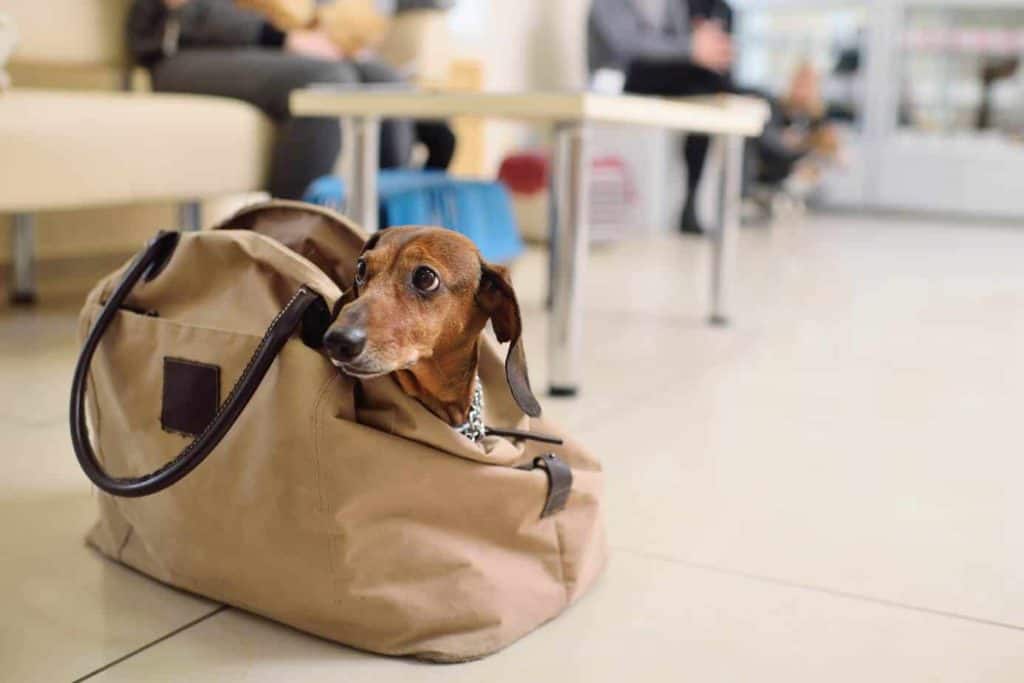
Sometimes the right answer is not flying. Knowing when to leave your dog in a trusted pet sitter’s care, book a reputable boarding facility, or arrange ground transport is part of being a responsible dog owner.
If air travel isn’t the best fit for your dog, consider professional pet sitters who provide one-on-one attention in your home, reliable boarding kennels staffed by experienced professionals, or pet transport companies that offer safe travel by car or train.
Exploring these alternatives can help you choose the option that’s best for your dog’s well-being.
Think twice about flying your dog if:
- Your dog has a pre-existing heart or respiratory condition. Altitude, stress, and reduced oxygen availability are real concerns.
- Your dog is very old or very young. Senior dogs and puppies under 8 weeks old handle travel stress differently than healthy adult dogs.
- Your dog is a brachycephalic breed and needs to travel in the cargo area. The risk is serious and documented.
- It’s summer or winter. Extreme heat and cold are dangerous for dogs in cargo, and airlines frequently suspend pet cargo service when temperatures at departure, connection, or arrival cities exceed safety limits.
- Your dog has shown extreme anxiety in any previous travel or vet situation. If your dog panics at the vet, a plane is likely to be worse.
- Your dog is in heat. Many airlines won’t accept female dogs in heat for cargo travel.
There’s no shame in deciding your dog would be better off at home. The most important thing is making the right call for your specific dog, not just for the convenience of the trip.
The bottom line on flying with your dog
Flying with your dog in the cabin is genuinely doable for most small dogs with the right prep and paperwork. Cargo travel is manageable for healthy, larger dogs when the planning is thorough. Neither is something to wing.
The airline pet policy landscape is complicated, it changes, and the stakes are high when you get it wrong.
Start early, call your airline directly, visit your vet well ahead of your departure date, and build the trip around what’s actually right for your dog — not just what’s most convenient for you.
Your dog is counting on you to get this right. You’ve got more than enough here to do exactly that.
Airline policies for dogs change more often than most people realize — and getting it wrong can mean your dog gets left at the gate.
Before you book, there’s a lot to sort out: whether your dog can fly in the cabin or has to go cargo, which breeds get restricted or banned outright, what paperwork your vet needs to sign off on, and how to actually keep your dog calm through all of it.
Sara B. Hansen has spent 20-plus years as a professional editor and writer. She’s also the author of The Complete Guide to Cocker Spaniels. She created her dream job by launching DogsBestLife.com in 2011. Sara grew up with family dogs, and since she bought her first house, she’s had a furry companion or two to help make it a home. She shares her heart and home with Nutmeg, a Pembroke Welsh Corgi. Her previous dogs: Sydney (September 2008-April 2020), Finley (November 1993-January 2008), and Browning (May 1993-November 2007). You can reach Sara @ editor@dogsbestlife.com.