
Dog vaccines: What every new owner must know to stay safe
You got a puppy. Now what? Vaccines sit near the top of your to-do list, right next to picking a vet and finding the squeakiest toy on the shelf.
They’re not optional for the core stuff, and they’re not one-size-fits-all, either.
Let’s break it all down so you know exactly what your dog needs, when to get it, and how much it’s going to cost.
Core dog vaccines

Think of core vaccines as your dog’s non-negotiables. The American Animal Hospital Association (AAHA) recommends them for every dog, regardless of lifestyle, unless a specific medical reason rules them out.
Skip these, and your dog faces diseases that can kill fast.
Canine distemper virus
Distemper is one of the most severe and contagious diseases dogs face. It doesn’t just affect dogs; raccoons, skunks, and other wildlife carry it, too. It spreads through sneezing and shared food or water bowls, making any dog park or shelter a potential exposure zone.
Infected dogs show eye and nose discharge, vomiting, diarrhea, twitching, seizures, and paralysis. The scary part? There’s no cure. Vaccination is your dog’s only real defense.
Canine parvovirus
Parvo is brutal. It attacks the digestive system and hits puppies under four months especially hard. The virus causes bloody diarrhea, vomiting, fever, and severe dehydration.
Most dogs who die from parvo die because their bodies can’t replace fluids fast enough. Again — no cure exists. Repeated vaccination builds the immunity that keeps it at bay.
Canine adenovirus-2 (infectious hepatitis)
This one targets the kidneys, liver, lungs, spleen, and eyes. Dogs with infectious hepatitis show vomiting, jaundice, belly pain, and an extended abdomen. No treatment exists, so your vet’s best tool — and yours — is prevention through vaccination.
Rabies virus
Rabies needs no introduction. It’s zoonotic — it can jump from animals to humans — and in most places, vaccinating your dog against it isn’t just a good idea. It’s the law. Beyond legal protection, it matters if your dog bites someone. An up-to-date rabies vaccine keeps you both out of trouble.
Leptospirosis
Lepto used to sit in the non-core column. Not anymore. AAHA’s 2024 update to the 2022 Canine Vaccination Guidelines elevated leptospirosis to core status for all dogs because the disease is spreading and nearly any dog that goes outside is at risk.
It transmits through water or soil contaminated with infected wildlife urine — puddles, ponds, even your backyard.
In dogs, it causes kidney and liver failure. In humans, it triggers fever, chills, headaches, jaundice, rashes, and in severe cases, meningitis. Ask your vet about adding lepto to your dog’s core vaccination schedule if it isn’t already included.
Non-core (lifestyle) vaccines

These aren’t for every dog. They’re for your dog — based on where you live, how you travel, and how social your pup is. A city apartment dog has different risks than a farm dog. Talk to your vet, and don’t dismiss these without a conversation first.
Lyme disease — Essential if you’re in tick country
Kennel cough (Bordetella) — Required by most boarding facilities and groomers
Canine influenza — Recommended for dogs who compete, travel, or board frequently
Canine parainfluenza — Often included in combo vaccines
Canine Coronavirus (CCoV) — A highly contagious intestinal infection, especially dangerous for puppies. Not the same as COVID-19.
One heads-up: for some non-core vaccines — like Lyme — in regions where the disease is endemic, your vet may treat them as effectively core. Geographic risk matters.
Work with your veterinarian to reassess your dog’s needs at least once a year.
Puppy vaccination schedule

The puppy series starts at 6–8 weeks of age — that’s when maternal immunity starts to fade, and your puppy’s own immune system needs to take over.
Miss that window, and you leave your pup exposed during one of the most vulnerable stretches of their life.
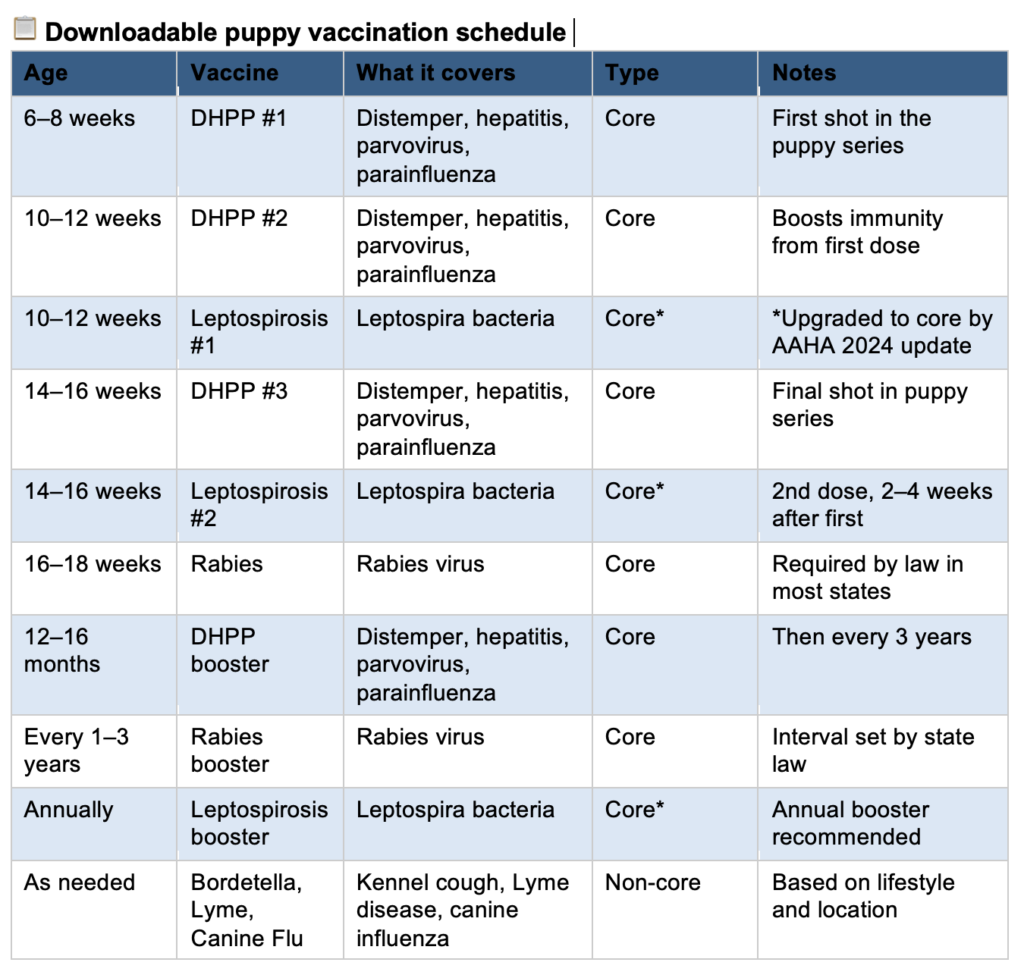
Print this table and bring it to every vet visit.
Why the series starts at 6–8 weeks
When a puppy is born, mom’s antibodies provide temporary protection — but only for so long. This passive immunity transfers through the placenta during pregnancy and through colostrum (the first milk) after birth. It’s a short-term loan, not a long-term solution.
That maternal immunity typically disappears around 12 weeks of age. The puppy series is timed to bridge the gap — starting at 6–8 weeks and running through 16–18 weeks — so your pup is never left unprotected.
That’s why finishing the full series matters. One shot isn’t enough.
Herd immunity: It’s not just about your dog
Vaccines don’t just protect your dog. They protect the whole community of dogs around them. When enough pets are vaccinated, diseases can’t find enough hosts to spread — that’s herd immunity doing its job.
Skip your dog’s vaccines, and you’re not just rolling the dice on their health. An unvaccinated dog that contracts a disease can pass it to other unvaccinated animals. Vaccination is a community responsibility, not just a personal one. Read more about the anti-vaccination debate and what the science says.
Common side effects of dog vaccines
Most dogs sail through vaccination with nothing more than mild, short-lived symptoms. A little sluggishness? Totally normal. Here’s what to expect and what to watch for.
Common mild side effects (usually resolve within 24–48 hours)
- Mild fever in the first 24–48 hours
- Sluggishness or low energy
- Vomiting or diarrhea
- Loss of appetite
- Swelling or tenderness near the injection site
Rare but serious reactions — contact your vet immediately
- Facial or paw swelling
- Anaphylaxis (severe allergic reaction — collapse, difficulty breathing)
Some dogs are allergic to specific vaccine ingredients, but you won’t know until it happens. Keep your pup at the clinic for 15–20 minutes after the shot — most serious reactions occur quickly.
If anything feels off once you’re home, call your vet. Don’t wait and see with anaphylaxis.

The following adverse reactions are rare.
- Facial or paw swelling (allergic reaction)
- Anaphylactic
Most mild symptoms go away naturally within 2 days. If you think your dog might be suffering from a more severe reaction, contact your veterinarian as soon as possible.
What’s actually in dog vaccines?
Some vaccines contain adjuvants — substances like aluminum salts that help boost immune response.
Others historically contained thimerosal (a mercury-based preservative) or formaldehyde used in the manufacturing process. These ingredients spark concern, and it’s worth discussing them with your vet.
Modern vaccines are safer and more refined than older formulations. Many thimerosal-free versions exist.
Ask your vet which specific vaccines they use and why — a good vet will welcome the conversation. The goal is always to choose a vaccine that offers protection with the lowest possible risk.
How much do dog vaccines cost?
This is one of the most common questions pet owners search for — and understandably so. Vaccine costs vary based on where you live, the type of clinic you use, and which vaccines your dog needs.
Here’s the honest breakdown.
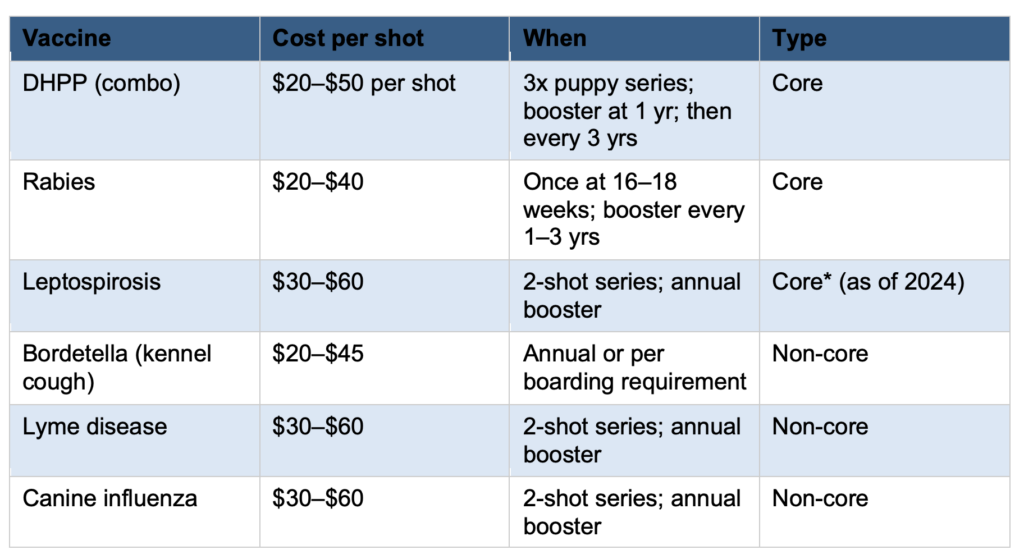
First year total: Expect to spend $100–$350 for your puppy’s complete first-year vaccination series, including the multi-shot DHPP series, rabies, and leptospirosis, plus your wellness exam fees ($30–$50). Urban areas typically run 30–50% higher than rural ones.
Annual adult costs: After the first year, costs drop significantly. Budget $80–$250 annually for boosters, depending on which vaccines are due that year and your dog’s lifestyle needs.
Ways to reduce costs:
Ask about puppy vaccine packages — many clinics bundle the series at a discount
Low-cost clinics and shelter-affiliated vaccination events often charge significantly less than private practices
Pet insurance wellness add-ons can offset $30–$80 in vaccine costs annually
If you adopted from a shelter, the puppy’s series may already be started — ask for records before paying for duplicate shots
Want to compare prices in your area? Tools like GoodRx for Pets let you search local vet pricing. Some big-box pet stores also offer low-cost vaccine clinics on weekends.
Keep your dog up to date
Vaccination isn’t a one-and-done situation. Immunity fades. Boosters keep it strong. Here’s the short version:
- DHPP: Booster at 12–16 months, then every 3 years
- Rabies: Booster timing depends on your state law — every 1 or 3 years
- Leptospirosis: Annual booster
- Bordetella, Lyme, Canine Flu: Annual, if your dog needs them
Dogs who frequent dog parks, boarding facilities, or travel with you face higher exposure risks. Their schedules may need more attention. Work with your vet to build a plan that actually fits your dog’s life — not just a generic one-size-fits-all schedule.
Some vets now offer titer testing — blood tests that measure existing immunity — as an alternative to automatic re-vaccination. Note: titer tests aren’t legally accepted as a substitute for rabies vaccines in most states.
The bottom line on dog vaccines
The core vaccines aren’t optional — they protect against diseases that are painful, fast-moving, and often fatal. The non-core vaccines? They might be just as important for your dog specifically, depending on where you live and how you both spend your time.
Your vet is your best resource for building the right plan. Talk to them. Ask the questions. Bring the records. And if you’re just getting started — welcome to dog parenthood. Starting the puppy series at 6–8 weeks is one of the best things you’ll ever do for your new best friend.
With a Ph.D. in veterinary oncology, Cristina Vulpe is a lifelong lover of pets. She’s passionate about infectious diseases, animal welfare, nutrition, and pathology. She manages a cat blog, My Feline Buddy, where she advises on preventing and treating feline diseases.