
Indoor cooling for dogs: Use 10 simple solutions to create a comfortable home
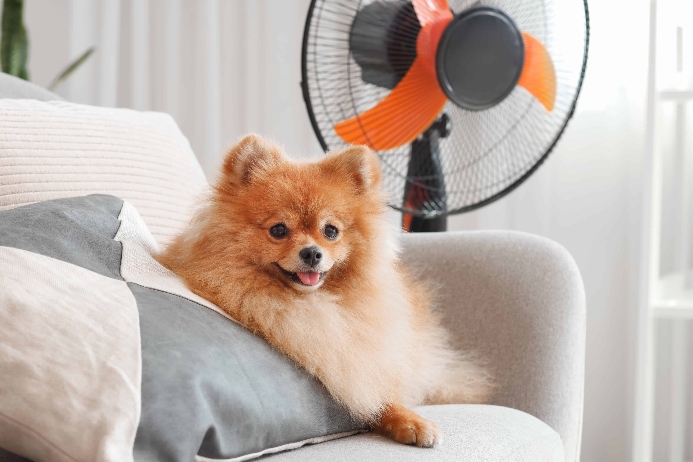
Your dog wears a fur coat in July. He can’t take it off.
And if you’re living in an apartment or a house without a yard, there’s no kiddie pool to splash in, no shady trail to escape to.
Just four walls, rising temperatures, and a panting dog staring at you like you have all the answers.
The good news? You do know the secrets to indoor cooling for dogs.
Keeping a dog cool indoors isn’t complicated, but it does require more than a bowl of water and good intentions.
Here’s what actually works: using A/C or strategic fan placement to control the temperature, trying simple DIY cooling hacks such as wet towels or frozen treats, and understanding how to make your space comfortable for your dog.
How dogs regulate body heat (and why they’re terrible at it)
- How dogs regulate body heat (and why they’re terrible at it)
- What’s the right indoor temperature for dogs
- A/C tips and fan placement for dogs
- DIY cooling mats and frozen treats
- Cooling vests: do they work?
- Brachycephalic breeds: they need extra help
- Signs of heat stress vs. heat stroke
- The cool room strategy for apartment dogs
- One last thought on indoor cooling for dogs
Dogs don’t sweat the way humans do. Their sweat glands are mostly in their paw pads, which does almost nothing to cool their core body temperature. Instead, they rely on panting.
Every rapid breath pushes hot air out and draws in cooler air, helping evaporate moisture from their tongue and upper respiratory tract.
It’s an inefficient system. A human can shed heat across their entire skin surface. A dog has to do it through their mouth.
When the ambient temperature climbs high enough, or the humidity becomes thick enough to slow evaporation, panting stops working well. That’s when things get dangerous fast.
Think of it like a car radiator that only has half the cooling capacity it needs. It works fine under normal conditions, but push it too hard and the whole engine overheats.
What’s the right indoor temperature for dogs
Most dogs are comfortable between 68°F and 78°F (20°C to 26°C).
Below that range, smaller dogs and short-coated breeds may feel chilly.
Above it, the risk of heat stress starts to climb, especially when exercise or excitement is layered on top.
A few things that tilt the scale:
- Breed and coat type. A Siberian Husky has a higher heat tolerance threshold than a French Bulldog, but that doesn’t mean huskies thrive in 85°F rooms. Double-coated breeds actually insulate in both directions, which helps somewhat. Flat-faced breeds (more on those shortly) hit their ceiling much earlier than other dogs.
- Age. Puppies and senior dogs regulate temperature less efficiently. They need the cooler end of that range.
- Activity level. A dog who just tore around chasing a toy generates internal heat. Factor that in.
- Body weight. Dogs that weigh too much have more insulating fat and less efficient cardiovascular systems. They overheat more easily.
If your home regularly sits above 80°F, it’s time to take active steps.
A/C tips and fan placement for dogs
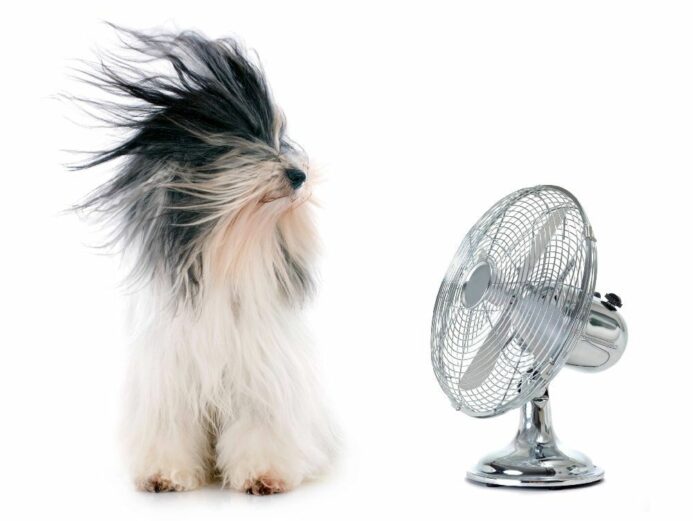
Central air conditioning is the gold standard for indoor cooling for dogs. If you have it, keep the thermostat set no higher than 78°F when your dog is home.
If you’re leaving for the day, don’t shut the A/C off to save money. A dog locked in a 90°F apartment for eight hours is in serious danger. The vet bill will cost more than the electricity.
For window unit users: Position the unit in the room where your dog spends the most time. Dogs don’t benefit from cold air on the far side of the house. If you have a single unit, close doors to concentrate the cool air in one space.
Fans matter, but not in the way you think. A fan blowing on a sweaty person feels amazing because it accelerates evaporation. Dogs don’t sweat through their skin, so a fan alone won’t cool them down the same way. What fans do help with is air circulation, which prevents hot pockets from forming in corners and keeps the room temperature more even. Point fans to push hot air out of windows (exhausting toward the outside), not just to circulate warm air around the room.
As for fan safety: It’s generally safe to leave fans running while your dog is home, as long as you use sturdy fans that are difficult to tip over and keep cords out of chewing range. Avoid placing fans on unstable surfaces, and consider using models with auto-shutoff features for added peace of mind.
Box fans in lower windows pull in cooler air from outside during the early morning hours when temps drop. Once the outdoor temperature exceeds your indoor temp, close the windows and switch to A/C or recirculating air.
DIY cooling mats and frozen treats
Cooling mats
Commercial cooling mats work well, but you don’t need to spend $60 to give your dog relief. Here’s what works at home:
The wet towel method. Soak a towel in cool (not ice-cold) water, wring it out so it’s damp but not dripping, and lay it flat on the floor. Many dogs will seek it out on their own. Refresh it every hour or two as it dries and warms.
The DIY gel mat. Freeze a zip-lock bag filled with water and a little dish soap (the soap keeps it pliable when frozen). Wrap it in a thin towel and place it on the dog’s bed or favorite resting spot. The soap-water mixture stays flexible instead of becoming a solid block of ice, so it conforms to your dog’s body. For dogs who are strong chewers or like to gnaw on things, always supervise when using DIY gel mats. This prevents any accidental ingestion of soap or plastic, and helps reassure safety-conscious owners.
The tile trick. Bare tile and hardwood floors are naturally cooler than carpet. If your dog gravitates to the bathroom or kitchen floor in summer, that’s not a coincidence. Clear a space and let them sprawl.
Frozen treats
Frozen treats work on two levels: they provide internal cooling, and they give your dog mental stimulation. Win-win.
Simple frozen broth cubes. Pour low-sodium chicken or beef broth into an ice cube tray. Freeze and serve. That’s it. Most dogs go absolutely wild for these.
The frozen Kong. Stuff a Kong toy with a combination of peanut butter (xylitol-free), plain yogurt, and banana chunks. Freeze overnight. This keeps a dog occupied for 20 to 30 minutes while also cooling them from the inside.
Watermelon pops. Blend seedless watermelon (no rind), pour into silicone molds or an ice cube tray, freeze. Watermelon is about 92% water and naturally low in calories. For more ideas on safe summer foods and frozen treat recipes, check out the DogsBestLife.com nutrition guide.
Avoid giving ice cubes in large quantities to very small dogs or dogs prone to bloat, and always make sure frozen treats are sized appropriately for your dog. Bloat (also called gastric torsion or GDV) is a serious condition where the stomach fills with gas and can twist, making it life-threatening and more common in deep-chested breeds like Great Danes, Boxers, and Standard Poodles. For these dogs, swallowing too much air or eating treats too quickly may increase the risk.
Cooling vests: do they work?
Yes, but with caveats.
Cooling vests work through evaporative cooling: you soak them in water, and the water’s evaporation cools your dog’s body.
They’re most effective in low-humidity places where evaporation happens quickly. In high humidity (think Gulf Coast in August), they’re less effective because the moisture doesn’t evaporate as fast.
What to look for:
- Evaporative designs (soaked in water before use) outperform passive cooling vests for most dogs.
- Look for vests with good coverage over the chest and back.
- Fit matters: too loose and it shifts around; too tight and it restricts breathing
- Reflective materials help by bouncing radiant heat away
Top-rated options include the Ruffwear Swamp Cooler, the Hurtta Cooling Vest, and the Canine Cooler vest. When choosing a cooling vest, look for options that are appropriately sized and adjustable for your dog’s body. For smaller or slim breeds, pick a vest that fits tightly without limiting movement.
Large or deep-chested dogs benefit from vests with wrap-around coverage and secure fastenings. If your dog has a thick coat, choose a vest that sits close to the body for better cooling contact, while short-coated dogs may do well with lighter-weight vests.
For highly active dogs, opt for a vest that allows full range of motion and dries quickly after soaking. These top-rated vests are worth the investment if you live somewhere consistently hot or if you exercise your dog outdoors during summer.
One important note: cooling vests are supplements, not substitutes for shade and water. They don’t replace a cool environment.
Brachycephalic breeds: they need extra help
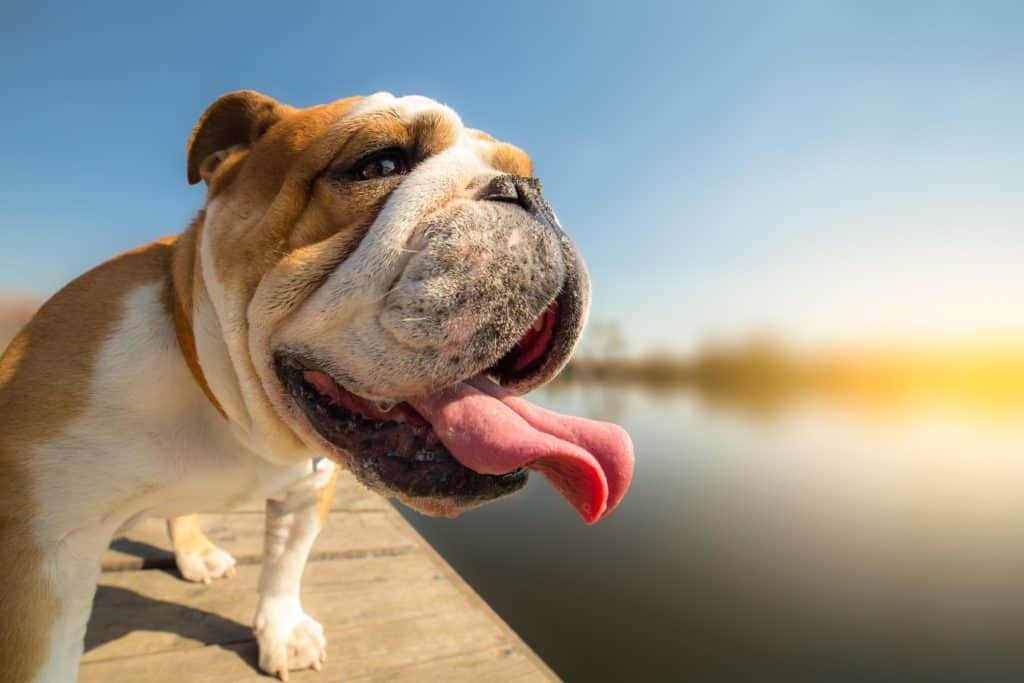
If you have a flat-faced dog, the standard advice isn’t enough. Brachycephalic breeds, including Bulldogs, Pugs, French Bulldogs, Boston Terriers, Shih Tzus, Boxers, and Cavalier King Charles Spaniels, have anatomical features that make panting significantly less efficient.
Their shortened airways, narrowed nostrils, and elongated soft palates mean they move less air with each breath. In plain terms: their cooling engine is already running at reduced capacity on a cool day. On a hot day, they’re fighting uphill the whole time.
For brachycephalic dogs specifically:
- Keep indoor temps at or below 75°F, not 78°F
- Never leave them in a car, even for two minutes.
- Avoid exercise during the warmest parts of the day entirely.
- Watch for signs of distress at temperatures that would be comfortable for other dogs.
- Talk to your vet about whether your dog is a candidate for corrective surgery to improve airflow (many brachycephalic dogs gain considerable advantage from it)
These breeds also tend to be loud breathers at baseline, making it harder to notice when their breathing becomes labored. If they seem quieter than usual, that can actually be a warning sign of exhaustion rather than calm.
Signs of heat stress vs. heat stroke
Knowing the difference can save your dog’s life.
Heat stress is early-stage overheating. Signs include:
- Heavy, rapid panting
- Excessive drooling
- Restlessness or seeking cool surfaces
- Bright red gums
- Mild lethargy
At this stage, move your dog to a cool area, offer fresh water, apply a damp towel to their neck, armpits, and groin, and let them rest. Most dogs recover quickly from mild heat stress with these steps.
Heat stroke is a medical emergency. Signs include:
- Panting that doesn’t slow with rest or cooling attempts.
- Vomiting or diarrhea (sometimes bloody)
- Stumbling, weakness, or collapse
- Glazed eyes
- Gums that are dark red, gray, or blue
- Seizures or loss of consciousness
If you see these signs, start cooling your dog immediately with cool (not ice-cold) water and get to an emergency vet without delay. Do not wait to see if they improve on their own. Heat stroke causes organ damage and can be fatal within minutes to hours.
If you suspect heat stroke, move your dog to a cool area, offer cool water, wet them with cool (not ice-cold) water, and get to an emergency vet immediately.
For a complete breakdown of what to do in a heat emergency, read our guide on detecting and managing heatstroke in dogs.
The cool room strategy for apartment dogs
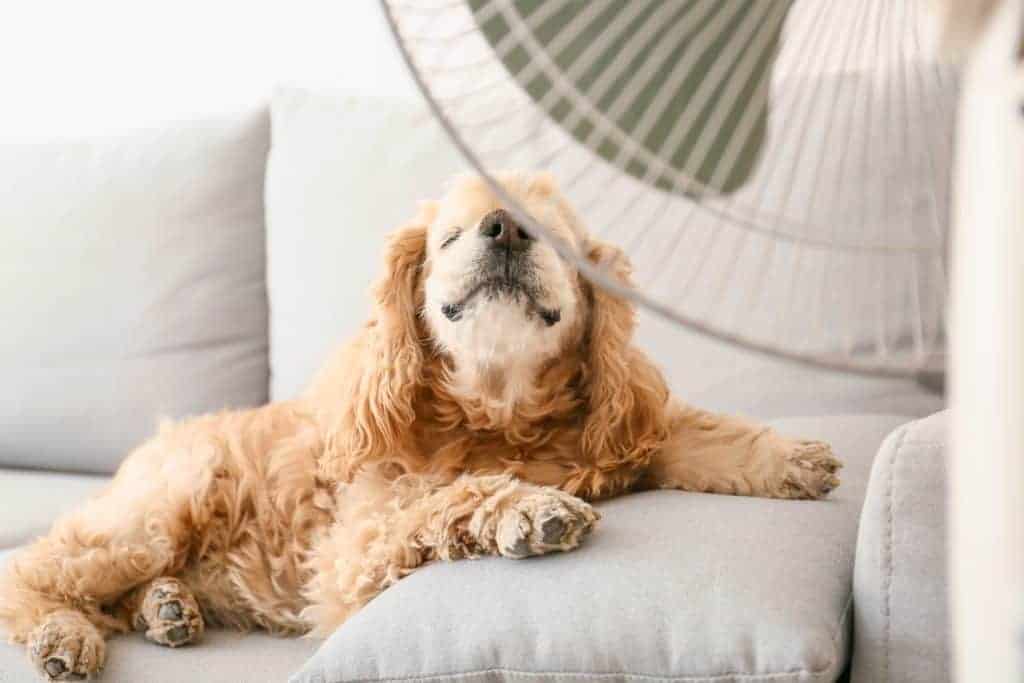
No yard. No pool. One A/C window unit. Sound familiar?
The cool room strategy is simple: pick one room in your apartment, make it as cool as possible, and keep your dog there during peak heat hours.
Here’s how to set it up:
Choose the right room. North-facing rooms stay cooler than south or west-facing ones. Interior rooms without windows get less radiant heat from direct sun. The bathroom, ironically, is often one of the coolest rooms in an apartment.
Block the sun. Blackout curtains are genuinely one of the most effective and underrated heat-reduction tools. Direct sunlight through a window can raise a room’s temperature by 10 to 20 degrees. Block it.
Seal the room. Close doors to rooms you’re not cooling. Concentrate the cold air. A window unit trying to cool an entire apartment is a losing battle. One closed-off room? That it can handle.
Layer the cooling. Combine your A/C or fan with a cooling mat on the floor, a frozen treat once or twice a day, and fresh cold water available at all times. Cooling works best in layers.
Keep water cold longer. Add ice cubes to your dog’s water bowl. Consider a pet water fountain, which keeps water moving and slightly cooler than a static bowl. Some dogs drink more when water is moving, which matters because hydration is part of the cooling equation.
One last thought on indoor cooling for dogs
Summer heat is serious. It’s one of the leading causes of preventable dog deaths in the U.S. every year. But “serious” doesn’t have to mean complicated.
A cool room, some frozen broth cubes, a damp towel, and an A/C unit set to 76°F covers most of what your dog needs.
The dogs counting on you don’t need a pool or a trail. They just need someone paying attention. That’s you.
Sara B. Hansen has spent 20-plus years as a professional editor and writer. She’s also the author of The Complete Guide to Cocker Spaniels. She created her dream job by launching DogsBestLife.com in 2011. Sara grew up with family dogs, and since she bought her first house, she’s had a furry companion or two to help make it a home. She shares her heart and home with Nutmeg, a Pembroke Welsh Corgi. Her previous dogs: Sydney (September 2008-April 2020), Finley (November 1993-January 2008), and Browning (May 1993-November 2007). You can reach Sara @ editor@dogsbestlife.com.