
How to train your dog to come running every single time you call

Your dog bolts when called. You shout their name; they glance back, then keep running. Sound familiar?
Many dog owners know that powerless feeling: one moment your dog is by your side, the next, they’re a shrinking dot, ignoring you. It’s embarrassing and terrifying, and it makes you question your bond.
But here’s the good news: you are far from alone in this experience, and it is absolutely something that can be improved.
Countless dog owners have been right where you are, and there are proven ways to turn things around.
A bad recall isn’t a personality flaw in your dog, and it’s not a failure on your part as an owner.
It’s a training gap—and you can fix training gaps. At any age. With any dog.
Why recall training is important
- Why recall training is important
- Common dog personality types and recall challenges
- Foundation training: Building a strong recall command
- Techniques for effective recall training
- Distraction proofing: Training your dog in several environments
- Common mistakes to avoid during dog recall training
- Emergency recall: Train for high-pressure situations
- Tips for steady consistency and patience
- Troubleshooting FAQ: Common recall problems and quick fixes
- Maintaining recall skills over time
A dog who won’t come when called isn’t just inconvenient—one misstep could mean tragedy.
Recall is the most important skill your dog will learn.
Think about it this way: every other command you teach your dog is a nice-to-have. Sit? Useful. Stay? Great.
But “come”? That’s the one that can pull your dog back from danger in real time. It’s your emergency override button.
Recall is often mishandled—not from lack of trying, but from incorrect training, frustration, and then giving up.
You deserve better than that. So does your dog.
Common dog personality types and recall challenges
Not all dogs struggle with recall for the same reason—and understanding your dog’s personality type can make your training approach far more effective.
Hounds (Beagles, Basset Hounds, Bloodhounds) are nose-first animals—when a scent trail fires up their brain, you cease to exist.
Use the highest-value rewards you can find (think cheese, hot dogs, salmon bites), work in low-distraction environments longer than feels necessary, and never trust a hound off-leash until recall is truly bombproof.
Retrievers and Labradors are eager to please but are easily distracted. Their strong food drive makes reward training effective. Keep sessions short and game-like.
Herding breeds (Border Collies, Australian Shepherds, Cattle Dogs) may respond well when calm but struggle when excited. Start in quiet settings, like a fenced yard, and slowly add distractions while keeping recall playful.
Terriers are independent thinkers bred to make their own decisions — they’re not being defiant, they’re doing exactly what centuries of breeding designed them to do. Short sessions, high-value rewards, and consistency matter more with this group than almost any other.
Shy or anxious dogs need recall to feel completely safe. Keep your body language open and inviting, crouch down when calling them, and never rush toward them when they arrive. Patience and gentleness are your most powerful tools.
Whatever your dog’s personality, the core principles remain the same: make yourself rewarding, be consistent, and meet your dog where they are — not where you wish they were.
Foundation training: Building a strong recall command
Before you can fix a recall, you have to understand why it breaks.
Dogs don’t come when called because everything else in the environment is more interesting than you — the squirrel, the other dog, the smell in the grass.
You’re competing with the entire sensory universe.

The foundation is simple: make yourself the most rewarding thing in your dog’s world when you say that word. Every. Single. Time.
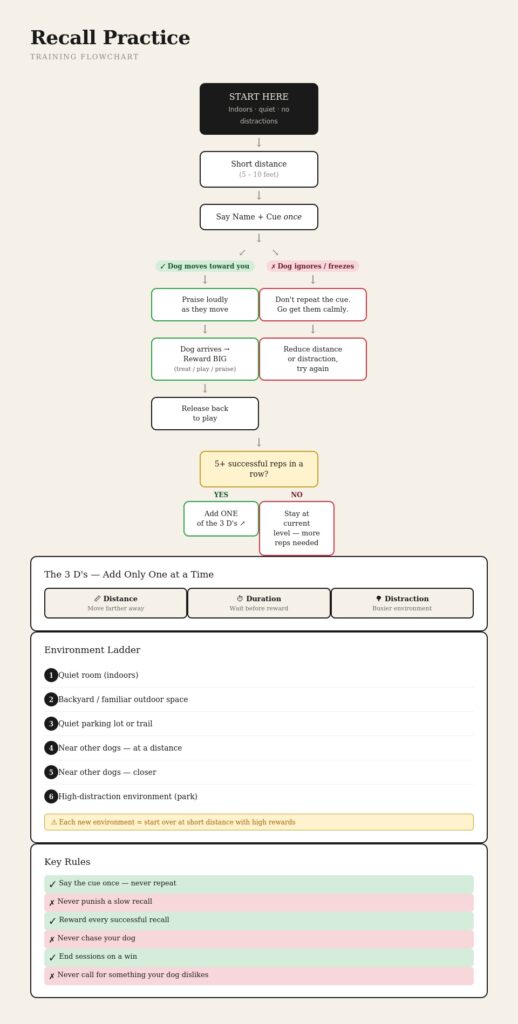
Start indoors. If your dog won’t come reliably inside, they won’t come outside. Pick one word and use it only for recall. Here’s the sequence:
1. Choose a quiet, distraction-free room.
2. Stand just a few feet away.
3. Say your dog’s name to get their attention, then give the recall word once in an upbeat tone.
4. As soon as your dog moves toward you, encourage them with enthusiastic praise to help them continue coming.
5. The second they reach you, reward immediately with a high-value treat, praise, or a favorite toy.
6. Let them return to what they were doing and repeat a few times
Keep sessions brief and positive. A handful of repetitions daily is plenty. Say the word once, mean it, and when your dog responds, lose your mind in excitement.
You’re not just rewarding obedience; you’re building a conditioned emotional response. That you should feel as good for your dog as the word “vacation” feels to you.
Never punish a dog who comes to you slowly. If you scold them for coming, you teach that returning ends badly—quickly ruining the behavior you’re building.
Techniques for effective recall training
The most powerful thing you can do in early recall training is practice short-distance, high-reward repetitions.
Ten feet. Five feet. Across the room. Keep the distances laughably small at first and the rewards ridiculously high.
Long lines (those 20- to 30-foot training leads) are your best friend during this phase. They give your dog the feeling of liberty while keeping you in control, so you can gently guide them back if they ignore the cue.
To use a long line safely, always attach it to a harness rather than a collar to avoid injury. Pay attention to where the line and your dog are so it doesn’t get tangled around trees, benches, or your own legs, which can cause accidents.
Never use a long line to yank your dog to you. That’s not recall training; that’s just dragging.
Play hide and seek. This sounds silly, but it works brilliantly. Have a family member hold your dog, then hide somewhere in the house.
Call them once. When they find you, throw a party. You’ve just made coming to you a game — and dogs love games.
The name-then-command sequence matters too. Use your dog’s name to get their attention, then give the recall cue.
Think of the name as a notice: “Hey, something’s about to happen.” Then the cue is the actual instruction. “Buddy — come!” gives your dog a moment to orient before you ask.
Distraction proofing: Training your dog in several environments
Here’s where most training falls apart. You’ve got a rock-solid recall in the kitchen. You get to the park, and it evaporates completely. What happened?
Generalization. Or rather, the lack of it. Dogs don’t automatically transfer skills from one environment to another. A recall trained at home is a home recall. You have to build it into every new context deliberately.
Each new place starts at a difficulty your dog can handle. Don’t expect a dog park to match your kitchen. It takes gradual, patient practice to build recall in new settings.
Start in a quiet parking lot. Then a calm trail. Move on to a spot near other dogs — at a distance. Then closer.
Gradually, systematically, increase the level of distraction over weeks and months, not days. Each time you enter a new environment, temporarily reduce your expectations and rebuild from a simpler baseline.
The three D’s drive everything here: distance, duration, and distraction. Add only one at a time. If you’re adding distance, keep distractions to a minimum. If you’re adding a distraction, stay close. Stacking all three at once is a setup for failure.
Common mistakes to avoid during dog recall training
Repeating the cue is the biggest one. “Come, come, come on, come here! Come, COME!”
Every repetition you add after the first reinforces the idea that the word is optional. You’ve turned “come” into background noise. Say it once, mean it, and follow through.
Using recall only for things your dog doesn’t like is another relationship-wrecker. If every time you call your dog, it means bath time, vet visit, or the fun ending, your dog will start dreading that word. Instead, make recall part of fun, everyday activities.
Call your dog to you before putting on the leash for a walk, or ask for a recall before tossing their favorite toy. Practice calling your dog to you for a treat when dinner is being prepared, or during play sessions in the yard.
Call your dog over to give them a scratch behind the ears or to join you on the couch.
Regularly call your dog, reward them with a treat or a quick word of praise, and then let them return to what they were doing.
By mixing recall into positive, normal times like these, you keep the word upbeat and unpredictable, making your dog keen to respond.
Chasing your dog when they don’t come is a trap that’s incredibly hard not to fall into — and it’s the exact wrong move. When you chase, your dog thinks you’re playing. Instead, run in the opposite direction.
Make yourself the thing moving away. Most dogs’ prey drive kicks in, and they’ll chase you before they even know what they’re doing.
Skipping maintenance is the silent killer of good recall.
This isn’t a skill you teach once and store away. It needs regular reinforcement throughout your dog’s life, especially during adolescence — that 6-to-18-month window where your previously angelic puppy seems to have forgotten everything they ever learned.
Emergency recall: Train for high-pressure situations
Every dog needs a separate emergency recall cue — a word or phrase reserved exclusively for those rare, high-stakes moments when you need an instant, no-hesitation response.
Think of it as your nuclear option.
This cue should be different from your everyday recall word. “Emergency,” “now,” or even something unusual like “jackpot” works well — the strangeness of the word can actually help cut through a distracted dog’s mental noise.
Train this one with the highest-value rewards you have — real chicken, roast beef, whatever makes your dog truly excited.
Crucially, use this cue rarely in practice and rarely in real life. If you use it too much, it loses its power. It should feel special every time your dog hears it.
Practice it a handful of times a week in a low-distraction environment, always pairing it with something outstanding.
Your dog should learn that this specific word means “drop everything and sprint to the human right now because something absolutely incredible is about to happen.”
When the real emergency comes — and at some point, it will — you’ll be grateful you built this.
Tips for steady consistency and patience
Everyone who trains this dog needs to use the same cue, the same rules, and the same rewards.
The moment one person repeats the cue five times or lets the dog ignore it, the whole system starts to erode.
Get everyone on the same page before you even start. A great way to do this is to have a quick family meeting before training begins.
Decide together on the recall word you’ll use, how you’ll reward your dog, and the rules.
You might even write it down to keep everyone consistent and avoid confusion. Even a simple plan on the fridge can help keep the whole family working as a team.
Set up for success, not failure. Don’t call your dog away from something irresistible unless you’re certain they’ll come.
Every time your dog blows off the recall cue, they’ve practiced ignoring you — and practice makes permanent. If you’re not confident they’ll come, get them instead.
Keep sessions brief and upbeat. Five minutes of engaged, high-energy training beats thirty minutes of frustrated, diminishing effort every single time. End on a win, even if you have to lower the bar to get there.
Track your progress honestly. If your dog is regressing, something in the environment or training protocol needs to change. Blaming the dog is easy. Troubleshooting the training is more useful.
Troubleshooting FAQ: Common recall problems and quick fixes
Q: My dog comes partway and then stops or veers off. What do I do?
This usually means the reward isn’t high-value enough to close the distance, or your dog has learned that “almost” is acceptable.
Go back to very short distances with outstanding rewards and only release them after they’ve made full contact with you — not when they’re hovering nearby.
Q: What if my dog freezes and won’t move at all when I call them?
Freezing is often a fear or anxiety response, not defiance. Avoid moving toward your dog quickly or repeating the cue in a frustrated tone — both increase pressure. Instead, crouch down, turn slightly to the side, and make yourself as non-threatening as possible.
Use a soft, playful voice. If your dog still won’t move, go to them calmly and end the session. Reduce the difficulty level next time.
Q: How do I handle recall training with puppies who have short attention spans?
Keep sessions to 2–3 minutes maximum. Puppies are learning everything at once, and their brains fatigue quickly. Use tiny, smelly, high-value treats and make every repetition feel like the best thing that’s ever happened.
One or two successful recalls per session is plenty for a young puppy. Frequency matters more than duration — multiple micro-sessions throughout the day beat one long session every time.
Q: My dog has great recall at home, but completely falls apart at the park. Is something wrong?
Nothing is wrong — this is completely normal. It means your dog has learned recall in one context but hasn’t yet generalized it to others.
Go back to basics in the new environment: short distances, high rewards, and low expectations. You’re essentially retraining recall from scratch in each new place, and that’s exactly what you should be doing.
Q: My dog used to have great recall, and now suddenly ignores me. What happened?
Adolescence is the most common culprit, especially in dogs between 6 and 18 months. Hormonal changes, increased independence, and a heightened interest in the environment can temporarily undo previously solid training.
Don’t panic — go back to foundation work, increase your reward value, and be patient. It will come back. Rescue dogs can also go through a similar regression period as they settle into a new home and start testing boundaries.
Q: What if my dog comes to me but won’t let me grab their collar?
This is called “keep away” behavior, and it’s very common. Your dog has learned that the moment you grab their collar, the fun ends.
Practice collar grabs separately: call your dog, reward them, then gently hold their collar, reward again, and release them back to play. Do this dozens of times until collar contact predicts good things, not the end of freedom.
Q: Can I use a whistle instead of a verbal recall cue?
Absolutely — and for some dogs, especially those with strong prey drive or who work at a distance, a whistle can be more effective than a voice cue.
The training process is identical: pair the whistle with high-value rewards consistently until the sound alone triggers a sprint back to you. Just make sure everyone who handles the dog uses the same whistle signal.
Maintaining recall skills over time
Recall training isn’t a destination. It’s a practice — something you keep building and sustaining throughout the entire life of your dog.
A puppy who comes perfectly at six months can become a teenager who won’t give you the time of day at ten months. An adult rescue dog who barely knew their name can develop a bombproof recall with consistent work.
The relationship between you and your dog sits at the center of all of this. Trust, positive associations, and a true desire on your dog’s part to engage with you — that’s what a strong recall is really built on.
So yes, it takes time. It takes patience. It takes resisting the urge to yell their name repeatedly into the void. But the payoff is a dog you can trust off-leash, a dog who genuinely wants to come back to you, and the freedom that comes along with knowing you have that connection.
You can build this. Your dog can learn this. Start small, stay consistent, and honor every single win along the way—even the tiny ones.
Especially the tiny ones. And remember, difficulties are completely normal. Every dog and its owner will face challenges or setbacks during training.
If things go wrong, it doesn’t mean you’re failing or that your dog can’t learn. It just means you’re both learning together.
Stick with it, keep your sense of humor, and know that progress is never a straight line.
Sara B. Hansen has spent 20-plus years as a professional editor and writer. She’s also the author of The Complete Guide to Cocker Spaniels. She created her dream job by launching DogsBestLife.com in 2011. Sara grew up with family dogs, and since she bought her first house, she’s had a furry companion or two to help make it a home. She shares her heart and home with Nutmeg, a Pembroke Welsh Corgi. Her previous dogs: Sydney (September 2008-April 2020), Finley (November 1993-January 2008), and Browning (May 1993-November 2007). You can reach Sara @ editor@dogsbestlife.com.