
10 dog-friendly road trip destinations that are worth every mile

You’ve packed the car, snacks are in the cooler, and your dog’s nose is already pressed to the window—ready to go before you even leave the driveway.
A road trip with a dog feels special. The energy is different, the adventure is bigger, and the stakes are higher— in the best way.
But here’s the thing nobody talks about: not every destination that calls itself “pet-friendly” actually is.
Some places tolerate dogs much like airports tolerate delays: technically allowed, but not exactly welcomed.
A water bowl in the parking lot isn’t hospitality. A single trail that allows leashed dogs isn’t a dog destination.
You’ve probably shown up somewhere that checked the “pet-friendly” box only to spend the whole trip apologizing for your dog’s existence.
The places on this list don’t make you do that.
Every destination on this list is truly designed for dogs. There are beaches to run, trails to explore, and patios where staff bring out water bowls without being asked.
Our list includes beaches, mountains, cities, and deserts because different dogs have different needs.
Think about what excites your dog when planning your trip. Does your dog love the noise of waves, or do they get excited for every hike?
Maybe your pup enjoys new smells in busy cities or prefers quiet trails and shady forests. Age and breed matter too. Older dogs might like flat city walks or easy beach mornings, while puppies may prefer soft sand and short walks as they build stamina.
Flat-faced breeds like Frenchies and pugs have trouble with heat and altitude, so deserts and high places aren’t ideal for them. Herding dogs often love open trails and space to run, while toy breeds might enjoy a slower pace and watching people from a cozy patio.
Let your dog’s personality, breed, and age guide your choice, and you’ll both end up somewhere you want to be.
Each destination stands out for its outdoor spaces, dog-welcoming eateries, pet-friendly places to stay, and proximity to veterinary care. That last point is often overlooked, but it matters.
What “dog-friendly” actually means
- What "dog-friendly" actually means
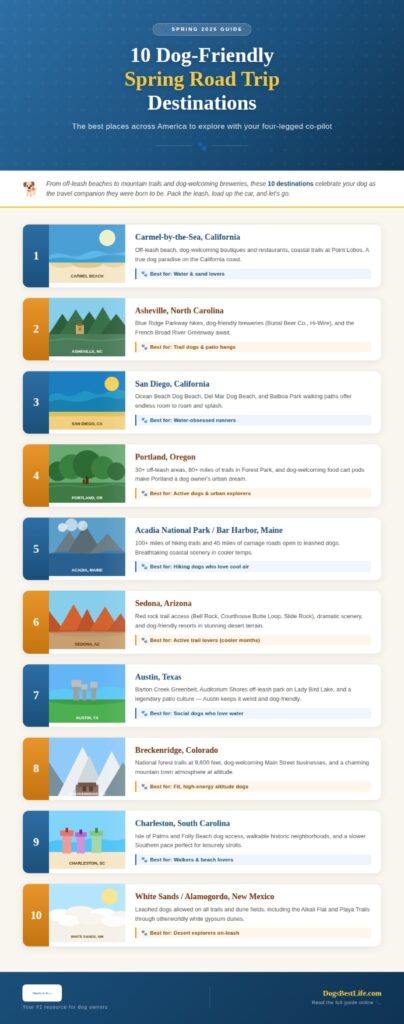
- Carmel-by-the-Sea, California
- Asheville, North Carolina
- San Diego, California
- Portland, Oregon
- Acadia National Park / Bar Harbor, Maine
- Sedona, Arizona
- Austin, Texas
- Breckenridge, Colorado
- Charleston, South Carolina
- White Sands National Park / Alamogordo, New Mexico
- Questions to ask before booking
- Before you load the car
- Go already
There’s a range when it comes to dog-friendliness, and it matters. On one end, some places technically allow dogs, but only on leash, in parking lots, and far from anything fun.
On the other hand, some places are truly designed for dogs. They have off-leash beaches, trail systems where dogs are common, and restaurants with treat jars at the host stand.
The destinations below represent the best examples of truly welcoming places for dogs.
Carmel-by-the-Sea, California
Vibe: America’s top dog town, built from the ground up for dogs.
Carmel doesn’t just allow dogs. It celebrates them. Boutiques keep water bowls outside. Hotel lobbies welcome dogs inside.
The whole town operates as if it understood, long before everyone else did, that dogs belong everywhere humans do.
Why dogs love it:
- Carmel Beach lets dogs run off-leash all year, making it one of the few legal off-leash beaches in California. There’s a full mile of white sand stretching to the end of Ocean Avenue, and most mornings, it looks like a golden retriever convention.
- The town is very walkable. Shops, restaurants, and galleries don’t just allow dogs; they welcome them inside.
- Point Lobos State Natural Reserve, just south of town, allows leashed dogs on several coastal trails. There are sea otter and harbor seal sightings that will make your dog very excited.
Why owners love it: Carmel is one of those rare places where the human half of the trip is just as good as the canine half. World-class scenery, some of California’s best restaurants, and a genuinely charming small-town feel that doesn’t feel manufactured.
Best for: All dogs, especially those who love sand and water.
Best season: Spring and fall. Summer weekends are crowded on the beach, so you may spend more time getting through crowds than relaxing.
Asheville, North Carolina
Vibe: A vibrant mountain arts town where dogs are part of daily life.
Asheville has figured out something other cities are still working on: dogs aren’t an exception to public life, they’re part of it. Walk down any block in the River Arts District, and you’ll pass three dogs before you pass a car.
Why dogs love it:
- The Blue Ridge Parkway has many pull-off points with short, leash-friendly hikes, many under two miles, that offer great mountain views. It’s one of the best drives in America, and dogs can enjoy the ride with you.
- Asheville’s brewery scene is famously dog-welcoming. Spots like Burial Beer Co. and Hi-Wire Brewing keep water bowls and treats on hand at their outdoor spaces. Your dog will become a regular before you do.
- The French Broad River Greenway offers flat, easy walking for older dogs or those who aren’t big hikers but still want to be out in the world.
Why owners love it: Asheville has a lively food and arts scene that stands on its own. Here, people can eat, drink, and visit galleries with their dogs, rather than just putting up with a trip for the dog’s sake.
Best for: Dogs who like a mix of trail time and patio time.
Best season: Late April through June, and September through October for fall color. Both are spectacular.
San Diego, California

Vibe: Sunshine, off-leash beaches, and a city that naturally welcomes dogs.
San Diego doesn’t make a big deal about being dog-friendly. It just is. Dogs appear everywhere — at the farmers market in Ocean Beach, along the bayfront trails, and in Balboa Park on a Tuesday morning. The infrastructure caught up with the culture a long time ago.
Why dogs love it:
- Ocean Beach Dog Beach is one of the first dedicated off-leash dog beaches in the United States. It’s large, sandy, and truly free-roaming. Here, a dog can run in circles for ten minutes and no one minds.
- Del Mar Dog Beach, just north of the city, allows off-leash dogs year-round and is excellent for swimming. The waves here are gentler, and the beach is wide.
- Balboa Park has miles of walking paths and open lawns where dogs are welcome on leash in most areas. It’s one of the best urban parks in the country and treats dogs as part of the experience.
Why owners love it: San Diego is one of the most complete cities on this list. Great food, neighborhoods worth wandering, and weather so consistently good it almost feels like cheating.
Best for: Water-obsessed dogs; any dog who needs serious space to run.
Best season: Year-round. Spring is ideal before summer crowds hit the beaches.
Portland, Oregon
Vibe: Urban culture shaped around dogs, with amenities everywhere.
Portland doesn’t just accommodate dogs; it has built an entire urban culture around them. The off-leash areas aren’t an afterthought. The dog-welcoming food cart pods aren’t an exception. This is just how Portland works.
Why dogs love it:
- Portland has over 30 off-leash areas across the city. That’s more than a statistic; it’s a way of life.
- Forest Park, one of the largest urban forests in the U.S. at over 5,000 acres, has more than 80 miles of trails where leashed dogs are welcome. You can spend an entire weekend in Forest Park and not cover the same ground twice.
- The city’s famous food cart pods almost universally allow dogs at outdoor tables. Your dog gets to sit with you while you eat a bánh mì. That’s the Portland promise.
Why owners love it: Powell’s Books, the food scene, and the neighborhoods make Portland a great city even before you consider how dog-friendly it is. Together, it’s exceptional.
Best for: Active dogs who love trail running and sniffing new things; owners who want an urban trip without leaving the dog behind.
Best season: May through October. Portland’s rainy season runs from October through April — beautiful in its own way, but plan accordingly.
Acadia National Park / Bar Harbor, Maine
Vibe: A truly dog-friendly national park paired with a coastal Maine town.
Most national parks are a disappointment for dog owners. Acadia is the exception that makes you forget the rule.
The access here is outstanding. Leashed dogs are welcome on over 100 miles of hiking trails and 45 miles of historic carriage roads, which is rare for a national park.
Why dogs love it:
- The carriage roads are perfect for dogs: wide, well-maintained, and varied, ranging from gentle lakeside loops to routes with real mountain views. They were built by John D. Rockefeller and are still among the finest-maintained trails in the Northeast.
- The hiking trail system includes everything from easy coastal walks like Ocean Path to more challenging summit routes. Dogs are welcome on most trails, except for the steep ladder and iron-rung trails, which are off-limits for safety.
- Bar Harbor’s downtown is highly walkable and genuinely dog-welcoming, with water bowls outside shops and restaurants. After a day on the trails, it’s a great place to wind down.
Why owners love it: Acadia’s scenery is world-class — rocky Atlantic coastline, forested valleys, mountain summits with views that reach into Canada on a clear day. It earns its reputation.
Best for: Hiking dogs; dogs who love cooler temperatures and varied terrain.
Best season: Late May through October. July and August are peak season, and trails get crowded by mid-morning. Late May, early June, and September are the best times for quieter trails, better parking, and the same great views.
Important note: Some specific trails and facilities within Acadia do restrict dogs. Always check current pet policies before finalizing your itinerary. Pet rules can change seasonally, sometimes on short notice. To avoid surprises, check the official site close to your travel dates.
You can also sign up for park update alerts on the NPS website or follow the park on social media for the latest changes. Setting up alerts or looking for updates a few days before your trip will help you stay ahead of any last-minute restrictions, so you and your dog won’t be caught off guard.
National park reality check
Most national parks have stricter rules for dogs than state parks, national forests, or other public lands. In many parks, dogs are allowed only on paved roads, parking lots, and developed areas, not on trails.
Acadia and White Sands (see #10) are notable exceptions. Before planning any national park trip around your dog, check the official NPS page for that park. Travel blogs frequently get these details wrong. The NPS page doesn’t.
Sedona, Arizona
Vibe: Red rock landscapes that feel out of this world, with plenty of leashed hiking to keep an active dog busy for a week.
Sedona is a place that leaves you speechless. The red rock formations seem unreal until you see them up close, and then they’re even more impressive. Dogs can enjoy all of it—the terrain, creek crossings, and canyon views—while on leash.
Why dogs love it:
- Many of Sedona’s trails allow leashed dogs, and the sensory experience here is extraordinary for dogs. New smells, new textures, red dirt that stains everything, and creek crossings that are basically mandatory fun.
- Bell Rock and Courthouse Butte Loop is one of the most popular trails in the area and allows leashed dogs. The views of the red rock formations from this trail are among the most dramatic in the Southwest.
- Slide Rock State Park allows leashed dogs in the park, though not in the swimming hole itself. It’s still worth the visit for the scenery.
Why owners love it: Sedona has grown into a serious destination for wellness, food, and art, alongside its reputation for hiking. Dog-friendly resorts and vacation rentals are widely available, and the town itself offers plenty to do beyond the trails.
Best for: Active, trail-loving dogs. It’s not ideal for brachycephalic breeds (pugs, French bulldogs, English bulldogs, Boston terriers) in summer because the desert heat makes breathing even harder for them, and the risk is real. Talk to your vet before planning a trip to Sedona with a flat-faced dog.
Best season: October through May. Summer temperatures routinely exceed 100°F and are genuinely dangerous for dogs. Plan outdoor activities for early morning, even in spring.
Austin, Texas
Vibe: A city with a long-standing dog culture and the facilities to support it.
Austin’s outdoor culture is inseparable from its dog culture. The two grew up together. If you’re heading to Barton Springs on a weekend morning, you’re going with your dog. That’s just how it works.
Why dogs love it:
- Barton Springs and the nearby Zilker Park area are at the heart of Austin’s dog scene. The greenbelt trails along Barton Creek let leashed dogs swim and explore miles of wooded terrain, giving a truly wild experience in a big city.
- Auditorium Shores off-leash dog park sits on the south bank of Lady Bird Lake, offering views of the downtown skyline. It’s one of the better-positioned urban dog parks in the country.
- Austin’s patio culture is extensive, and many restaurant patios actively welcome dogs. You won’t spend the trip eating alone while your dog waits in the car.
Why owners love it: The food, the music, the general energy of the city — Austin holds up independently of the dog angle. The outdoor culture means dogs fit naturally into almost any itinerary.
Best for: Social dogs who love meeting people; dogs who enjoy water and trail time.
Best season: Spring (March through May) and fall (October through November). Austin summers are brutal — plan any outdoor activity for early morning and keep afternoons indoors.
Breckenridge, Colorado

Vibe: A high-altitude mountain town where dogs are as welcome at the brewery as people.
Breckenridge is at 9,600 feet and surrounded by national forest trails that welcome leashed dogs. The town’s outdoor culture is so strong that dogs are a normal part of life—on the trails, on Main Street, and outside the taprooms.
Why dogs love it:
- The trail system is directly accessible from Main Street. You don’t need to drive to the trailhead. You walk out of your accommodation, and you’re already in the mountains.
- Many businesses along Main Street keep water bowls outside, and the town’s general culture of outdoor life means dogs are a normal part of the streetscape rather than an exception.
- The surrounding national forest trails offer everything from easy valley walks to serious mountain routes. The terrain changes dramatically with elevation, and the views are genuinely stunning.
Why owners love it: Breckenridge is one of Colorado’s most charming mountain towns, with good restaurants, great craft beer, and scenery that makes the 90-minute drive from Denver worthwhile.
Best for: Fit dogs who handle altitude well; high-energy working breeds.
Best season for hiking: June through September.
Altitude note
Breckenridge sits above 9,600 feet, and altitude affects dogs just as it affects people. Dogs can begin showing symptoms above 8,000 feet — excessive panting, lethargy, vomiting, and loss of appetite.
Give your dog a full day to acclimate, keep activity light on arrival, and watch closely for those signs. Brachycephalic breeds face a higher risk and should not be pushed hard at elevation. Ask your vet before the trip if you’re unsure.
Save the ASPCA Animal Poison Control number (888-426-4435) or Vetster’s 24/7 vet service in your phone before you leave.
If your dog shows signs of distress: move to a lower altitude, offer water, and call a vet. Locate the nearest clinic before you arrive, and keep your dog’s medical records accessible throughout the trip.
Charleston, South Carolina
Vibe: Southern charm, historic streets, and dog-friendly beaches. The historic neighborhoods are made for walking, the streets are shaded by live oaks, and the people are genuinely friendly in a way that makes strangers stop to ask your dog’s name.
Why dogs love it:
- Isle of Palms allows dogs on the beach year-round, with seasonal leash requirements. It’s a beautiful stretch of the Atlantic coast and one of the better dog-beach options in the Southeast.
- Folly Beach also allows leashed dogs during certain hours and seasons — verify current rules before visiting, as beach restrictions tend to shift seasonally.
- Charleston’s historic downtown neighborhoods, especially the French Quarter and South of Broad, are very walkable, with tree-lined streets and water bowls outside shops. Taking a slow morning walk with your dog is one of the best ways to enjoy the city.
Why owners love it: Charleston has some of the best food in the American South, a genuinely beautiful historic core, and a slower pace that makes it feel like a real escape rather than a checklist.
Best for: Dogs who enjoy walking and exploring; beach dogs in shoulder season.
Best season: Spring (March through May) and fall (October through November). Summer is hot and humid, and beach restrictions tend to tighten during peak season.
White Sands National Park / Alamogordo, New Mexico
Vibe: The most visually surreal dog-friendly national park in the country, with a landscape that seems almost impossible.
White Sands is a place that leaves people speechless. The gypsum dunes stretch in every direction, bright white against a blue sky, and the silence itself is something you can feel. Dogs are welcome in almost all areas.
Why dogs love it:
- White Sands allows leashed dogs on all trails and throughout the dune fields, which is rare for a national park. Unlike most parks, where dogs are limited to parking lots and paved roads, here they are truly part of the experience.
- The Alkali Flat Trail (about 4.6 miles round trip) and the Dune Life Nature Trail both welcome leashed dogs and offer the full White Sands experience: open dunes, long views, and terrain with endless new smells for your dog.
- The gypsum sand stays much cooler than regular desert sand, which is better for your dog’s paws. This is one reason the park is more dog-friendly than other desert spots, though summer heat can still be a problem.
Why owners love it: White Sands is one of the most genuinely otherworldly landscapes in the United States. The combination of accessibility, relatively low visitor density compared to more famous parks, and genuine dog-friendliness makes it an underrated gem.
Best for: Dogs comfortable in open desert terrain; owners who want something genuinely off the beaten path.
Best season: October through April. Summer temperatures at White Sands can be extreme and dangerous for dogs. The park shares land with White Sands Missile Range, and sometimes closes trails midday for missile testing. Check for current hours and closures before you go.
Questions to ask before booking
- Is there off-leash space, or meaningful leash-friendly outdoor space, within easy reach?
- Does the accommodation have weight limits or breed restrictions? Read the actual policy, not just the “pets welcome” label.
- Are there dog beaches or dog-friendly trails within 30 minutes?
- Is there a 24-hour emergency vet nearby? Remote wilderness is beautiful until something goes wrong.
Before you load the car
A few things worth doing before any long road trip with a dog.
Schedule a vet check before your trip, especially if you’ll be dealing with altitude, extreme heat, or new terrain.
Update flea, tick, and heartworm prevention, since different areas have different parasites.
When packing, use a short checklist to make things easier:
- Food and water bowls
- Enough food for the whole trip (plus a little extra)
- Water from home or a travel-safe supply
- Collar with ID tag and up-to-date microchip
- Leash (and a backup)
- Medications (including extras, just in case)
- Your dog’s medical/vet records (paper or digital)
- Favorite bed or blanket
- A couple of well-loved toys
- Poop bags
- Towel for drying off
- Simple first aid kit
You’ll never regret having these basics on hand.
Book places that are truly pet-friendly
“Pet-friendly” on booking sites can mean anything — always read the actual policy for weight limits, breed restrictions, and fees. Use BringFido or GoPetFriendly to find verified options, check recent reviews from dog owners, and call the property if something is unclear.
Know the national park rules before you go
In most national parks, dogs are not allowed on trails, beaches, or in backcountry areas, but Acadia and White Sands are exceptions. Always check the park’s official NPS page before planning a visit with your dog, since travel blogs often have outdated information.
Plan real rest stops
The general advice is to take a 15- to 20-minute break every two hours of driving, mainly for your dog’s benefit. Choose routes that let your dog get out and move, not just stop in parking lots. For more tips, see our guide to planning a dog-friendly trip.
Follow Leave No Trace principles on trails
Pack out waste, stay on designated trails, and keep your dog from disturbing wildlife. The access dogs have at places like Acadia and White Sands exists because previous visitors respected the rules. Leave No Trace has specific guidance for dog owners that’s worth reading before any backcountry or wilderness trip.
Go already
The car’s packed. The dog is ready — has been ready, probably since you pulled out the bag. The road is ahead.
Dogs make road trips better. They encourage you to stop in places you might otherwise pass by. They help you meet new people and remind you to be present in ways that apps and podcasts can’t.
Choose one of these destinations, mark a weekend on your calendar, and go. Your dog has waited long enough.
Sara B. Hansen has spent 20-plus years as a professional editor and writer. She’s also the author of The Complete Guide to Cocker Spaniels. She created her dream job by launching DogsBestLife.com in 2011. Sara grew up with family dogs, and since she bought her first house, she’s had a furry companion or two to help make it a home. She shares her heart and home with Nutmeg, a Pembroke Welsh Corgi. Her previous dogs: Sydney (September 2008-April 2020), Finley (November 1993-January 2008), and Browning (May 1993-November 2007). You can reach Sara @ editor@dogsbestlife.com.