
Why these 5 brain games work better than long walks to calm energetic dogs
You walked your dog for an hour. Or you threw the ball until your shoulder hurt. You did everything right, but your dog is still pacing, still whining, and still looking at you like you owe them something. Again.
Sound familiar?
Here’s something nobody tells you when you bring home a Border Collie, Husky, or Jack Russell with endless energy: physical exercise alone often isn’t enough.
It’s not your fault, and your dog isn’t broken. The truth is, a tired body and a tired brain are two different things.
Most high-energy dogs have tired bodies, but their minds are still looking for something to do.
“A tired dog is a good dog.” You’ve heard it so many times you could scream. The advice isn’t wrong. It’s just incomplete.
Dogs have up to 300 million smell receptors, while humans have about 6 million. Their brains are built for a level of sensory engagement that a simple walk barely touches.
Mental stimulation lowers stress, encourages calm behavior, and can tire out an energetic dog just as much as a run in the park.
For many dogs, a 15-minute nose work session can settle them even better than another 30-minute walk, because it works their brain, not just their body.
Of course, every dog is different—some may need longer or more challenging enrichment sessions, while others could be satisfied after just a few minutes.
It’s normal for each dog to respond in their own way, so experiment to find what leaves your dog truly relaxed.
Here are five mental enrichment games you can try today. The first three don’t need any special equipment.
Why “just exercise them more” isn’t always the answer
- Why “just exercise them more” isn’t always the answer
- Game 1: Scatter feeding
- Game 2: The snuffle mat
- Game 3: The muffin tin puzzle
- Game 4: Indoor nose work, or hide-and-seek with scent
- Game 5: The frozen Kong or lick mat
- The 15-minute enrichment routine that changes everything
- A note on truly high-drive dogs
- Final thoughts on mental enrichment games
Before we get into the games, let’s clear something up: training and enrichment are not the same. Training is like school; it teaches your dog specific behaviors. Enrichment is more like playtime. It lets your dog do what their brain was made for: sniffing, hunting, foraging, and solving problems.
High-energy dogs aren’t acting out because they’re bad. They’re just coping. Boredom and not enough stimulation can lead to barking, chewing, and anxious pacing—basically all the behaviors that make you want to escape for a few minutes.
Enrichment doesn’t get rid of your dog’s energy. It gives that energy a healthy outlet.
Mental tiredness from problem-solving and scent work is real. Think about the last time you learned something new, like a skill, a language, or a piece of software. You were probably tired afterward, even if you hadn’t moved much.
That’s what enrichment does for your dog. Even 5 to 15 minutes of focused nose work or puzzle play can help your dog truly relax.
This is especially true for scent hounds, herding breeds, sporting dogs, and terriers. These breeds were made to work and need mental challenges.
Game 1: Scatter feeding
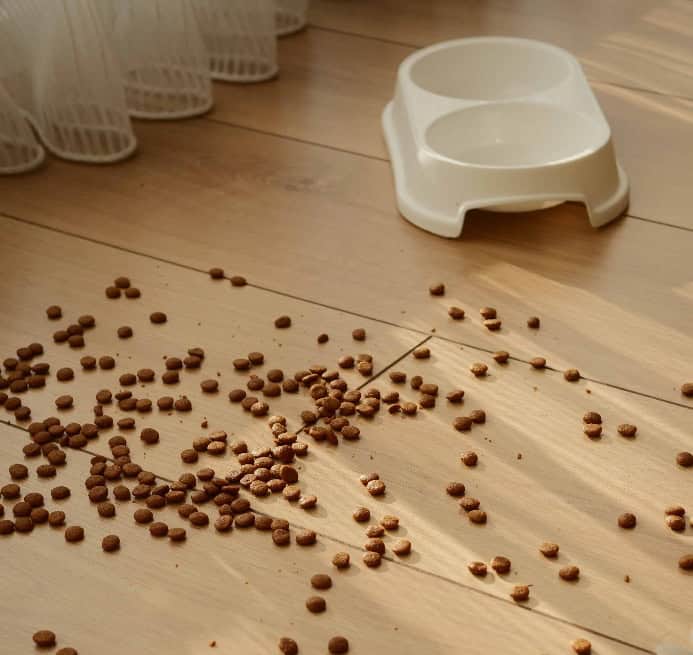
What you need: Your dog’s regular kibble or small treats. That’s it.
How to play: Skip the bowl. Scatter your dog’s meal across the kitchen floor, a yoga mat, or a patch of grass. Let them sniff out every single piece.
Start with kibble scattered loosely; as your dog gets better at it, spread the food wider, use smaller treats, or move to a more complex surface.
Why it works: Scatter feeding taps into your dog’s natural foraging instincts by making them search for each piece of food. Instead of finishing a bowl in seconds and then looking for something to do, your dog has to use their nose and concentrate on the task.
This type of mental work is genuinely tiring and leaves your dog more satisfied. Scatter feeding also helps your dog slow down while eating and learn to settle after meals.
Best for: Fast eaters, dogs prone to bloat (scatter feeding naturally slows consumption), and any dog who has never tried enrichment before. This is the entry point. No training required. Works the first time you try it.
Game 2: The snuffle mat

What you need: A snuffle mat, which is a rubber mat with fabric strips that hide food. For a budget version, roll kibble into a bath towel and tie it loosely.
How to play: Scatter kibble or small treats through the cloth strips. Set it on the floor and let your dog work.
Don’t help them. The challenge is the point. Start with treats near the surface; as your dog gets more experienced, push treats deeper into the fabric.
Why it works: The snuffle mat imitates natural foraging areas like grass and undergrowth, which your dog’s nose is made to explore. Scent work naturally calms dogs and gives them a sense of accomplishment.
Research shows that nose work can improve your dog’s well-being and reduce stress-related behaviors. Sniffing itself has a calming effect; it’s not just a distraction, it actually helps your dog relax.
Level up: Freeze the snuffle mat after loading it to extend engagement time. Or layer treats under folded fleece squares on top of the mat.
Best for: Anxious dogs, indoor dogs, and dogs recovering from surgery or injury. The snuffle mat is one of the few enrichment tools that calms a dog while keeping them busy, which is exactly what you need when your dog is bouncing off the walls in the evening.
Snuffle mats are easy to find on Amazon and at pet stores for about $15 to $30.
Game 3: The muffin tin puzzle
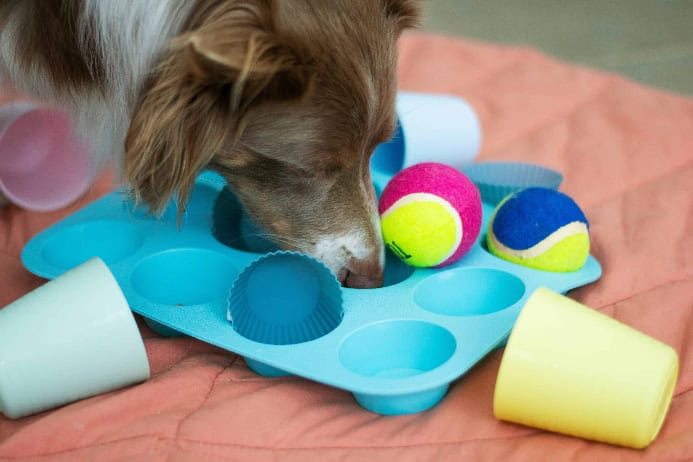
Photo by Ayla Verschueren
What you need: A muffin tin, tennis balls (or similarly sized objects), and treats.
How to play: Put a small treat in some or all of the muffin tin cups. Cover each cup with a tennis ball. Set it on the floor and let your dog figure it out.
Start with treats in every cup so your dog can succeed right away. As your dog gets better, put treats in only a few cups so they have to sniff out the right ones.
Why it works: This simple game encourages your dog to use their nose and solve problems, which helps them focus and stick with a task.
Problem-solving activities like this are shown to reduce stress and improve focus in dogs. Professional trainers often recommend this game because it’s free, easy to adjust, and most dogs love it.
Level up: Add a cardboard box over the entire tin so your dog has to remove the box before they even get to the tennis balls.
Best for: Dogs that love solving problems, including herding dogs, retrievers, poodles, and other working breeds.
Dogs who like to use their paws will especially enjoy it. Honestly, most dogs will love this game after just one try.
Game 4: Indoor nose work, or hide-and-seek with scent
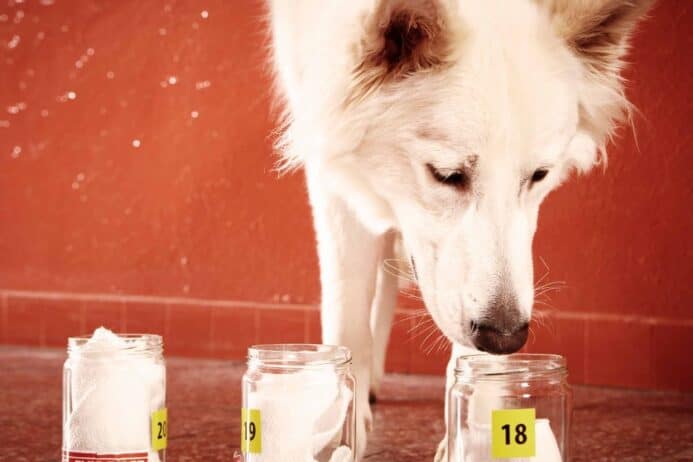
What you need: Treats, a dog who knows a basic “wait” or “stay,” and small cups or boxes (optional).
How to play: While your dog waits in another room, hide a treat under one of three cups lined up in a row. Let your dog back in and say, “Find it.” Praise your dog enthusiastically when they find the treat.
Once your dog understands the game, make it a bit more challenging by hiding the treats in harder spots, such as under a towel, behind furniture, or inside a box.
To move toward more advanced nose work, place the treat inside a small tin with holes, or a container that lets scent out while hiding the food. When your dog shows interest by sniffing or pawing, reward them.
Over several sessions, you can teach your dog to give a clear signal, like sitting or touching with their nose at the correct spot, before being rewarded. This gradual approach is how dogs start learning the basics of formal scent work.
Why it works: These games promote problem-solving, focus, and persistence. The concentration required to follow a scent trail and make a correct identification produces genuine mental fatigue.
This is the kind of activity that results in a dog who lies down and actually stays down. For reactive or anxious dogs, nose work is especially powerful because it provides a productive outlet that doesn’t require constant environmental management.
Level up: Try introducing a specific scent, like birch essential oil on a cotton swab, which is used in competitions. Pair the scent with a reward, then hide it in increasingly difficult places. This is how you start AKC Scent Work, a sport any dog can enjoy, no matter their age or ability.
Best for: All dogs, but especially scent hounds like beagles, bloodhounds, and basset hounds, as well as herding breeds and dogs that are reactive or anxious outside.
Game 5: The frozen Kong or lick mat
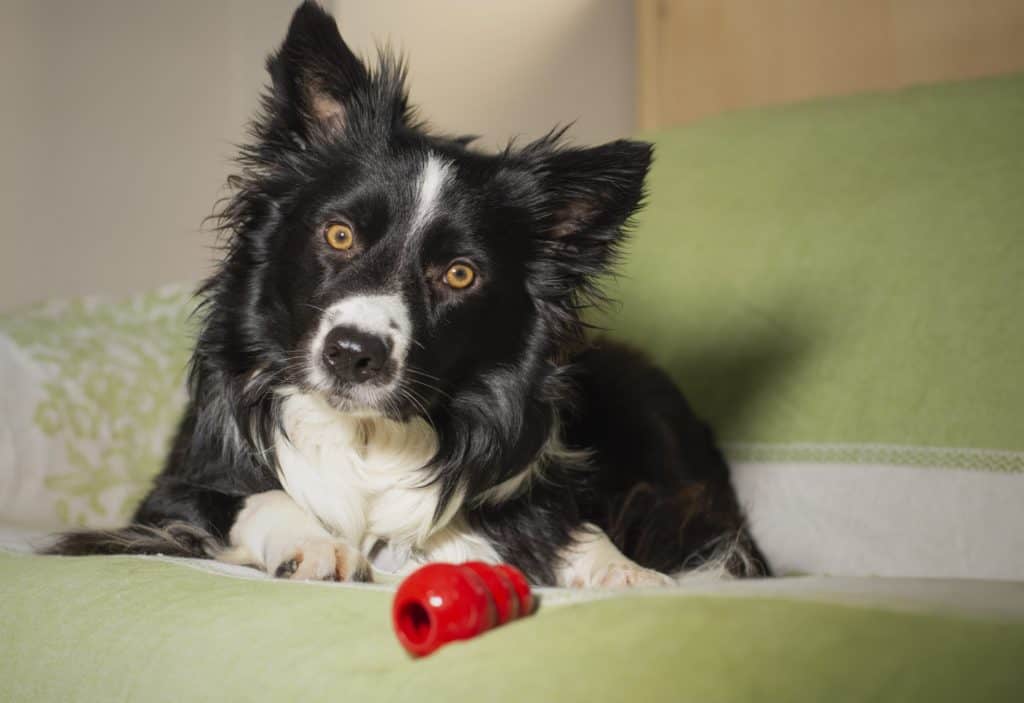
What you need: A Kong or lick mat. Filling options: plain peanut butter (more on this in a second), plain yogurt, canned dog food, mashed banana, or wet kibble.
How to play: Mix your filling, put it in the Kong or on the lick mat, and freeze for at least four hours. Overnight is best.
Give it to your dog when you need them busy, like before a video call, while you cook dinner, or after a walk, to help them relax. A regular Kong lasts 5 to 10 minutes, but a frozen one can last 20 to 30 minutes.
For lick mats: smear a thin layer of filling, freeze it, then add a second layer before serving. The layering creates extra texture and scent complexity.
Why it works: Licking is naturally calming for dogs and can really help reduce stress and anxious behaviors. For energetic dogs, the frozen version helps them transition from excitement to rest. It gives them something to do that gradually helps them relax, rather than expecting them to calm down instantly.
Level up: Prepare five Kongs on Sunday evening, then freeze them. This way, you have a week’s worth of enrichment ready to go. There’s no daily setup, so enrichment becomes a regular habit instead of something you do only once in a while.
Best for: Dogs who struggle to settle after walks, dogs with separation anxiety (give it before you leave), puppies, older dogs, and post-surgery dogs.
⚠️ Important: Safety first! If you’re using peanut butter, always check the label carefully—peanut butter containing xylitol is extremely toxic to dogs. Only use plain peanut butter with no added sweeteners.
Check all the ingredients in any foods you share with your dog. Some common foods that are dangerous for dogs include grapes, raisins, onions, and macadamia nuts. If you are ever unsure about whether something is safe, consult the ASPCA’s complete list of foods that are toxic to dogs. When in doubt, don’t use it. Your dog’s safety comes first.
The 15-minute enrichment routine that changes everything
The best enrichment isn’t something you do once in a while; it’s something you do every day. It doesn’t have to be complicated.
Fifteen minutes each day is better than a two-hour session once a week.
Here’s a simple framework:
- Morning: Scatter feed breakfast instead of using a bowl. Five minutes. Zero extra effort.
- Midday or afternoon: One game from the list above. Ten to fifteen minutes.
- Evening wind-down: Frozen Kong or lick mat after the evening walk.
One important note: enrichment should be challenging but not frustrating. If your dog gives up, quits, or looks stressed, the game is too hard. Make it easier and help your dog build confidence.
The goal is for your dog to be engaged and successful, not to test their limits. If your dog gets frustrated, try making the game simpler by reducing the difficulty, breaking it into smaller steps, or switching to a game they are already comfortable with.
You can also use more enticing treats to keep your dog interested and motivated. If your dog loses focus or seems overwhelmed, end the session on a positive note and try again later.
Every dog learns at their own pace, so adjust the games as needed to set your dog up for success.
Also, remember to rotate the games. If your dog does the muffin tin puzzle every day, they’ll get bored. Switch between the five games and try new variations. The novelty keeps enrichment interesting.
A note on truly high-drive dogs
For some dogs, especially working-line herding breeds, high-drive working dogs, and dogs bred for specific jobs, even a strong enrichment routine might not be enough.
Think Belgian Malinois, Australian Shepherds, Border Collies, German Shepherds, Vizslas, and Belgian Tervurens. These are dogs built for serious work and intense activity.
For these breeds, a structured dog sport like AKC Scent Work, herding, agility, flyball, or dock diving is often the best way to meet their physical and mental needs.
Many of these activities are available through local clubs and don’t require any previous experience.
For dogs whose high energy is accompanied by anxiety, destructive behavior, or apparent distress, a consultation with a certified professional dog trainer (CPDT-KA) or a veterinary behaviorist is worth it. Enrichment is an effective tool — but some dogs need more focused support.
Final thoughts on mental enrichment games
Picture your dog right now, lying on the couch and truly resting. No pacing, no whining, no eyeing the trash can. All it took was a muffin tin and some kibble.
Adding mental enrichment to your dog’s daily routine doesn’t dim your dog’s personality or kill their drive. It gives their brain exactly what it was designed to do: hunt, solve, sniff, and find.
Try scatter feeding tonight. Add the muffin tin game tomorrow. In a week, you’ll wonder why you ever just gave your dog food in a bowl.
Sara B. Hansen has spent 20-plus years as a professional editor and writer. She’s also the author of The Complete Guide to Cocker Spaniels. She created her dream job by launching DogsBestLife.com in 2011. Sara grew up with family dogs, and since she bought her first house, she’s had a furry companion or two to help make it a home. She shares her heart and home with Nutmeg, a Pembroke Welsh Corgi. Her previous dogs: Sydney (September 2008-April 2020), Finley (November 1993-January 2008), and Browning (May 1993-November 2007). You can reach Sara @ editor@dogsbestlife.com.