
Dog separation anxiety: How to fix what’s happening in your dog’s brain

Your dog tears apart the couch every time you leave. Or howls until the neighbors complain. Or refuses to eat, paces the floors, and trembles by the door for hours.
You’ve tried everything: a peanut butter-stuffed Kong, background TV noise, and a second dog. Nothing sticks. This can be tough, but real progress is possible, and things really can get better.
But you can change your dog’s future. With the right steps, you can move from feeling stuck to seeing real improvement.
Separation anxiety is one of the most common — and most misunderstood — behavioral issues dogs face.
Getting better requires understanding what’s actually happening in your dog’s brain, why it happens, and what genuinely helps versus what just makes you feel like you’re doing something.
This guide walks you through the causes, signs, training approaches, and tools to help solve your dog’s problems. You’ll also learn when it’s time to involve your vet. Let’s explore what you can do next.
Understanding separation fear in dogs
- Understanding separation fear in dogs
- Common myths about separation anxiety
- Common causes of separation anxiety
- Signs and symptoms to watch for
- Signs of separation anxiety checklist
- Preventing separation fear early on
- Training methods to reduce anxiety
- Management tools and techniques
- Separation anxiety in multi-dog households
- When and how medication can help
- Create a safe place for your dog
- Frequently asked questions
- Emotional support for owners of dogs with separation anxiety
- The bottom line on dog separation anxiety
Here’s the thing about separation anxiety: it’s not your dog being dramatic. It’s not manipulation or spite.
It’s genuine, physiological fear — the same kind of panic a person feels when they think something terrible is about to happen.
Dogs are social animals. They developed alongside humans for thousands of years. That bond runs deep.
For many, being alone doesn’t just feel uncomfortable — it feels dangerous. Their nervous system kicks into overdrive, flooding their body with stress hormones.
Heart rate rises. Breathing quickens. Rational thought disappears. What you see — destruction, barking, accidents — is outward panic.
Some dogs experience mild distress. Others spiral into a full-scale crisis the moment you pick up your keys.
The intensity varies, but the underlying mechanism is the same: your dog genuinely believes something is wrong, and they don’t have the tools to cope with that feeling.
Key takeaway: With focused and consistent training, most dogs can overcome separation anxiety and live comfortably when alone.
Common myths about separation anxiety

Before diving into causes and solutions, it’s worth clearing the air. Separation anxiety comes loaded with guilt, confusion, and a lot of bad advice. Here are the most persistent myths — and what’s actually true.
Myth: “My dog is doing this out of spite.”
Fact: Dogs don’t have the cognitive architecture for spite. What looks like revenge is panic — your dog isn’t punishing you for leaving. They’re suffering while you’re gone.
Myth: “I spoiled my dog and caused this.”
Fact: Loving your dog didn’t cause separation anxiety. Genetics, early life experiences, and temperament play far more of a role than affection ever could.
Myth: “Getting a second dog will fix it.”
Fact: Separation anxiety is about the absence of their primary attachment figure — usually you — not loneliness in a general sense. A second dog is a companion, not a cure.
Myth: “Crating them will make it worse.”
Fact: A crate, introduced gradually, can reduce anxiety by giving your dog a secure, predictable space. The problem isn’t the crate — it’s forcing a dog into one without preparation.
Myth: “They’ll grow out of it.”
Fact: Separation anxiety typically won’t resolve without help. Early, proactive intervention gives your dog the best shot at recovery.
Myth: “Punishing them after the fact will teach them not to do it.”
Fact: Dogs don’t connect after-the-fact punishment with past behavior. It doesn’t teach them anything useful — it just adds to an already frightened dog’s fear.
Common causes of separation anxiety
No single thing causes separation anxiety. It’s usually a set of factors — genetics, early experiences, and environment working together to create a dog who struggles to be alone.
Genetics plays a bigger role than most realize. Certain breeds are simply more prone to anxiety. Border Collies, Australian Shepherds, Vizslas, and German Shepherds often struggle more.
If your dog’s breed was developed to work closely with humans, solo time can feel especially foreign.
Initial life experiences matter enormously. Puppies who don’t get proper socialization between three and 12 weeks old often grow up with a shaky foundation for handling stress.
Dogs who spent time in shelters — especially those who bounced between homes — frequently develop attachment issues that show up as separation anxiety later on.
Life changes can also trigger it. A new baby, a move, a change in your work schedule, or the loss of a companion animal or family member can disrupt a dog’s sense of stability. Any of these can set anxiety in motion. Sometimes, without any obvious reason, it just develops.
Key point: Be mindful not to unintentionally reinforce anxious behaviors, as your response can shape how persistent the problem becomes.
Signs and symptoms to watch for
Not all separation anxiety looks the same.
Some dogs go loud. Others go quiet. Some destroy. Others just shut down. Knowing what to look for—and distinguishing it from boredom or normal dog behavior—matters a lot.
Classic signs include destructive behavior that happens only when you’re gone.
Add excessive barking or howling, as reported by neighbors. House soiling from an otherwise housetrained dog, and frantic escape attempts—scratching at doors, windows, or crates, digging, and destructive chewing—are also common.
Less obvious signs matter too. Your dog may refuse to eat when alone, pant or drool excessively, pace or circle, or withdraw when they sense you’re about to leave.
You may have seen pre-departure anxiety already. When you grab your keys or put on your shoes, your dog follows you from room to room. Their eyes go wide. They whine. Maybe they plant themselves by the door. That vigilance — reading your every move for clues — is a hallmark of separation anxiety.
To tell the difference between separation anxiety and boredom: set up a camera and watch. A bored dog gets into mischief, then settles.
An anxious dog stays in distress the whole time. This distinction matters. The fix for one won’t help the other.
The key takeaway: The earlier you take action, the better. Addressing separation anxiety and its related behavior problems promptly can set your dog up for a healthier, calmer life when alone.
Signs of separation anxiety checklist
Use this checklist to identify whether your dog may be experiencing separation anxiety. Check all that apply.
Obvious signs (happen only when you’re away)
☐ Destructive behavior (chewing, scratching, tearing up furniture or belongings)
☐ Excessive barking, howling, or whining
☐ House soiling despite being housetrained
☐ Frantic escape attempts (scratching at doors, windows, or crate)
☐ Refuses to eat or drink when left alone
Physical signs
☐ Panting or drooling excessively when alone
☐ Pacing, circling, or unable to settle
☐ Trembling or shaking before or during departures
☐ Vomiting or diarrhea during absences
Pre-departure signs (before you even leave)
☐ Follows you from room to room as you prepare to leave
☐ Becomes visibly distressed when you pick up keys or put on shoes
☐ Whines, barks, or plants themselves by the door
☐ Eyes go wide, ears flatten, or tail tucks
Post-return signs
☐ Frantic, over-the-top greeting every time you come home
☐ Takes a long time to calm down after you return
How to interpret your results
3 or fewer checks — May be normal dog behavior or boredom. Set up a camera to observe.
4–7 checks — Moderate concern. Begin desensitization training and monitor closely.
8 or more checks — Strong indicators of separation anxiety. Consider consulting your vet or a behaviorist.
Preventing separation fear early on
Prevention is easier than treatment. Early independence training sets the stage for a confident, happy dog.
Teach independence early. That means not allowing your puppy to follow you from room to room every single moment.
It means practicing short separations — step outside, come back in, no big drama. It means teaching them that being alone is normal, safe, and nothing worth panicking over.
Crate training, done right, gives your dog a den — a place that’s theirs, that feels secure. The keyword is “done right.” A crate should never be used as punishment. It should be introduced slowly, with high-value treats and meals inside, so your dog builds a positive association with the space over time.
Keep your departures and arrivals calm and predictable. Leave quietly. When returning, wait for your dog to settle before giving attention. This teaches your dog that alone time is safe and ordinary, preventing anxiety and over-excitement about comings and goings.
And build your dog’s confidence broadly. Dogs with good general resilience — who’ve been exposed to lots of environments, sounds, people, and experiences — tend to handle stress better across the board.
Socialization isn’t only about getting along with other dogs. It’s about building a nervous system that can handle uncertainty.
Training methods to reduce anxiety
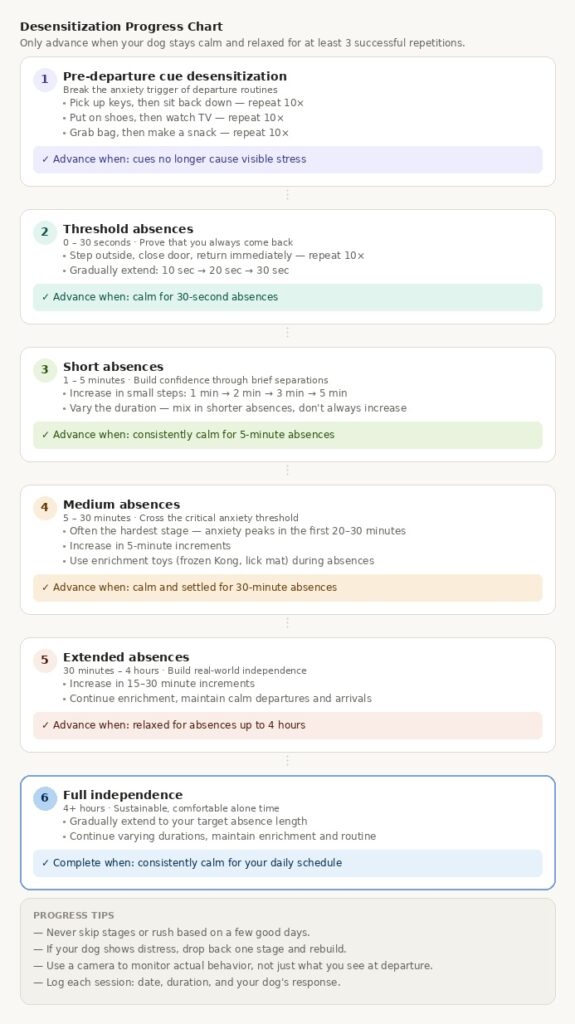
Consistency and patience are vital. Change comes from steady, gradual training that respects your dog’s limits.
The best approach: systematic desensitization and counter-conditioning. In plain language: teach your dog that being alone leads to good things. Go so gradually that you never trigger their anxiety response.
Start with absences so short they feel trivial. Step outside for five seconds. Return. No reaction. Repeat. Keep your dog under threshold — calm, not stressed — throughout. Gradually lengthen the time away, but only as your dog remains calm.
Work on departure cues. Pick up your keys without leaving to break their power. Grab your keys and watch TV. Put on your shoes and make a sandwich. When routines lose predictability, your dog’s anxiety starts to fade.
Practice independence exercises indoors, too. “Go to your place” is one of the most useful skills you can teach a dog with anxiety.
It gives them somewhere to go — and something to do — when they’re feeling uncertain. Combine it with a long-lasting treat or a puzzle toy, and you’ve got a powerful self-soothing tool built right in.
Be consistent. Inconsistency is one of the biggest training killers. If you work on short absences all week and then leave for four hours on Saturday, you’ve potentially undone significant progress.
During treatment, use dog sitters or daycare to protect your dog from absences they can’t yet handle. Failures are normal — progress is seldom a straight line. What matters most is keeping at it.
Management tools and techniques
Training is the foundation, but good management makes everything easier. Think of management tools as scaffolding — they support your dog while the real work of building a new emotional response happens underneath.
Food puzzles and enrichment toys rank high on the list. A stuffed frozen Kong, a lick mat, a snuffle mat — these give your dog’s brain something to do and a way to self-soothe. Reserve them for when you leave, so your dog starts to associate your departure with something genuinely good.
White noise machines or calming music can reduce environmental triggers that ramp up anxiety. Some dogs also respond well to pheromone diffusers that mimic the calming signals that mother dogs produce for their puppies. These aren’t miracle cures, but for mild anxiety, they can take the edge off.
Pressure wraps — like a Thundershirt — work for some dogs by creating light, constant pressure. Think of it like a hug. It doesn’t fix the underlying anxiety, but it can reduce the intensity of the stress response in the moment.
Exercise matters more than most people think. A solid 45-minute walk or play session before a planned absence lowers the baseline stress level your dog starts from. Physical and mental exhaustion leaves less room for panic.
Doggy daycare or a dog walker mid-day can be a genuine lifesaver during treatment — not as a permanent solution, but as a way to limit hours alone while your dog is still building tolerance at home.
Separation anxiety in multi-dog households
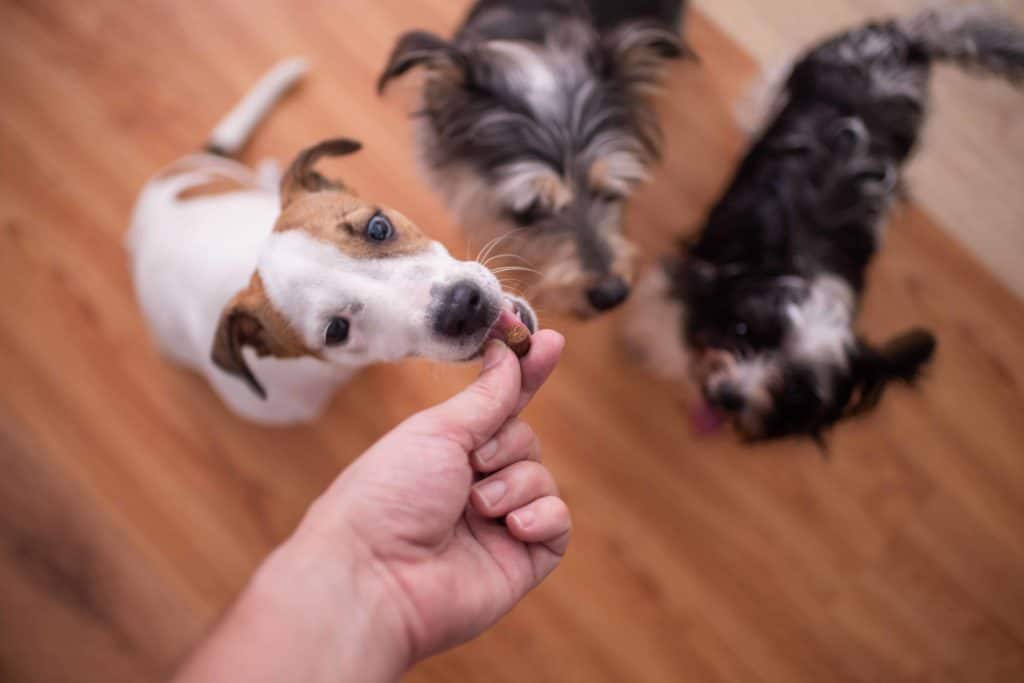
If you have more than one dog, the dynamics of separation anxiety can get more complicated — and more confusing. Here’s what you need to know.
First, having multiple dogs doesn’t prevent separation anxiety. As mentioned above, the anxiety is usually tied to a specific person rather than to the presence of other dogs. One dog in your household may be perfectly fine when left alone, while another is in full distress. They can be in the same room and have completely different experiences.
Second, multi-dog households make it harder to identify which dog has the problem. If you’re coming home to destruction or hearing reports of barking, set up a camera to watch all your dogs.
You may find one is calm while the other is the source of everything. Treating the wrong dog — or treating both when only one needs it — wastes time and energy.
Third, dogs can reinforce each other’s anxiety. If one dog paces and whines at the door, another may pick up on that stress and escalate alongside them. During training, you may need to practice absences with dogs separated so each one builds its own tolerance independently.
Finally, if your anxious dog is deeply bonded to your other dog rather than to you, the dynamic shifts. In that case, separating the bonded pair — even briefly — may trigger more distress than being left alone without humans. A behaviorist can help you untangle which attachment is driving the anxiety and build a plan from there.
When and how medication can help
There’s still a lot of stigma around medicating dogs for behavioral issues. Medication isn’t giving up or a crutch. For dogs with moderate to severe separation anxiety, it can be the thing that makes training possible in the first place.
If your dog is in full-blown panic every time you leave, they can’t learn. Fear shuts down the part of the brain responsible for forming new associations. Anti-anxiety medication can bring baseline anxiety down to a level where your dog is actually capable of learning something new.
Your veterinarian may consider two types. The first is daily medication — typically an SSRI — taken consistently to lower overall anxiety over time. These take four to six weeks to reach full effect and work best alongside behavior modification.
The second is situational medication, given before a specific stressor or during severe reactions. Side effects are usually mild, but monitor your dog and report anything unusual.
Always work with your vet. A veterinary behaviorist is the gold standard for severe cases, but a general vet familiar with behavioral medications is a solid starting point. Bring notes on duration, frequency, and specific behaviors, so they have a clear picture.
Combining medication and training produces the best outcomes. Think of medication as creating the conditions under which your dog can do the emotional work — not as a replacement for it.
Create a safe place for your dog
Everything in your dog’s environment sends a message. The goal is to make that message as calm and clear as possible: you are safe, nothing bad is happening here.
Start with their physical space. A designated resting area with familiar-smelling bedding gives your dog an anchor. Leave a piece of worn clothing nearby — your scent is genuinely calming. It signals your presence even when you’re gone.
Establish predictable routines. Dogs are creatures of habit, and consistency reduces uncertainty. Feed and walk at the same time each day. The more stable life feels, the lower your dog’s baseline anxiety tends to run.
Think about sound. Sudden noises — traffic, neighbors, delivery trucks — can spike anxiety in an already stressed dog. A white noise machine near the door can buffer those surprises.
Limit space thoughtfully. Some dogs feel safer in a smaller, cozier area rather than having the run of the house. Others need freedom to move. Pay attention to what your dog gravitates toward and let that guide you.
Frequently asked questions

Can I leave my dog alone for eight hours?
For a dog without anxiety, most adult dogs can manage six to eight hours, though it’s not ideal. For a dog actively experiencing separation anxiety, that length of time is too much — especially during treatment.
Use a dog walker, daycare, or a trusted friend to break up long absences while you’re working on building tolerance at home.
Can I use calming treats?
Yes, with realistic expectations. Calming treats containing ingredients like L-theanine, melatonin, CBD, or ashwagandha may take the edge off mild anxiety.
They won’t resolve moderate to severe separation anxiety on their own, but they can be a useful supplement alongside training.
Always check with your vet before adding supplements, especially if your dog is on other medications.
Should I get a dog camera?
Absolutely. A camera is one of the most useful tools you have. It lets you see exactly what your dog is doing when you’re gone — which tells you whether you’re dealing with true separation anxiety or boredom, how severe the distress is, and whether your training is actually working.
Some cameras also have two-way audio, though talking to your dog through a speaker can sometimes increase anxiety rather than reduce it.
My dog is doing well at doggy daycare. Does that mean they don’t have separation anxiety?
Not necessarily. Some dogs are distressed specifically in the home environment or specifically when separated from their primary person.
Others do fine in group settings but fall apart when alone. Daycare can be a great management tool, but it doesn’t mean the anxiety isn’t real or doesn’t need to be addressed.
How long does treatment take?
It depends on severity. Mild cases can show meaningful improvement in a few weeks. Moderate to severe cases often take several months of consistent work.
Some dogs need ongoing management long-term. Progress is rarely linear — expect good weeks and harder weeks. What matters is the overall trend.
Is my dog in pain when I leave?
Not physical pain, but genuine emotional distress — yes. The stress hormones flooding their body during an anxiety episode have real physiological effects.
This is why treatment matters. It’s not just about the furniture or the neighbors. It’s about your dog’s quality of life.
Emotional support for owners of dogs with separation anxiety
Living with a dog who has separation anxiety is genuinely hard. It affects your schedule, your relationships, your ability to travel, and sometimes your sense of yourself as a capable dog owner.
Separation anxiety is not a reflection of how much you love your dog or how good an owner you are. It’s a condition — you didn’t cause it by being too loving.
The guilt is real. Watching your dog tremble as you head for the door, coming home to destruction — it wears on you.
Many owners feel trapped, like they can’t leave without causing suffering. That feeling is valid, and it’s also a sign that you’re deeply attuned to your dog.
A few things that help:
Track progress, not perfection. Keep a simple log of your training sessions. On hard days, looking back at how far you’ve come makes a real difference.
Talk to other owners who get it. Online communities for dogs with separation anxiety are full of people who understand exactly what you’re going through.
Celebrate small wins. Your dog made it through a five-minute absence without spiraling? That’s real progress. Honor it.
Give yourself permission to use support. Dog walkers, daycare, pet sitters — using these resources isn’t giving up. It’s smart management that protects your dog while you work on the bigger picture.
The fact that this is hard for you is proof of how much you care. That bond — even when it’s complicated by anxiety — is the very thing your dog is fighting to protect.
The bottom line on dog separation anxiety
Your dog’s separation anxiety isn’t a character flaw.
It’s not something they chose. It’s a fear response — real, intense, and deeply uncomfortable for them.
But it’s also workable with a behavior modification plan.
With the right combination of understanding, training, management, and (when needed) professional support, dogs overcome it every day.
Your dog doesn’t need you to be perfect. They need you to be consistent, patient, and willing to learn alongside them. The fact that you’re reading this at all says something. You’re already doing better than you think.
Sara B. Hansen has spent 20-plus years as a professional editor and writer. She’s also the author of The Complete Guide to Cocker Spaniels. She created her dream job by launching DogsBestLife.com in 2011. Sara grew up with family dogs, and since she bought her first house, she’s had a furry companion or two to help make it a home. She shares her heart and home with Nutmeg, a Pembroke Welsh Corgi. Her previous dogs: Sydney (September 2008-April 2020), Finley (November 1993-January 2008), and Browning (May 1993-November 2007). You can reach Sara @ editor@dogsbestlife.com.