
Why does my dog lunge and bark? Understand and fix dog reactivity

Picture it: a calm evening walk, your dog trotting along nicely, and then a Lab rounds the corner 20 feet ahead. In under a second, your dog is barking, lunging, wrapping the leash around your legs while you do damage control and try to avoid eye contact with the other owner.
Most people I work with have been told their dog is dominant, out of control, or simply aggressive.
Spend five minutes actually watching the dog, and a different picture emerges. The tail is tucked. The eyes are wide. The body is rigid with something much closer to panic than menace. These dogs are not trying to start trouble.
Reactive dogs are overwhelmed, and this is the only strategy that has ever worked for them.
Reactive behavior is extremely common, and it responds well to the right approach. What follows is a plain-language breakdown of what reactivity actually is, why it develops, and what owners can do about it.
What dog reactivity actually means
- What dog reactivity actually means
- Read the room: Stress signals before the explosion
- Where dog reactivity comes from
- Stop the rehearsal first
- Desensitization: Distance as a training tool
- Counter-conditioning: Changing the association
- Build check-in behavior
- What not to do
- When professional help makes sense
- Progress looks different for every dog
Reactivity refers to a dog that overreacts to specific triggers. Another dog, a stranger, a bicycle, a skateboard coming from behind — the dog registers them as threats and responds with an intensity that makes no sense given the actual situation.
Barking, lunging, growling, spinning, and hard staring. While a non-reactive dog sniffs the air and moves on, the reactive dog is running a full emergency protocol.
Reactivity and aggression are distinct, and conflating them leads to many poor training decisions.
Aggression in dogs tends to be quiet, focused, and intentional. Reactivity is loud, explosive, and driven by fear or frustration rather than intent to harm. The outward displays can look similar, but they have different causes and require different responses.
Punishing a fear-reactive dog for the outburst does nothing to address the fear; it usually makes it worse.
Reactivity is also highly context-specific. The dog who melts down at every dog on a leash walk may play perfectly well at an off-leash park. That inconsistency is not random. It is a clue about the mechanism driving the behavior, which brings us to why this happens at all.
Read the room: Stress signals before the explosion
By the time a dog is barking and lunging, you have already missed several earlier signals.
Dogs communicate stress long before they boil over, and learning to read those signals is where the real leverage is in managing reactivity day to day.
Watch for these in the moments before a trigger appears, or in the early seconds after your dog notices one:
- Whale eye — the whites of the eyes become visible at the outer corners
- Lip licking or repetitive yawning when nothing in the situation calls for it
- A freeze: sudden stillness with a hard, fixed stare
- Hackles rising along the spine
- Weight shifting forward onto the front legs, body rigid.
Two or more of these together mean your dog’s stress is climbing. That window, before the bark, is when you have options. Increase distance, redirect attention, change direction.
Once the reactive dog crosses the threshold, learning stops and management begins.
If your dog also shows these signs in other contexts, such as around strangers at home, during thunderstorms, or when left alone, it is worth looking at the broader pattern.
Reactivity and generalized anxiety often share the same roots, and addressing anxiety in dogs alongside the specific trigger work tends to get faster results.
Where dog reactivity comes from
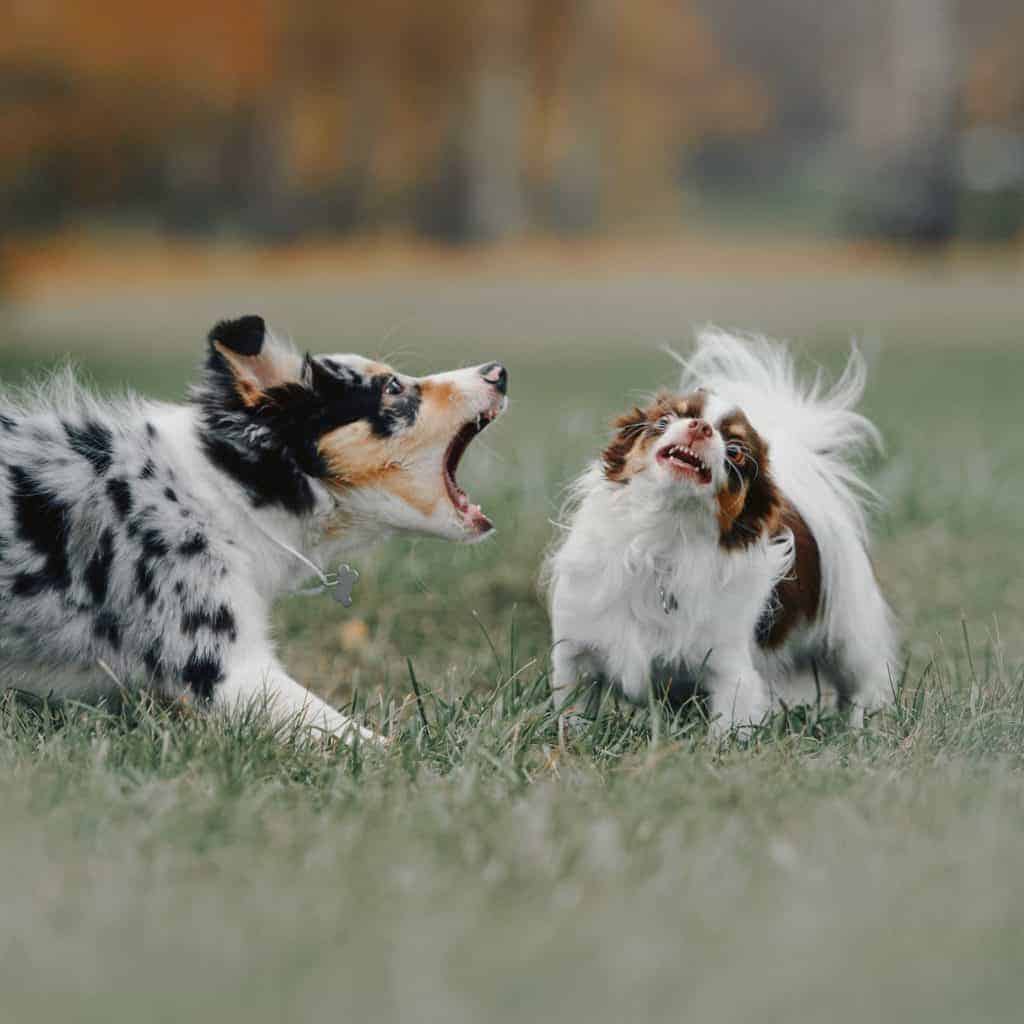
In my work with reactive dogs, the cause almost always falls into one of these categories — sometimes in combination.
Fear
A dog who is afraid of something but cannot get away from it will often try to drive it off instead. Barking and lunging at another dog on the street is frequently less about aggression and more about making the scary thing leave.
And it works. The other dog walks away. The owner retreats. The scary person changes course. Every time the behavior produces that result, it gets stronger.
A missed socialization window
Between roughly three and fourteen weeks of age, the puppy brain is unusually receptive to forming associations with the world. Experiences during this period, positive or negative, tend to stick. The ASPCA’s guidance on dog behavior identifies this socialization window as one of the most influential factors in long-term temperament.
Dogs who spent this period in isolation, in a shelter, or without adequate exposure to people, animals, and environments often grow into adults who find ordinary things genuinely threatening.
Barrier frustration on leash
This is the mechanism behind the reactive dog who is perfectly relaxed off-leash but falls apart on a walk.
On leash, a dog loses the ability to control their own approach and exit. They cannot curve toward another dog in the natural, arcing path dogs use when greeting. They cannot simply walk away if they feel crowded.
The leash takes those options off the table, and that loss of control generates frustration that comes out as reactivity.
Leash tension from a nervous owner compounds it, because dogs read physical signals through the leash and interpret tightness as confirmation that something is wrong.
A bad experience
Dogs form associations quickly, especially under fear.
One attack from an off-leash dog, one harsh physical correction during training, one extremely frightening encounter with a stranger — any of these can establish a lasting conditioned response. The dog is not being dramatic.
The nervous system genuinely registered that situation as dangerous, and it is acting accordingly.
Pain or a medical issue
This one gets missed constantly. Chronic pain lowers the threshold for everything.
A dog with undiagnosed hip dysplasia, dental pain, or an ear infection will react to things a healthy dog would brush off.
If reactivity appeared suddenly in an adult dog with no clear behavioral explanation, start with a vet exam, not a training plan.
Training methods with evidence behind them
Two techniques form the core of reactive dog behavior modification: desensitization and counter-conditioning.
They are almost always used together, and the research behind them is solid. Both are endorsed by the International Association of Animal Behavior Consultants and align with what we know about how fear memories form and change in the mammalian brain.
Stop the rehearsal first
Every time a dog completes a reactive episode, the neural pathway for that behavior gets reinforced. Before any training can take hold, the behavior needs to stop being practiced.
That means management: walking at off-peak times, crossing the street before a trigger gets close, using parked cars and hedgerows as visual buffers, and keeping sessions short. This is not a long-term solution. It is the precondition for training to work.
Desensitization: Distance as a training tool
Desensitization means controlled exposure to the trigger at an intensity level your dog can handle without reacting.
For most leash-reactive dogs, that means distance. You find the threshold — the point at which your dog can see another dog and stay calm enough to take a treat and look at you — and you work there. Not closer. The distance closes gradually over many sessions as the dog’s tolerance builds.
The mistake most owners make is moving too fast. If your dog reacts during a session, you have exceeded the threshold. Back up. The work happens below it.
Counter-conditioning: Changing the association

Counter-conditioning runs alongside desensitization. Every time your dog notices the trigger at or below threshold, a high-value reward appears immediately.
The sequence matters: trigger appears, then treat. Repeat that pairing across dozens of sessions, and the dog’s brain begins to link the trigger with something good rather than something threatening.
The behavioral sign that counter-conditioning is working is a dog who spots the trigger and turns toward the owner with an expectant look rather than going rigid and staring.
That reorientation reflects a genuine shift in the emotional response, not just a suppression of the outward behavior.
Build check-in behavior
A dog with a strong history of voluntarily orienting to their owner has a ready-made coping behavior available when stress rises.
Simple exercises like eye contact on a loose leash, hand targeting, and rewarding any spontaneous glance at the handler build this over time.
It does not need to be formal training — a few seconds here and there on every walk adds up quickly.
For a solid foundation in reward-based work across behavior areas, the same principles behind basic dog training fundamentals apply directly to reactivity modification. Consistency, short sessions, and high rates of reinforcement for the behavior you want.
What not to do
Punishment-based approaches are consistently contraindicated for reactive dogs. The American Veterinary Society of Animal Behavior has addressed this directly in its published position statements: applying aversive stimuli to a fearful or anxious dog suppresses the outward signals without touching the underlying state.
The dog stops warning. The fear continues. The result is an animal who is less predictable, not better behaved.
Forcing greetings is similarly counterproductive. Bringing a reactive dog within range of their trigger before they have developed the emotional capacity to handle it is not exposure therapy. It is flooding, and it tends to entrench the fear rather than reduce it.
When professional help makes sense
Some owners make real progress working on leash reactivity on their own, particularly when the reactivity is mild and the trigger set is narrow.
But certain situations genuinely require a professional:
- The dog has made contact in a bite or near-bite situation.
- Reactivity is getting worse despite consistent management.
- The dog is reactive across many different trigger types.
- You suspect a medical or anxiety component that training alone will not address.
When vetting a trainer, credentials matter. The Certification Council for Professional Dog Trainers awards the CPDT-KA designation to trainers who meet established standards for knowledge and humane practice. For complex cases, a board-certified veterinary behaviorist (DACVB) can evaluate whether medication might lower the dog’s baseline anxiety enough for behavioral work to gain traction.
If you are based in New York City, PJH Dog Training offers behavior modification programs for reactive, fearful, and anxious dogs using the evidence-based methods described in this article.
Dogs dealing with reactivity often have broader fear and anxiety running underneath it. Addressing both at the same time, rather than treating the leash behavior in isolation, usually produces more durable results.
Progress looks different for every dog
I have worked with dogs who took six weeks to stop reacting on a quiet residential block and dogs who took two years to walk past another dog at ten feet.
Both made progress. The timeline depends on the dog’s history, the severity of the fear, how consistently the owner can train, and sometimes factors nobody fully controls.
What I tell every owner at the start: measure progress against where your reactive dog was, not against some other dog you saw at the park who walks perfectly on a loose leash.
The dog that used to react from 50 feet now holds it together at 20 feet, indicating a significant behavioral change. That is worth something, even if it does not look like a cure.
Reactivity rarely disappears completely. With the right approach, it becomes manageable enough that both the dog and the owner can actually enjoy a walk. For most people dealing with this, that is exactly what they were hoping for.
Dr. Pepe Hernandez (PhD, CPDT-KA) is a behavioral neuroscientist and certified professional dog trainer based in New York City. Through his work at PJH Dog Training, Dr. Hernandez helps owners understand and address behavioral challenges, including reactivity, fear, and aggression. He combines a research background in the neuroscience of animal behavior with practical, positive-reinforcement training protocols designed for real-life situations with real dogs.