
How to socialize an adult dog: It’s not too late (even for rescue dogs)

Your dog barks and lunges every time another dog passes on the sidewalk. He flattens himself against the wall when a visitor walks through the door. She freezes on the corner and won’t move when a bike rolls by.
You might have heard that dogs need to be socialized by 16 weeks, and now you’re worried you missed your chance.
That’s not true. It’s not too late to socialize adult dogs.
You can still socialize an adult dog, even if they seem very reactive or withdrawn. Real progress is possible.
Socializing an adult dog takes more time and patience than socializing a puppy, but there is a clear way forward.
The next sections offer practical steps to help you, whether you’re just beginning or feeling stuck.
The puppy window closed. What that means
- The puppy window closed. What that means
- Figure out what you’re working with
- Desensitization and counterconditioning
- How to start (without stressing your dog or yourself)
- Rescue dogs deserve extra patience
- Ask for help
- Frequently asked questions
- Celebrate small wins
- Final thoughts on adult dog socialization
The key socialization period is from about 3 to 16 weeks old, when a puppy’s brain is most flexible.
What a puppy experiences during this time shapes how they see the world more than at any other age. Meeting friendly people, hearing traffic, and playing with other dogs helps them believe that “the world is generally safe.”
After this window, dogs can still learn, but it takes more time and practice.
An adult dog who missed out on early socialization may be less comfortable in new situations, but you can help them grow. Take it slow and gently introduce new experiences, one at a time.
Here’s something worth holding onto: many perfectly happy, well-adjusted dogs were undersocialized as puppies and worked through it.
Rescue dogs, in particular, routinely make dramatic progress with patient, consistent owners.
The goal isn’t perfection. Some dogs with a history of fear may never feel totally comfortable in every situation, and that’s okay.
What matters most is progress and your new dog’s quality of life. If your dog can now stay calm on their mat when guests come over, that’s a real win.
Figure out what you’re working with

Every undersocialized dog is different, and what helps one dog might not help another.
Don’t confuse fear with aggression, and be prepared to find the best path for your dog.
Before you begin, figure out exactly what sets your dog off.
Common triggers include:
- Unfamiliar people — especially men, children, or anyone wearing a hat, uniform, or hood
- Other dogs on leash
- Fast-moving objects — bikes, skateboards, joggers
- Loud or sudden sounds
- Unfamiliar surfaces — grates, wet pavement, stairs
- New environments — the vet, a car ride, a busy street
- Being approached or touched by strangers or new people
After you know your dog’s triggers, there’s one more thing to learn: threshold.
Every dog has a point where they go from just noticing something to reacting. For example, a dog who lunges at other dogs from 10 feet away might stay calm if the other dog is 50 feet away.
The space between calm and reactive is where you want to work. Socialization happens best when your dog can notice the trigger but still stay relaxed.
If your dog is barking, lunging, or shutting down, they’re past their threshold and can’t learn at that moment.
A note on safety: If your dog’s reactivity includes snapping, growling, or lunging at people or other animals to the point where you’re worried about safety, please consult a certified professional dog trainer or veterinary behaviorist before working on this alone.
Certified trainers often hold credentials such as CPDT-KA (Certified Professional Dog Trainer – Knowledge Assessed), while veterinary behaviorists are veterinarians with specialized training in animal behavior. Looking for these qualifications ensures you are getting expert, science-based guidance.
There’s no shame in starting with professional help. In fact, it’s often the smartest choice.
Desensitization and counterconditioning
These two techniques really help adult dogs with fear or reactivity, and they work best when used together. Here’s what they mean in simple terms.
Desensitization
Desensitization means exposing your dog to a trigger at a low level so they notice it but don’t react. Start where your dog feels calm, and only make things harder very slowly.
The most important rule is to never go past your dog’s threshold. If your dog reacts, you went too fast. Step back, make things easier, and start again from a place where your dog feels safe. This isn’t failure; it’s just feedback.
Example: Your dog is afraid of skateboards. You start with a skateboard sitting completely still across the street.
When your dog can look at it calmly, you let the board move slightly. Over multiple sessions, you gradually reduce the distance.
Eventually, a moving skateboard nearby won’t bother your dog, because you never pushed them to do more than they could handle.
Counterconditioning
Counterconditioning means pairing the trigger with something your dog loves — almost always high-value food — so that the trigger begins to predict something good.
Order matters: the trigger appears, then the treatment follows. The trigger always signals that something good is coming.
Over time, your dog’s emotional response begins to shift. Fear or stress starts to give way to something more neutral, or even positive.
Example: Your dog is reactive to strangers. When a stranger appears at a manageable distance, you begin feeding a continuous stream of small, high-value treats — chicken, cheese, whatever your dog finds irresistible — until the stranger is gone.
Session by session, your dog starts to form a new association: a nearby stranger means I get amazing food. The emotional response changes because the prediction changes.
Used together, desensitization and counterconditioning are the most evidence-based, humane tools available for fear and reactivity work. They take patience, but they work.
How to start (without stressing your dog or yourself)
Here’s a realistic week-by-week framework to get you moving.
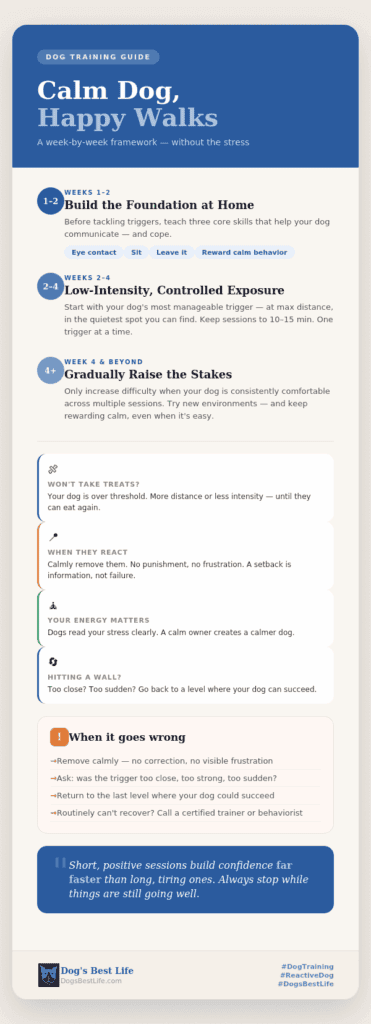
Weeks 1–2: Build the foundation at home
Before you start working with triggers, teach your dog a few basics: eye contact, sit, and leave it. These aren’t just obedience commands; they help your dog cope. When your dog knows how to communicate with you, they have a way to handle stress.
Here’s a quick way to begin each skill:
Eye contact: Hold a treat by your face and say your dog’s name. When they look at you, say “yes” and give the treat. Repeat until your dog reliably looks at you when called.
Sit: Hold a treat above your dog’s nose and slowly move it back over their head. As their head tilts up, their bottom usually lowers to the ground. Once they sit, say “yes” and reward.
Leave it: Place a treat in your closed hand and let your dog sniff. When they stop sniffing or back away, say “yes” and give a different treat from your other hand. Gradually build up to the treat being on the floor.
Also, use this time to:
- Practice rewarding calm behavior. Stillness and relaxation are behaviors, too, and they pay off.
- If you’re using new gear like a front-clip harness, head halter, or treat pouch, help your dog get used to them at home and make sure they connect these items with good experiences before you go out.
Weeks 2–4: Controlled, low-intensity exposure
Pick your dog’s most manageable trigger and begin working on it in the most controlled environment you can find. A quiet park at 7 a.m. A side street with minimal foot traffic. Lots of distance.
Keep training sessions short, about 10 to 15 minutes at most. Stop before your dog gets overwhelmed, while things are still going well. Short, positive sessions help your dog build confidence much faster than long, tiring ones.
Work one trigger at a time. Tackling multiple fear triggers simultaneously overwhelms both the dog and the owner.
Week 4 and beyond: Gradually raise the stakes
Only raise intensity when your dog is consistently comfortable at the current level. “Consistently” means across multiple sessions, not just once.
Start introducing new environments: a pet-supply store, a dog-friendly patio, a different neighborhood park. Dogs don’t generalize learning the way humans do.
A dog who is calm around strangers in your neighborhood might still feel anxious around strangers in a busy downtown area, and that’s normal. New places are a new kind of socialization.
Keep giving treats, even when your dog is doing well. Don’t stop rewarding calm behavior just because it happens more often. You’re helping your dog build a new, calmer way of reacting, and that takes time.
When it goes wrong
Your dog reacts — barks, lunges, freezes, shuts down. Calmly remove them from the situation: no punishment, no correction, no visible frustration.
If you keep running into setbacks, take a break and look at your plan. Is the trigger too close or too strong? Did you move to a new place, or did you take on too many challenges too soon? Go back to a level where your dog can succeed, even if it means making things much easier for now.
If your dog won’t take treats when exposed to a trigger, it means they’re over their threshold. A dog who can’t eat is too stressed to learn.
In these cases, increase the distance from the trigger or reduce the intensity until your dog feels safe enough to take food. If your dog routinely cannot recover or cannot take treats even at what seems like a low level, bring in a certified trainer or veterinary behaviorist for support.
Dogs read your body language and emotional state clearly, and a stressed or frustrated owner can make a stressed dog even more stressed.
After the session, ask yourself: Was the trigger too close? Too sudden? Was your dog tired or hungry? Then adjust for next time.
A setback gives you information. It’s not a failure.
Rescue dogs deserve extra patience
If you’ve just adopted an adult rescue dog, you’ll use the same techniques, but you might need to start a little further back and go more slowly. That’s okay. It’s just part of the process.
You may have heard of the 3-3-3 rule, commonly shared in rescue communities: 3 days to decompress, 3 weeks to settle into a routine, 3 months to genuinely feel at home.
Don’t begin socialization work in earnest until your dog has completed the decompression phase and is showing signs of stability in your home.
For rescue dogs, safety and trust are the most important things. If your dog doesn’t trust you yet, they can’t learn from you. Spend the first weeks building your bond with calm routines, gentle handling, and no pressure. This isn’t wasted time—it’s the best foundation you can give.
If your rescue dog’s fear or reactivity doesn’t decrease after several weeks of patient work, or if they’re unable to accept food even when triggers are far away (a sign of extreme arousal), it’s time to bring in professional support.
Ask for help
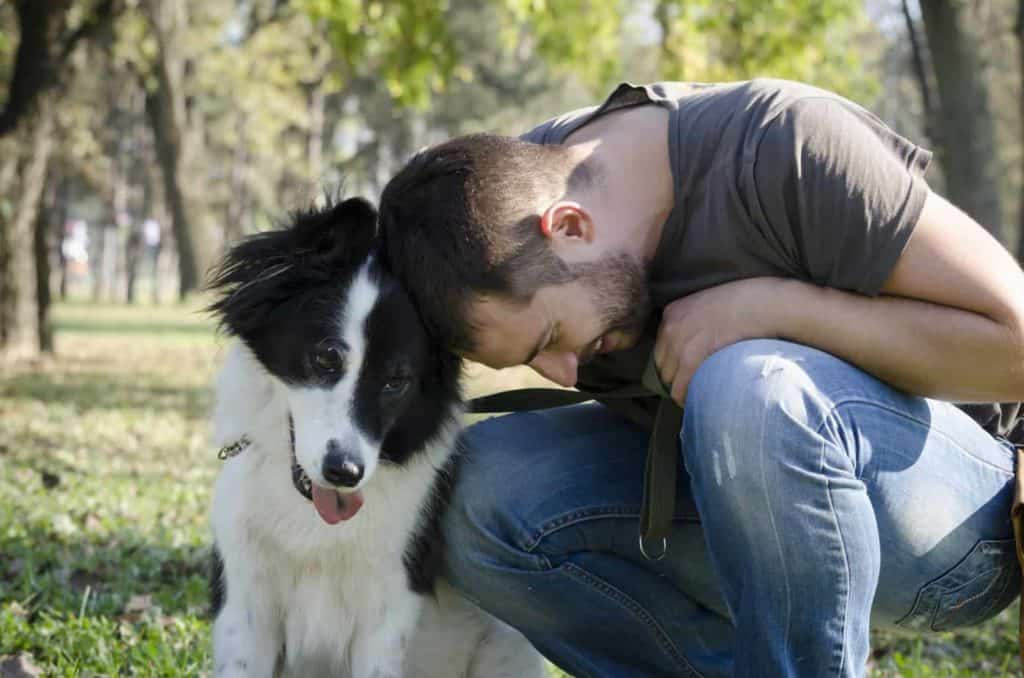
Socializing an adult dog, especially one who is fearful or reactive, can be really hard to do on your own.
Reading your dog’s body language accurately, managing trigger intensity, and staying calm when your dog isn’t all take real practice. Many owners who successfully do this work do so with professional support.
Signs it’s time to call in a professional
- Your dog’s behavior isn’t improving after 4–6 weeks of consistent effort.
- Behavior is getting worse, not better.
- Any situation that raises safety concerns
What to look for in a trainer
Look for certified trainers. The CPDT-KA (Certified Professional Dog Trainer) is the standard certification, and a veterinary behaviorist (DACVB) is the top specialist for severe cases.
Search for certified trainers online. Prioritize trainers who use force-free, positive reinforcement methods.
Avoid anyone who suggests punishment, prong collars, or dominance-based methods for a fearful dog. These approaches can worsen fear-based behavior.
Using medication
If your dog is anxious, a veterinary behaviorist or your regular vet may recommend anti-anxiety medication combined with training. This isn’t giving up; it’s lowering your dog’s baseline anxiety enough that training can actually take hold.
Like any medication, these drugs can have side effects, so talk with your vet about your options and any concerns. Medication is just another tool, not a last resort.
Frequently asked questions
What if my dog won’t eat treats near triggers?
This is one of the most common sticking points, and it’s actually useful information. A dog who refuses food is telling you they’re over threshold — too stressed to engage with anything except the thing that’s scaring them. The fix isn’t a better treat (though high-value food helps). It’s a longer distance. Move far enough away from the trigger that your dog can breathe, sniff around, and take food again. That’s the level where learning happens. If your dog can’t take treats anywhere near a trigger, no matter the distance, that’s a sign to bring in a professional.
How long does socialization usually take?
There’s no honest single answer, because it depends on your dog’s history, temperament, the specific trigger, and how consistently you’re able to work. That said, most owners begin to notice meaningful improvement — calmer responses, faster recovery after a reaction, more willingness to engage — within 4 to 8 weeks of consistent, structured work. Full, lasting change can take several months to a year. Some dogs with deep fear histories will always need more management than others. The goal isn’t a finish line; it’s a better life for your dog, one session at a time.
Can I socialize my dog if I live in a busy city with triggers everywhere?
Yes, but you’ll need to be strategic. Early morning walks, quiet side streets, and low-traffic parks give you the controlled exposure your dog needs without constant overwhelm. You can also do a lot of work from a parked car or a bench at a distance — watching the world go by at a pace your dog can handle. Urban environments are actually full of training opportunities once you learn to use distance as your tool.
What if I’m making things worse?
If your dog’s reactions are becoming more frequent or more intense, stop and reassess. Common reasons include moving too fast, working too close to triggers, or accidentally reinforcing the wrong moments. Take a full week off from formal training, return to basics, and consider consulting a certified trainer for a fresh set of eyes. A short reset is always better than grinding through a plan that isn’t working.
Do I need special equipment?
Not much. A front-clip harness or head halter can give you better control without causing pain or fear. A treat pouch keeps rewards accessible so you’re never fumbling. Beyond that, the most important tools are patience and consistency — neither of which costs anything.
Celebrate small wins
Progress in dog socialization is rarely dramatic. It tends to show up quietly: your dog glances at a passing bike and looks back at you instead of lunging. They eat a treat within sight of another dog for the first time. They walk past the neighbor’s yard without freezing.
These moments are easy to overlook, especially when you’re focused on how far you still have to go. But they matter enormously. Each small win is evidence that your dog’s nervous system is beginning to shift — that the world is starting to feel a little safer to them.
Keep a simple log if it helps. A few notes after each session — what your dog handled, where they struggled, what surprised you — can make gradual progress visible in a way that’s hard to see day to day. Looking back over a month of notes often reveals how much has quietly changed.
And when you hit a rough patch, which you will, come back to the last thing that went well. That moment was real. It still counts.
Final thoughts on adult dog socialization
Adult dogs can change. Rescue dogs can make big transformations. Dogs who once pressed themselves against the wall when someone walked in can learn to stay calmly on their bed and wait.
It takes longer than puppyhood socialization and requires consistency, patience, and a willingness to go slow when everything in you wants to go faster.
But owners who keep at it and show up with their treat pouch week after week almost always say the same thing: it was worth every treat.
Start with your dog’s current comfort level. Move at their pace. Every calm moment you share is helping you build something real together.
Sara B. Hansen has spent 20-plus years as a professional editor and writer. She’s also the author of The Complete Guide to Cocker Spaniels. She created her dream job by launching DogsBestLife.com in 2011. Sara grew up with family dogs, and since she bought her first house, she’s had a furry companion or two to help make it a home. She shares her heart and home with Nutmeg, a Pembroke Welsh Corgi. Her previous dogs: Sydney (September 2008-April 2020), Finley (November 1993-January 2008), and Browning (May 1993-November 2007). You can reach Sara @ editor@dogsbestlife.com.